Why Raising the EU Crowdfunding Cap to €12M Could Reshape Europe’s Private Capital Markets

No time to read? Let AI give you a quick summary of this article.


Europe’s capital markets are at a turning point. Across the region, more startups are emerging1, more founders are building ambitious businesses, and more retail investors2 want access to private market opportunities. The demand is there.
Yet the regulatory framework, originally designed to protect investors, is now limiting how far this ecosystem can grow3. The current rules under the European Crowdfunding Service Providers Regulation (ECSPR)4 cap fundraising at €5 million within a 12-month period. A new initiative led by the European Digital Finance Association (EDFA) proposes raising that ceiling to €12 million5.
This is not just another technical policy adjustment. It is a decision that could shape the future of Europe’s private capital markets and determine whether innovative companies can scale at home and whether everyday investors can take part in long-term value creation.
What you will learn in this post:
The bottleneck at €5 million
Under the current ECSPR rules, a company using a regulated crowdfunding platform, whether for equity or debt, can raise no more than €5 million within a 12-month period. If it goes beyond that amount, it must comply with full securities regulation. That usually means that the company has to prepare a detailed prospectus, face higher legal and compliance costs, and deal with procedures that are often too heavy for early-stage businesses.
The intention behind the limit is understandable. It is meant to protect retail investors from taking on too much risk in private, unlisted companies. But in reality, the rule creates inconsistencies.
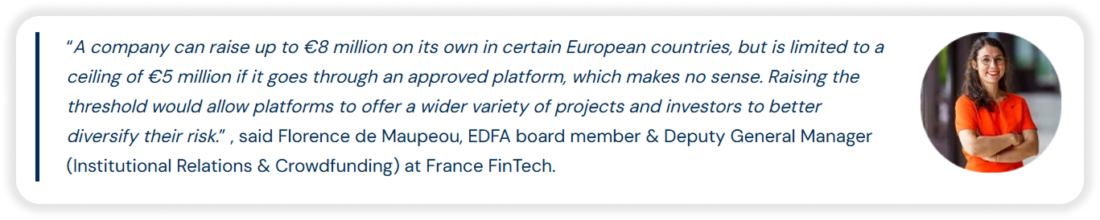
In some EU countries, a company can raise more than €8 million on its own without using a platform. Yet if it wants to raise funds transparently through a regulated crowdfunding platform and include small investors, it is capped at €5 million.
That is difficult to justify. Yes, higher caps are often connected with more investor risk. But the proposal from EDFA and its coalition is not a free-for-all. It leaves the protective framework of ECSPR intact. Standardized disclosure, mandatory risk warnings, and investor safeguards would remain fully in place. The change would simply allow those protections to apply to larger funding rounds where they are already tested and effective.
In fact, EDFA argues that regulated crowdfunding platforms often offer stronger investor protection than wholly unregulated direct raises.

Regulated crowdfunding platforms were created precisely to protect investors. They operate under clear disclosure standards, risk warnings, governance checks, and supervision requirements. In other words, they already include built-in safeguards that direct, unstructured fundraising may lack.
Allowing platforms to operate at higher funding levels would therefore expand the reach of an already regulated environment. It would strengthen investor protection by channeling more capital through supervised platforms rather than pushing larger raises into less structured formats.
Also, increasing the threshold to €12 million would bring the crowdfunding limit closer to other EU regulatory benchmarks, including the prospectus exemption under the EU Listing Act.
Why the cap matters
A funding limit is not just a technical rule. It directly affects how money moves through the economy and how companies grow.
More money for growing companies
Europe’s startups need more than early seed funding. Many companies in deep tech, clean energy, and digital infrastructure require over €7 million6 or more to bring a product to market.
With a €5 million cap, these businesses often have to split their fundraising into smaller rounds, turn quickly to venture capital, or stop using crowdfunding altogether. That slows them down and reduces flexibility.
A €12 million limit would make crowdfunding a practical option for companies that are past the early stage but not yet ready for large institutional funding. It would create a clear middle step between angel investment and venture capital, allowing founders to raise meaningful capital without giving control to a small group of large investors.
Keeping growth capital in Europe
Europe has a history of losing promising companies to larger markets7 once they begin to scale. When startups need bigger funding rounds, they often look to the United States8, where capital pools are deeper, or the UK, where regulation is more flexible.
A higher crowdfunding ceiling would allow companies to raise more substantial growth capital within the EU framework. That will strengthen Europe’s own capital markets instead of pushing its best companies elsewhere.
How to launch a private equity investment platform with LenderKit
Raising the cap is not only about startups and investors. It is also about infrastructure.
A €12 million ceiling changes the scale of operations. Platforms will need stronger governance tools, structured workflows, automated investor onboarding, KYC and AML procedures, document management, and reporting capabilities that meet regulatory standards across jurisdictions. Platform owners will require scalable, compliant systems rather than improvised solutions.
This is where LenderKit comes in.
LenderKit provides white-label crowdfunding software built specifically for regulated investment platforms. It supports equity, debt, and fund structures while integrating the compliance mechanisms required under ECSPR and comparable regulatory frameworks. The system is designed to help operators run professional, institution-ready platforms without sacrificing efficiency.
Its main capabilities include:
- Investor onboarding and verification (KYC/AML)
- Risk acknowledgment workflows
- Structured deal rooms and disclosure documentation
- Cap table management
- Investor communication and reporting tools
- Payment processing integration
As funding rounds grow in size, platforms cannot rely on manual processes or fragmented systems. Larger raises mean more investors, more documentation, more scrutiny, and higher expectations. Infrastructure must be built properly from the outset.
If you are planning to launch a private equity or crowdfunding platform or scale an existing one to support larger, more sophisticated deals, now is the time to prepare.
Get in touch with the LenderKit team to discuss your model, your regulatory framework, and your growth plans.

Article sources:
- 35,000 Startups and Counting European Startup Growth: Europe's Growing Entrepreneurial Spirit
- PDF (https://www.esma.europa.eu/sites/default/files/2025-01/ESMA50-2085271018-4039...)
- PDF (https://europeandigitalfinance.eu/wp-content/uploads/2026/02/20260204_EDFA_EC...)
- Crowdfunding - Finance - European Commission
- Raising the ECSP Threshold: Scaling Crowdfunding to Support European Innovation - European Digital Finance Association
- Europe Crowdfunding Market Size & Share Report, 2033
- European tech growth ‘hampered by red tape’
- PDF (https://www.imf.org/-/media/files/publications/cr/2024/english/1eurea2024001.pdf)