Crowdfunding Like a Billionaire: Overview of the World’s Leading Startups


No time to read? Let AI give you a quick summary of this article.


Many unicorn companies started their way to success by raising funds from retail investors. Some of the companies that crowdfunded their way up still rely on their supporters. Others show what can go wrong for the crowd once the valuations get large.
In this article, we review well-known startups that used crowdfunding on their way to billion-dollar valuations. We also look at where each of them stands today:
- Boxabl
- BrewDog
- Fanatics
- Monzo
- Revolut
None of them relied on crowdfunding alone, but it was a deliberate part of each company’s capital-raising strategy. Let’s take a closer look at these companies and see what platform operators and investors can learn from them.
What you will learn in this post:
Boxabl
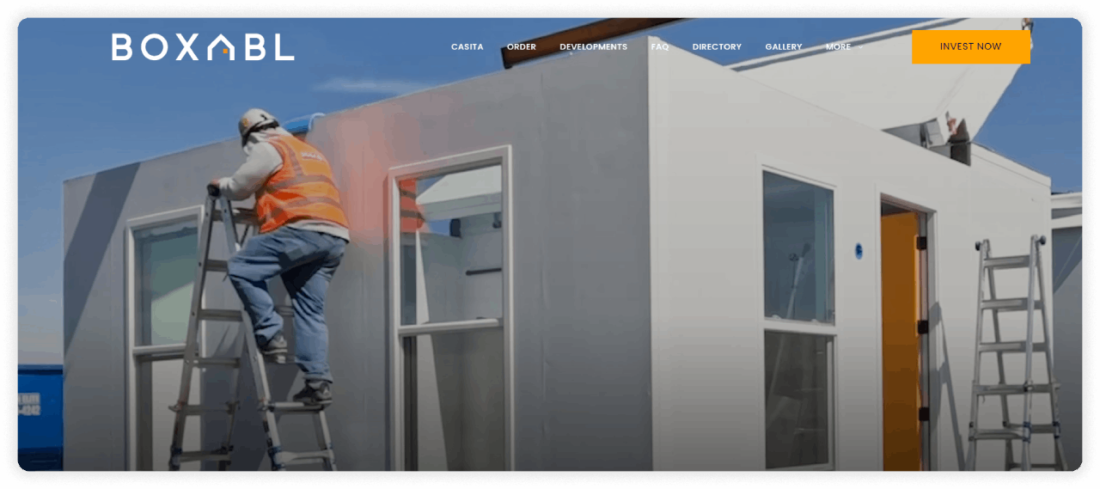
Boxabl1 is a prefabricated housing manufacturer launched in 2017. It built much of its early investor base through crowdfunding.
Boxabl is no longer a private, crowdfunded unicorn. On July 17, 2026, it completed its merger with FG Merger II Corp. at a stated $3.5 billion valuation2. Its Class A common stock began trading on Nasdaq under the ticker BXBL on July 20, 2026.
Two caveats matter for anyone reading that number:
- It is a deal valuation, not today’s value. The $3.5 billion was the valuation agreed in the merger agreement signed on August 4, 2025. It is not a live market capitalisation, so check the current BXBL quote for that.
- The SPAC brought in little cash. Before closing, holders of about 6.6 million FGMC shares tendered them for redemption, worth about $68.8 million3. That left roughly $14 million in the trust account.
After the deal, Boxabl has about 241.5 million common shares outstanding. A dual-class structure gives co-CEOs Paolo and Galiano Tiramani concentrated voting control.
May 2021, WeFunder
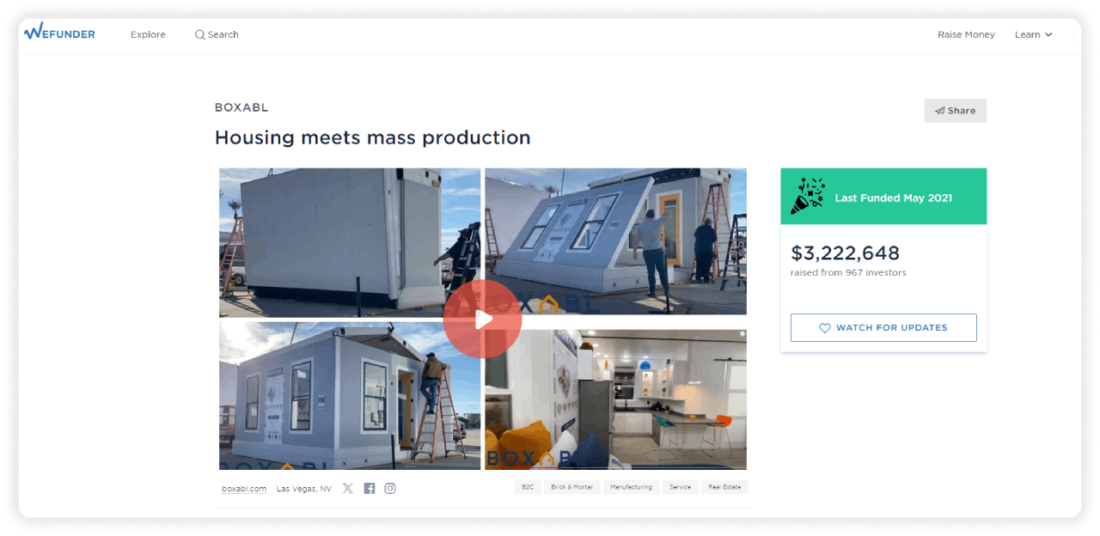
In a crowdfunding campaign launched on WeFunder4 in 2021, Boxabl raised $3,222,624 from 967 investors. That campaign was open to accredited investors only, with a promise to launch a campaign for retail investors soon.
The company said it would make money by mass-producing and selling room modules built with modern manufacturing technology. It said the raised funds would go towards building more factories to meet domestic and international demand.
August 2022, StartEngine
Retail investors got their turn on StartEngine5 in 2022. Boxabl’s Reg A round there closed on August 26, 2022, with about $24.8 million raised.
August 2022, Republic
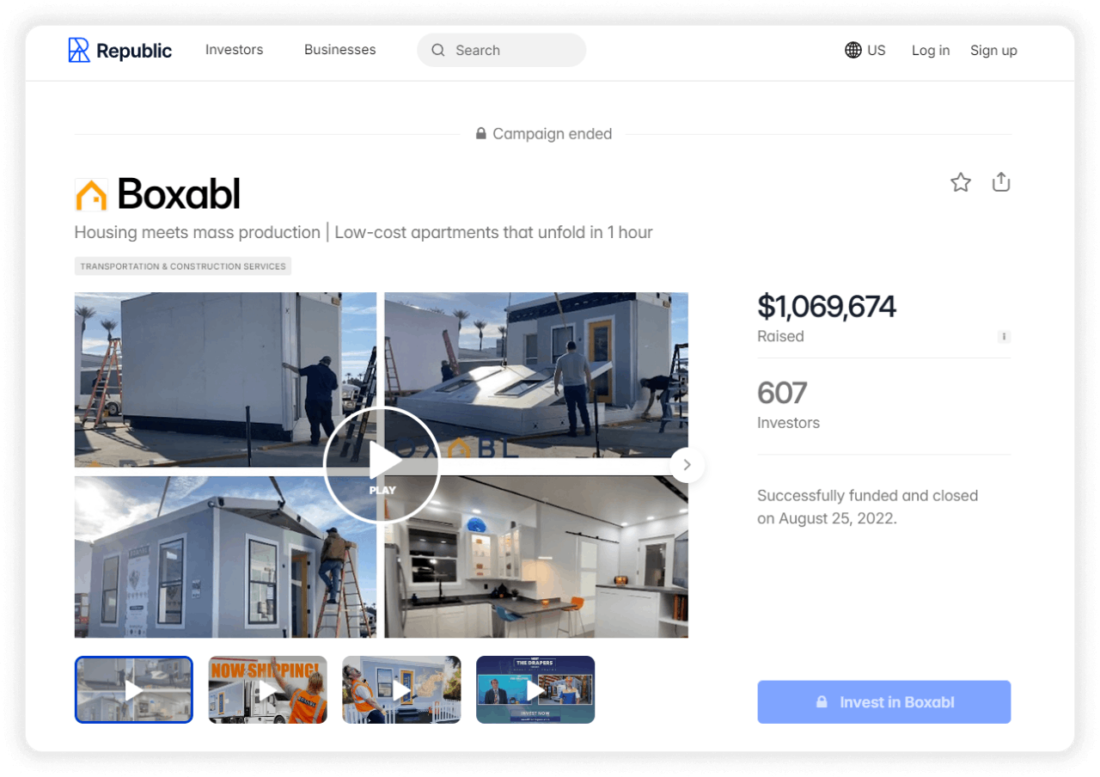
Another Reg CF campaign6 was launched on Republic, where Boxabl raised $1,069,674 from 607 investors. The minimum investment was $1,000 and the maximum was $100,000. The company was valued at $3 billion at that time.
StartEngine, 2023–2025 (closed)
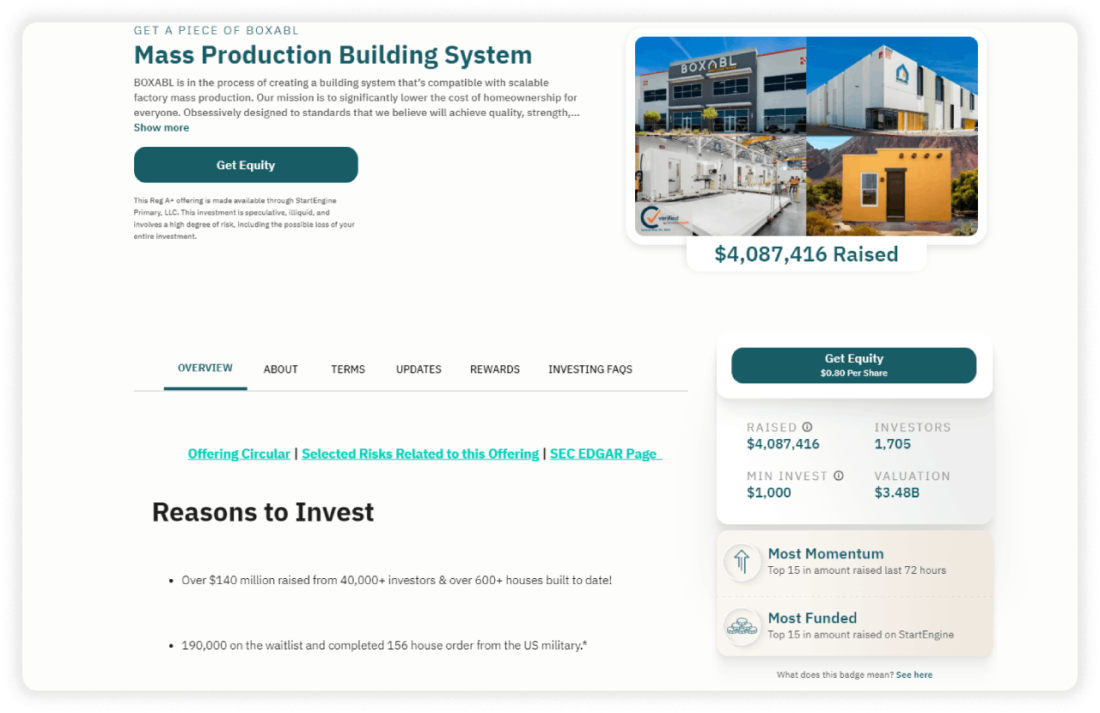
Boxabl returned to StartEngine with a Reg A+ offering on StartEngine7 that ran from April 26, 2023 to April 14, 20258.
The minimum investment was $1,000, and the offering sought up to $74 million in total8 at a pre-money valuation of about $3.48 billion. That $74 million was the cap on the whole raise, not a limit per investor. Under Reg A+, how much a non-accredited investor can put in depends on their income or net worth.
Final totals for the round have not been published in a form we could verify. As a mid-campaign snapshot, in October 2024 it had secured almost $3,786,000 from 1,601 investors. Boxabl later raised further rounds through DealMaker Securities, including one in July 2025.
The round was priced at $0.80 per preferred share9, a price Boxabl set rather than one a market discovered. Since July 2026, Boxabl’s Class A common stock has traded on Nasdaq at market prices2.
The preferred stock held by crowd investors is not listed. According to the deal disclosures, it converts to Class A common about 14 months after closing10. Insider lock-ups of up to 12 months also apply. For Boxabl’s crowd investors, a listing did not mean instant liquidity.
BrewDog
BrewDog11 is a multinational brewery and pub chain based in Ellon, Scotland, that used crowdfunded resources to expand its business. In 2022, the beer brand was ranked the 14th most valuable beer brand in the world by Brand Finance, an independent brand valuation and consultancy firm12.
The brand used crowdfunding not only to raise funds but also to build a loyal community around itself. Its story remains the best-known case of community equity. It is now also the clearest warning about what that equity can be worth.
2009, Equity for Punks
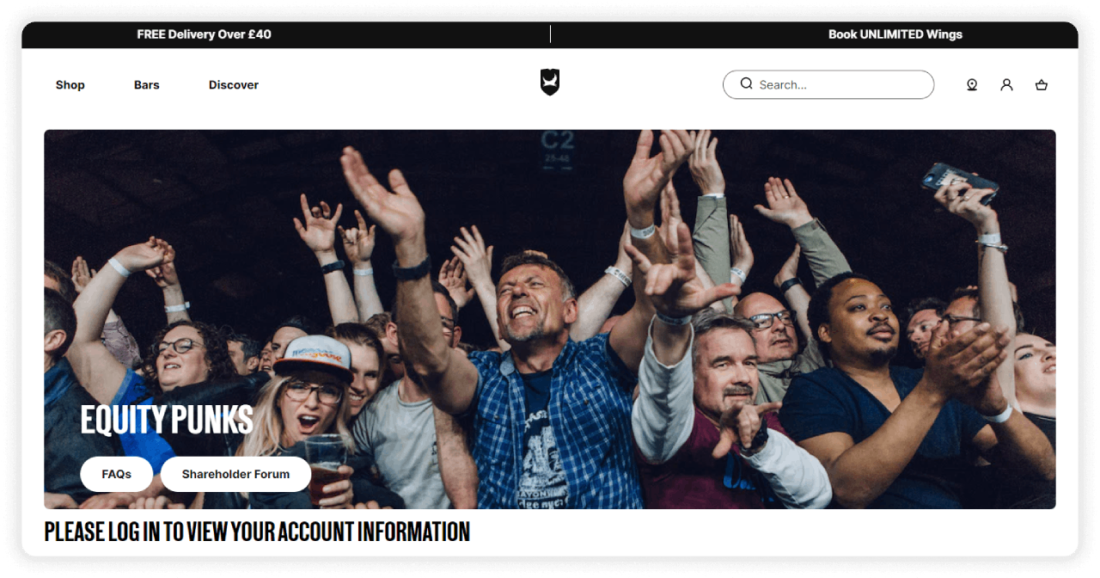
In 2009, BrewDog launched its first crowdfunding campaign, called Equity for Punks13. The campaign’s goal was to raise enough funds to expand beer production and preserve independence from external investors. It raised £750,000 from more than 1,300 investors.
Further rounds followed until the last one closed in 2021. Across them, about 220,000 investors put in roughly £75 million14.
These campaigns helped BrewDog expand internationally, open bars around the world, launch a brewery in the United States, and even found a television network dedicated to craft beer.
2026: a cautionary ending
By 2019, the founders said the company’s value had doubled and that the first investors had seen a return of up to 2,800%. That return only ever existed on paper, as a valuation. It was never realised in cash.
The capital structure explains why. In 2017, TSG Consumer Partners paid £213 million for a 22.3% stake. Its preference shares carried a return that compounded at 18% a year to about £800 million, and they ranked ahead of the ordinary shares held by the crowd.
Losses then mounted:
- Losses doubled to £59 million in James Watt’s final year as CEO.
- BrewDog lost £37 million in 2025, the year co-founder Martin Dickie left.
- In early 2026, the company began a formal sale process with AlixPartners.
On March 2, 2026, Tilray bought BrewDog for £33 million through an administration process, leaving Equity for Punks investors with nothing15. In the UK, 38 BrewDog pubs and bars closed immediately, with almost 500 jobs lost, while 18 franchise bars kept operating. James Watt’s July 2026 bid to regain control16 from Tilray failed.
The lesson for crowdfunding platforms is specific. Retail investors bought ordinary shares that ranked below private-equity preference shares. Their position was weak long before the sale. Clear disclosure of share classes and liquidation preferences is what separates a community round from a trap.
Fanatics
Fanatics17 is a sports-merchandising company licensed to sell apparel of the most famous US sports teams. They service over 100 million fans all around the world.
Revenue was about $8.1 billion in 2024 and, by CEO Michael Rubin’s account, about $13 billion in 202518. Fanatics is private and does not publish audited accounts, so treat the 2025 figure as the company’s own. Independent estimates are lower: Sacra puts 2025 revenue at about $9.6 billion19.
The business has raised about $4.9 billion across 10 funding rounds20. Its last priced round, in December 2022, set a $31 billion valuation. Later marks have moved in both directions: an employee share sale in 2024 valued the company at about $25 billion, and Fidelity’s holdings implied about $33.5 billion in November 202521.
The most prominent funding rounds were the following.
May 2021, Series D
In 2021, Fanatics raised $320 million in Series D22 funding round from such investors as Major League Baseball, Silver Lake, Fidelity Investments, Neuberger Berman, and Thrive Capital, among others. The company valuation reached $12.8 billion.
August 2021, Series D
The next funding round took place in August the same year. The company raised $337 million23 from its previous investors and from new investors such as Rocnation, Insight Partners, Eldridge Industries, and SoftBank Vision Fund, among others. This boosted the company valuation to $18 billion.
March 2022, Series E
In March 2022, Fanatics raised $1.67 billion23 more in a Series E funding round from such investors as Fidelity Investments, BlackRock, MSD Capital, and SoftBank Vision Fund. The company’s valuation reached $27 billion.
December 2022, Series E
In a Series E funding round that took place in December 2022, Fanatics raised $700 million23 from its previous investors and from new investors such as Clearlake Capital Group. This round boosted the company’s valuation to $31 billion, which remains its last priced round.
April 2024, StartEngine
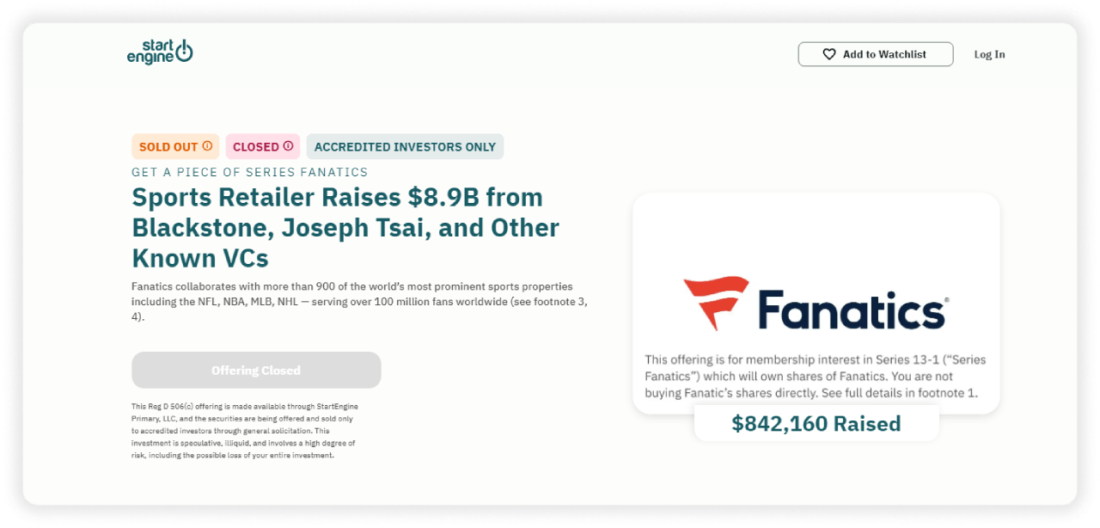
In April 2024, a securities offering for Fanatics was listed on StartEngine24. It ran through StartEngine Private, so it was open to accredited investors only. With a minimum investment of $8,400, the offering raised $842,160.
Monzo

Monzo25 was founded in 2015 as Mondo. In February 2016, it set the record for the quickest crowdfunding campaign in history when it raised £1 million in 96 seconds on CrowdCube26.
In 2016, the company announced that the name Mondo was taken by another company, and it rebranded to Monzo.
In April 2017, Monzo received its full banking license27 from the Prudential Regulation Authority and the Financial Conduct Authority. By 2018, it already had 1 million customers.
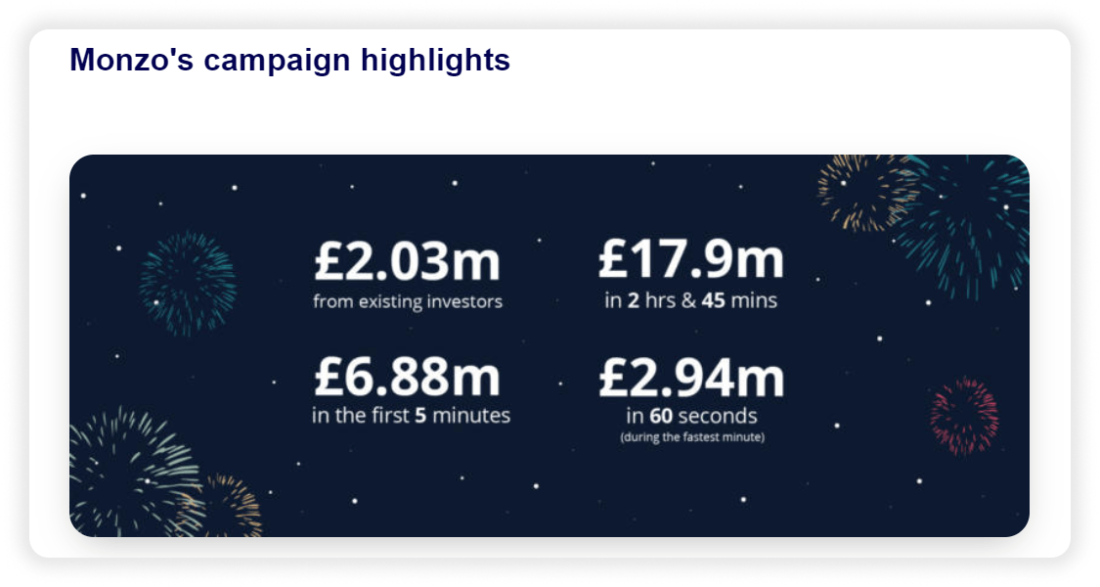
In 2018, the company raised £85 million in a Series E funding round from such investors as Thrive Capital, Stripe, Orange Digital Ventures, and others. This funding boosted the company valuation to a billion pounds. Within the same year, Monzo launched another crowdfunding campaign on CrowdCube and raised £20 million26 from 36,000 community members, with almost £18 million raised within 2 hours 45 minutes.
Monzo’s last confirmed valuation is £4.5 billion (about $5.9 billion), set by an employee secondary share sale in October 2024. In FY2025, it reported revenue of £1.24 billion, a pre-tax profit of £60.5 million and more than 12 million customers.
Monzo has dropped its plan to return to the US. It shut down its US operation around April 2026 and is focusing on Europe after securing an EU banking licence28.
The leadership has changed too. TS Anil’s departure was announced in October 2025, and Diana Layfield, formerly of Google and Standard Chartered, took over as CEO in February 2026. Former chair Gary Hoffman left in September 2026.
A listing is in preparation but not yet scheduled. Morgan Stanley is advising on a possible London IPO29 with a reported £6–7 billion target. As of mid-2026, no prospectus or date had been set. In October 2026, Monzo was reported to be seeking new capital at about £8 billion30 after Nubank’s parent dismissed takeover talks. Both figures are targets, not completed valuations.
Revolut
Revolut31 is a global neobank and financial technology company with headquarters in London, UK, that started its way thanks to crowdfunding. It is one of the most successful examples of a startup that opened early equity to retail investors, though not the first: BrewDog had been selling shares to its fans since 200932.
Revolut received a restricted UK banking licence in July 2024. On March 11, 2026, it launched Revolut Bank UK Ltd as a fully licensed UK bank33, with 13 million UK customers and eligible deposits protected by the FSCS up to £120,000.
Revolut has about 80 million customers worldwide34. It launched full banking in Mexico in January 2026 and has committed to invest £3 billion in the UK.
2016, CrowdCube
In 2016, Revolut partnered with CrowdCube to let retail investors acquire 2.4%35 of the company shares. Revolut raised over $1 million from 433 investors.
2017, Republic Europe
The next crowdfunding campaign took place in 2017 on Republic Europe (formerly Seedrs). Revolut raised $3.836 million from 3486 retail investors.
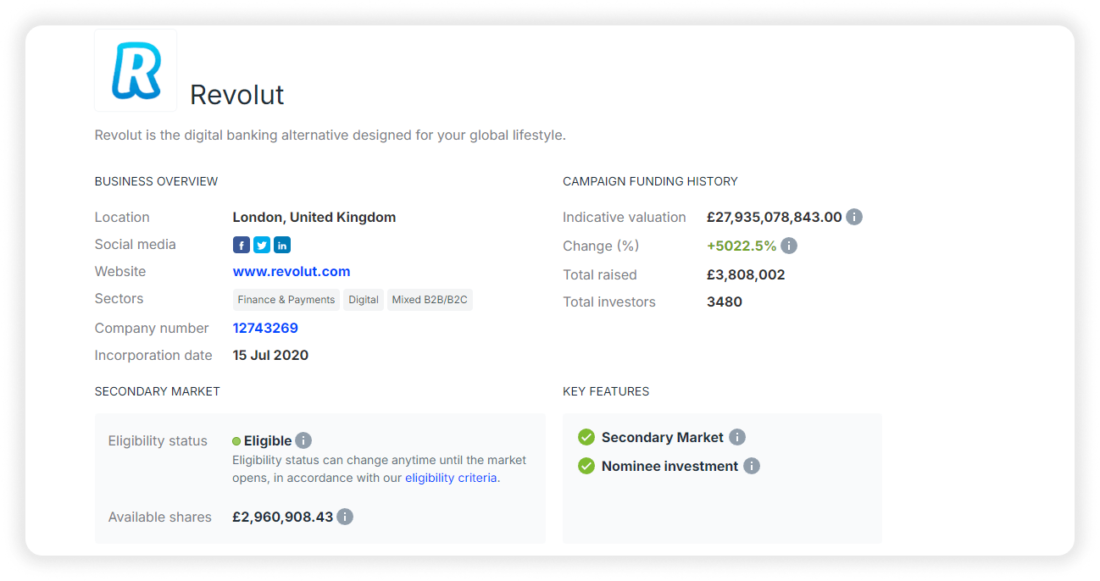
Revolut also raised funds from venture capitalists such as Index Ventures, Balderton Capital, Ribbit Capital, SoftBank Vision Fund, and Tiger Global Management, among others.
Its valuation has climbed quickly:
- August 2024: $45 billion in a secondary sale.
- November 24, 2025: $75 billion in a completed share sale.
- July 22, 2026: Revolut confirmed a new secondary share sale that was reported to value it at about $115 billion37. Revolut has not confirmed that figure.
- October 15, 2026: Forge Global’s indicative price of $2,125 per share implied about $121 billion38. This is a mark, not a transaction.
For 2025, Revolut reported revenue of about $6.0 billion and profit before tax of about $2.3 billion.
Revolut remains private. In April 2026, its CEO said an IPO is about two years away39, with a reported target of $150–200 billion.
The 2016 and 2017 crowd investors are sitting on very large paper gains. Their exact multiple depends on how far later rounds diluted them. Those gains stay on paper until a secondary sale or a listing gives investors a way out.
How to launch a crowdfunding platform with LenderKit
These cases show what crowdfunding can do: early community capital helped Boxabl, Fanatics, Monzo and Revolut on their way to billion-dollar valuations. BrewDog shows the other side. What retail investors end up with depends on share classes, investor rights and how clearly the platform discloses them.
If you are inspired by these success stories and are thinking of launching a crowdfunding platform to help promising startups get funding, check out white-label crowdfunding software by LenderKit.
We offer a scalable investment solution that helps you get started quickly and grow your business, expanding the platform as you need. Your platform comes with the tools it needs to go live quickly, such as payment systems, KYC/AML and document signing.
If you would like to learn more about what LenderKit offers, reach out to us via the contact form.
Article sources:
- Invest in BOXABL (BXBL) | Nasdaq Investor Relations
- Completed its merger with FG Merger II Corp. at a stated $3.5 billion valuation
- Tendered them for redemption, worth about $68.8 million
- Invest in Boxabl | Housing meets mass production.
- Just a moment...
- Boxabl
- Reg A+ offering on StartEngine
- Boxabl on StartEngine 2023
- Priced at $0.80 per preferred share
- Boxabl Stock Price Prediction & IPO Timeline: When Could It Trade Publicly - MARUDE.COM
- BrewDog - Online Craft Beer Shop & Craft Beer Bars
- Beer growth shifts beyond the US as heritage lagers lose their fizz | Press Release | Brand Finance
- BrewDog | Equity For Punks Account
- Just a moment...
- Equity holders ‘punked’ as BrewDog sale leaves them empty-handed
- James Watt (entrepreneur) - Wikipedia
- Fanatics
- Who owns Fanatics? Ownership structure explained (2026)
- Fanatics vs. Kalshi | Sacra
- Fanatics - 2026 Company Profile, Team, Funding & Competitors - Tracxn
- Fanatics revenue, valuation & funding | Sacra
- Fanatics valuation doubles to $12.8 billion after new funding round
- Fanatics - 2026 Funding Rounds & List of Investors - Tracxn
- StartEngine
- Monzo | Open a Free Account
- Just a moment...
- Monzo - Wikipedia
- Monzo is shutting down its US operation, and its European banking licence explains why
- Monzo IPO 2026: valuation, timeline and how to buy shares - IG UK
- Just a moment...
- Banking & Beyond | Revolut United Kingdom
- BrewDog Sold Fans Equity in the Company for $100 Million. That Stock Might Now Be Worthless.
- Revolut Launches UK Bank
- Revolut’s $115 Billion Valuation Tests Its Ambition to Challenge Global Banks
- Just a moment...
- Revolut
- Revolut’s Global Tech Ambition: AI, Profits and $115B Valuation | PRESDA
- Revolut hits a $121.2 billion valuation mark as IPO talk turns serious - Startup Fortune
- Revolut eyes valuation of up to $200B in eventual IPO | TechCrunch