No Code Crowdfunding Platform Development

No time to read? Let AI give you a quick summary of this article.


No-code development has changed how digital platforms are built. Today, entrepreneurs can launch web apps, marketplaces, and even crowdfunding platforms without writing code.
Services like Crowf, DrapCode, Glide, and AI builders such as Lovable promise to turn a complex fintech product into something that can be launched in weeks instead of months.
For early-stage founders, this is very attractive.
Launching an investment platform the traditional way usually means hiring developers, designing backend systems, integrating payment providers, and dealing with compliance requirements. Building a crowdfunding platform can cost tens or even hundreds of thousands of dollars before the platform is ready to launch.
No-code tools try to remove this barrier. They allow founders to build interfaces visually, create workflows with drag-and-drop tools, and connect services like payments or user accounts without deep technical knowledge.
But an important question remains: are these tools enough if you want to build a serious crowdfunding platform that can grow and compete in a regulated financial market?
The answer depends on the type of platform you want to create. No-code tools are very useful for prototypes, MVPs, and niche crowdfunding communities. However, they often become harder to use as a platform grows and needs more complex features, regulatory compliance, and the ability to handle larger numbers of users and transactions.
In this article, we look at several popular no-code tools used to build crowdfunding platforms and explain where they work well and where they may not be enough.
What you will learn in this post:
No-code tools for building crowdfunding platforms
Here are some examples of no-code tools and apps that can be used to build a crowdfunding platform.
Crowf
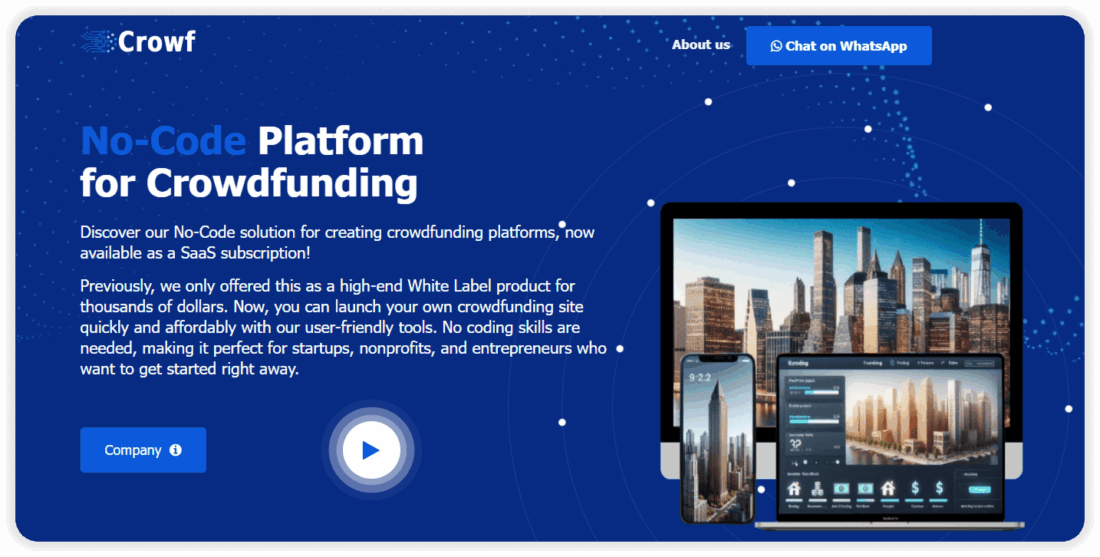
Crowf1 is a no-code solution specifically designed for crowdfunding platforms. The platform offers a SaaS tool that allows founders to launch a crowdfunding site quickly without technical expertise.
Crowf includes features commonly required for crowdfunding operations, such as:
- investor portals and dashboards
- project listings and campaign management
- back-office tools for platform administrators
- support for multiple currencies and languages
- integrations with external services and payment providers
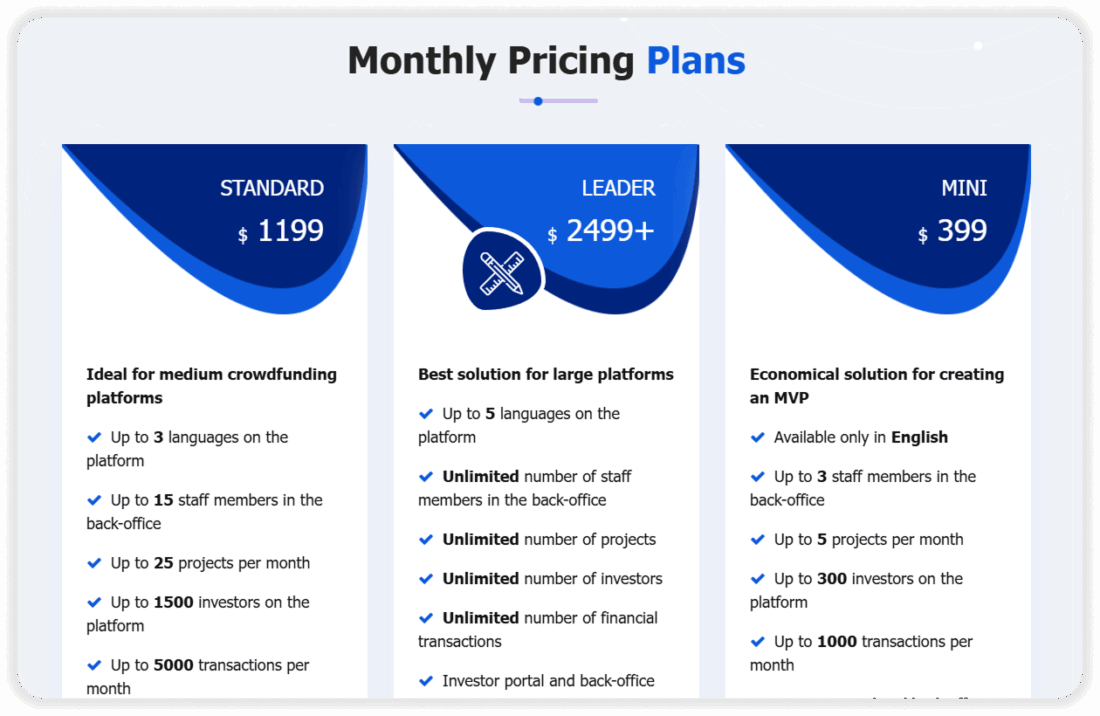
The platform offers several subscription tiers, ranging from small MVP setups to larger platforms capable of supporting unlimited investors and transactions.
Where Crowf works well
Crowf is particularly suitable for:
- reward-based crowdfunding platforms
- donation fundraising sites
- community funding portals
- early-stage investment platforms
Because it already includes investor dashboards and transaction management tools, it can also support simple equity crowdfunding models.
For startups looking to test a niche crowdfunding concept, such as a platform for creative projects, local charities, or specialized communities, Crowf provides an efficient way to launch without building custom software.
Limitations
Platforms developed with Crowf may struggle when:
- transaction volumes increase significantly
- complex regulatory workflows are required
- advanced integrations with external financial infrastructure are needed
These limitations become especially visible in large equity crowdfunding platforms, where compliance, reporting, and investor management systems must be deeply integrated.
DrapCode
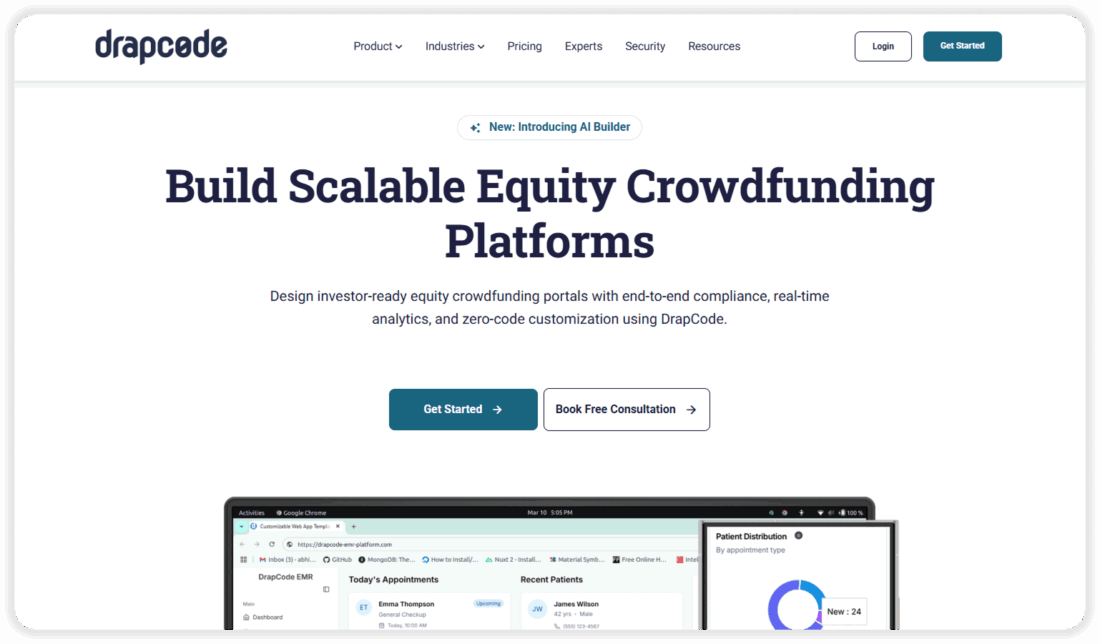
DrapCode2 is another no-code platform designed to build web applications, including financial platforms such as equity crowdfunding portals.
The platform allows founders to visually configure complex workflows, such as:
- investor onboarding and verification
- startup deal listings
- share allocation calculations
- digital share certificate generation
- investor communication channels
DrapCode also supports integrations with compliance tools, identity verification systems, and document management workflows. This is why DrapCode is more suitable for financial platforms than many generic no-code tools.
Where DrapCode works well
DrapCode is useful for:
- equity crowdfunding portals
- startup investment marketplaces
- real-estate crowdfunding platforms
- peer-to-peer lending marketplaces
Because it allows configuration of investor onboarding workflows and compliance checks, it can support regulated fundraising models better than simpler tools.
Limitations
Despite its flexibility, DrapCode still relies on a visual builder model. As a result:
- extremely complex financial logic may require custom development
- integration with proprietary financial infrastructure can be difficult
- large-scale performance optimization is limited
These limitations become more noticeable as platforms attempt to handle thousands of simultaneous investors or complex financial products.
Glide
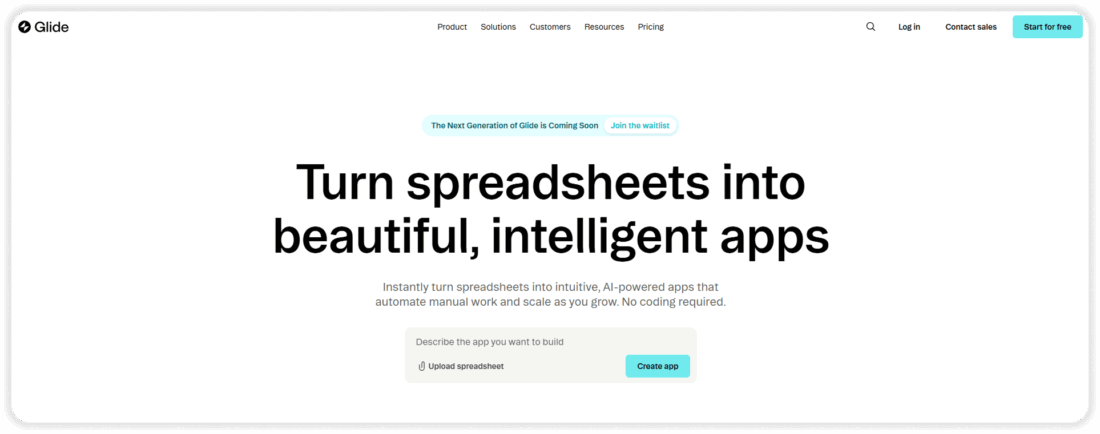
Glide3 is a general no-code application builder rather than a dedicated crowdfunding platform tool. It allows users to create web or mobile apps using visual editors and integrated services like Stripe for payments.
However, Glide is typically used to build simpler apps and MVPs, rather than large-scale fintech platforms.
One important limitation of many no-code tools, including Glide, is that their capabilities depend heavily on the platform itself. Users cannot freely extend the platform’s functionality beyond what it allows.
Another limitation is platform dependency: Glide apps run on Glide’s infrastructure, and exporting the full application code is usually not possible.
Where Glide works well
Glide can work well for:
- internal fundraising dashboards
- small community funding portals
- simple donation apps
- prototype crowdfunding marketplaces
Limitations
It is not suitable for large crowdfunding platforms due to limited backend flexibility and scalability.
Lovable
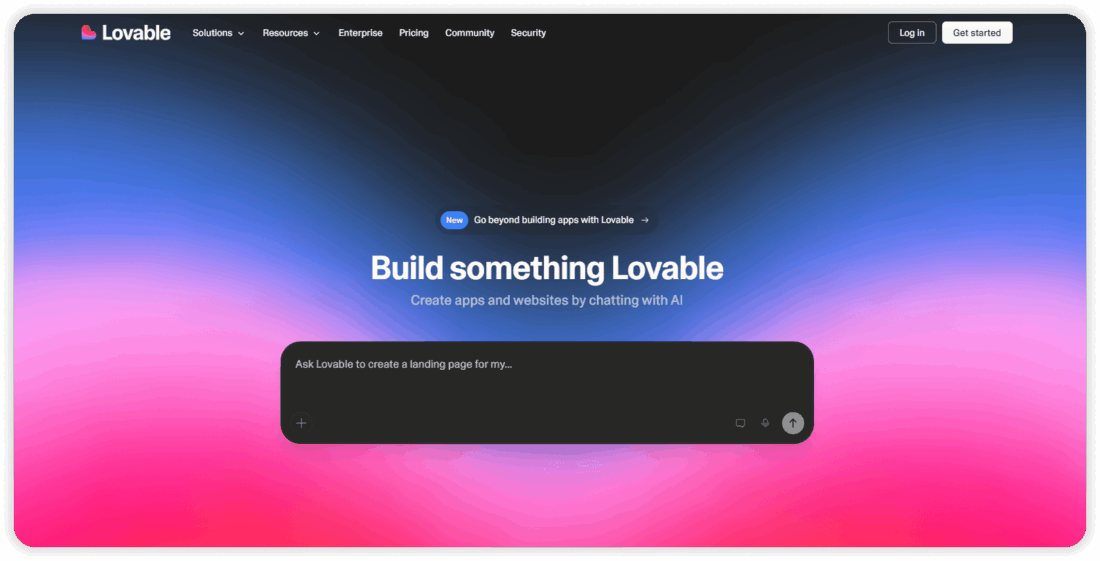
A newer category of no-code tools relies on AI to generate applications from natural-language prompts. Lovable4 is one of such examples. It can generate full-stack web applications using AI.
Lovable allows users to describe the application they want, and the platform generates code, user interfaces, and backend infrastructure automatically.
The tool is often promoted as a way to build marketplaces and crowdfunding platforms quickly.
Where Lovable works well
Lovable’s main strengths include:
- rapid application generation
- automatic frontend and backend creation
- integrations with tools like Stripe and Supabase
- exportable code for further development
This makes it useful for building working prototypes or validating platform ideas.
Limitations
However, Lovable has significant constraints when used for production systems.
Many reviews note that applications generated by the platform are better suited for prototypes rather than production-ready software, particularly because they may lack stability and scalability.
Other limitations include:
- fragile or inconsistent code structures
- difficulty implementing complex business logic
- challenges with large user bases or heavy data loads
For crowdfunding platforms dealing with financial transactions and regulatory requirements, these issues can quickly become critical.
Features commonly missing in no-code crowdfunding platforms
No-code tools can create functional crowdfunding sites, but still, many enterprise-level features are often absent or difficult to implement.
These features are the following.
Advanced compliance systems
Financial platforms often require:
- investor accreditation checks
- regulatory reporting
- AML and KYC verification
- audit trails
Even though some tools offer integrations for these processes, a full regulatory infrastructure is rarely built into no-code platforms.
Scalable transaction infrastructure
Crowdfunding platforms that handle large transaction volumes need to support secure escrow systems, systems for automated dividend or return distributions, and investment allocation algorithms. It is very difficult, if not impossible, to implement these systems with no-code tools.
Custom financial logic
Advanced crowdfunding models often require multi-round investment structures, dynamic share pricing, and payout structures. It is very difficult to configure them using drag-and-drop workflows.
Infrastructure flexibility
No-code platforms run on their own hosted infrastructure. This often creates vendor lock-in, which means the platform owner has limited control over how the system is built, scaled, or customized.
This can become a problem as the platform grows. When you need custom integrations, advanced features, or better performance, the no-code platform may not give you enough flexibility to implement them.
When no-code is not enough
No-code tools are excellent for testing crowdfunding ideas, launching niche fundraising communities, validating platform concepts, and building MVP products quickly.
However, as platforms begin to grow, founders often face new challenges. Compliance requirements increase, transaction volumes grow, and the platform needs more advanced investor management systems and custom financial workflows.
At this stage, many startups move away from no-code tools and switch to more robust infrastructure that can support long-term growth.
Why specialized providers like LenderKit are often a better choice
For entrepreneurs planning to build a serious crowdfunding platform from the beginning, specialized software providers offer a more sustainable approach.
White-label crowdfunding software such as LenderKit is designed specifically for investment and crowdfunding marketplaces. Instead of offering a generic no-code builder, we provide infrastructure built around financial workflows.
LenderKit or similar systems typically include:
- investor onboarding and verification
- KYC/AML compliance workflows
- investment management dashboards
- automated payment and distribution systems
- detailed reporting and analytics
- scalable backend infrastructure
Software offered by LenderKit is better suited for handling compliance-ready investment operations, investor onboarding and deal management. In addition, you get long-term technical support and customization options that no-code builders rarely provide.
If you want to launch a serious crowdfunding business rather than test an idea, get in touch with our team to discuss the option that best suits your needs.