US Equity Crowdfunding in 2026: Reg A vs Reg CF, Data Shock, Transparency Crisis, and the SEC’s Next Move


No time to read? Let AI give you a quick summary of this article.


The U.S. equity crowdfunding market entered 2026 with a reality check. What was once framed as a high-growth, democratized capital channel is now under pressure: from declining deal flow to growing scrutiny around disclosure standards and issuer behavior.
That shift is already visible in the recent data. In the article, we will have a closer look at what exactly is going on and what it means for the market.

What you will learn in this post:
The reality check: Q1 2026 by the numbers
The first quarter of 2026 delivered a clear signal: volume is down, but expectations are rising.
| Metric (Q1 2026) | Performance | Trend |
| Reg CF Total Capital | $87.8 Million | 📉 28% YoY |
| Reg CF Average Check Size | $2,000 | 📉 16% YoY |
| Reg CF Average Raise Size | $815,000 | 📈 66% YoY |
| Reg CF Valuation Disclosure | 88.7% | ✅ Strong |
| Reg A Valuation Disclosure | 21.4% | ⚠️ Critically Low |
At first glance, the contraction in Reg CF looks negative. Fewer deals, less capital, smaller investor checks. However, the main signal is that the average raise size surged by 66%, reaching approximately $815,0001.
It suggests that smaller, undercapitalized campaigns are being squeezed out, while more structured, better-prepared issuers are still raising. In other words, the market is moving away from “lifestyle startups” toward businesses that can justify larger rounds.
This is how markets mature.
Reg A vs Reg CF: Why the structures matter
To understand the shift, it is important to look at how Reg CF and Reg A are designed.
These are not only about limits but also about different types of issuers. Reg CF is typically used by early-stage companies testing demand. Reg A is positioned as a “mini-IPO” for more mature businesses.
In theory, Reg A should attract more sophisticated investors and larger deals. However, in practice, the data shows a different problem.
The transparency gap: A growing risk
A major concern that emerges in 2026 is the gap in valuation disclosure between Reg CF and Reg A offerings.
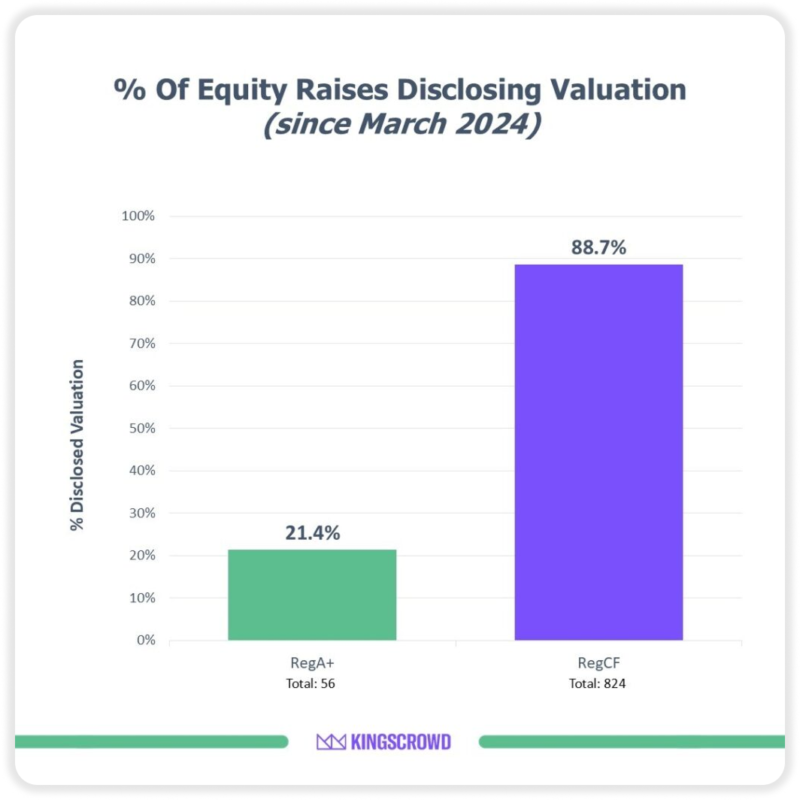
Reg CF shows strong transparency, with nearly 89% of issuers disclosing valuations. Reg A tells a very different story, with just over 21%.
That gap is not a technical detail. It is about investor protection.
Under Regulation Crowdfunding, issuers must provide standardized information in Form C4, including offering terms and pricing details5. This makes it difficult to avoid key disclosures.
Reg A relies on Form 1-A6, which allows more flexibility7 in presentation and structure. Many issuers use that flexibility to obscure critical information like pre-money valuation or fully diluted share count.
The result is a growing imbalance. Retail investors in Reg A deals often face less clarity than those investing in smaller Reg CF offerings. This opens the door to what many in the industry describe as a “dumb money” risk, where less experienced investors participate without fully understanding pricing or dilution.
If this trend continues, regulators may shift from guidance to enforcement.
The “vanity metric” trap
Another issue undermining the market is the use of artificially low funding targets. Sherwood Neiss, founder of Crowdfund Capital Advisors and one of the architects behind Regulation CF, noted that a campaign can be labelled “successful” without having meaningful validation.
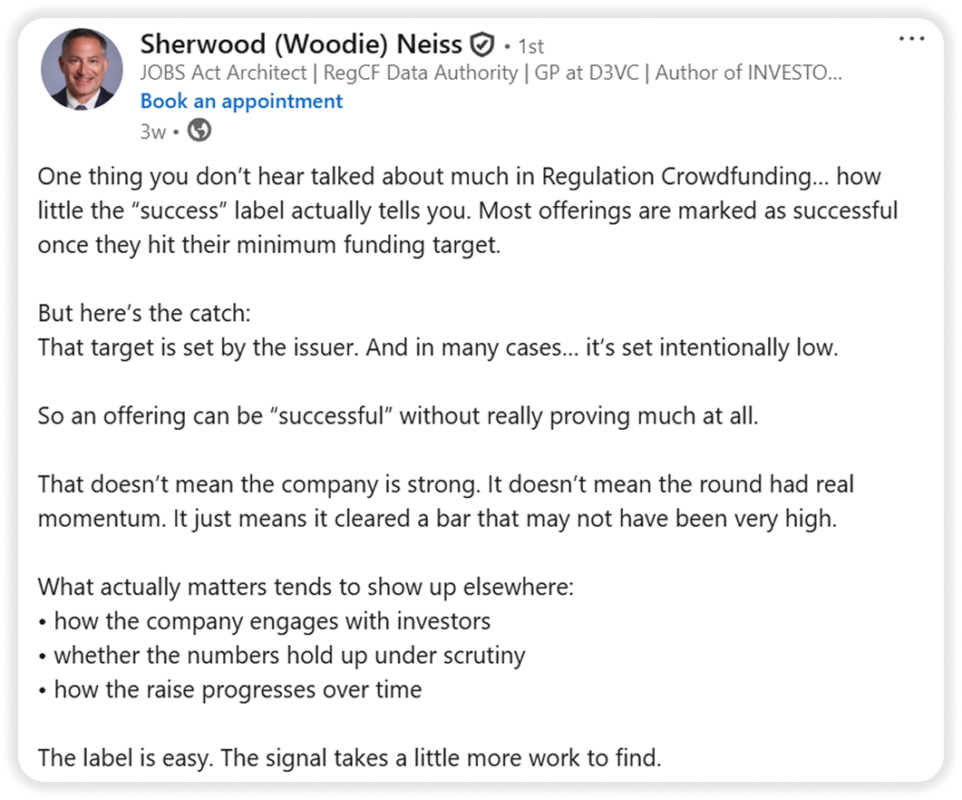
From a distance, these campaigns look like wins. But in reality, a company raising $10,000 against a real capital need of $500,000 is not a success story but a failure.
Such campaigns create two problems:
- Investors are misled by superficial success metrics
- Platforms damage their credibility over time
Serious investors, especially those comparing Reg CF with private markets, pay attention to these signals. If platforms tolerate low-quality deals, capital will move elsewhere.
The regulatory pivot: SEC’s new playbook
Regulators are already responding. In February 2026, the U.S. Securities and Exchange Commission updated its Compliance & Disclosure Interpretations (C&DIs)9. This document affects Reg A offerings.
Here’s what changed:
The changes signal a more structured approach:
New flexibility:
- Companies now have more freedom to test investor interest early (“testing the waters”)
- More efficient pathway from Tier 1 to Tier 2 offerings
At the same time, tighter expectations:
- Greater accountability in disclosures
- Stricter oversight of how offerings are marketed
- Increased scrutiny of multi-channel promotion (including TV and radio post-qualification)
Overall, the message is simple: the market is moving away from a relaxed approach and toward stricter, more structured compliance.
For platforms, it creates a new requirement: compliance can no longer be manual, but to be built into the product itself.
Platforms will need to provide infrastructure that enables message consistency, disclosure alignment, and audit-ready communication trails. In other words, the SEC is pushing the industry toward professional standards without eliminating access.
What this means for the industry
Taken together, the signals are consistent. The equity crowdfunding market is moving out of its experimental phase.
The market is gradually rejecting:
- Micro-raises that do not fund real businesses
- Opaque deals with missing valuation data
- Campaigns built on optics rather than fundamentals
And it is moving toward:
- Larger, better-structured offerings
- Higher transparency standards
- Greater accountability from platforms
If the industry wants to be taken seriously alongside traditional private markets, the path forward is not complicated: Fewer deals. Better deals. Full transparency.
Looking for a ready-made solution or exloring a custom build?
Here's how we can help
How to build a compliant equity crowdfunding platform with LenderKit
Regulation tightens and investor expectations rise, this is why building a compliant equity crowdfunding platform is needed to operate. This is where infrastructure becomes critical.
US crowdfunding platforms need to handle investor onboarding, KYC/AML checks, deal structuring, disclosure management, and multi-channel communication in line with regulatory requirements. At the same time, they must maintain a smooth user experience and support scalable deal flow.
LenderKit provides white-label crowdfunding software for launching and managing equity crowdfunding platforms with compliance built into the system. It supports key workflows, including investor verification, transaction processing, campaign management, and reporting. With it, your platform is technically prepared to operate within frameworks such as Reg CF and Reg A.
To find out how the solutions work and select the best option for you, get in touch with our team.

Article sources:
- Crowdfunding: Reg CF Contracted Dramatically In Q1 2026 | Crowdfund Insider
- SEC Releases Data on Regulation A and Regulation Crowdfunding Offerings
- Who’s Hiding the Valuation? A Crowdfunding Transparency Study
- PDF (https://www.sec.gov/files/formc.pdf)
- SEC.gov | Regulation Crowdfunding
- PDF (https://www.sec.gov/files/form1a.pdf)
- More flexibility
- Regulation Crowdfunding Success Metrics Go Beyond the Label | Sherwood (Woodie) Neiss posted on the topic | LinkedIn
- Vercel Security Checkpoint