AI Startup Investing: Complete Guide


No time to read? Let AI give you a quick summary of this article.


How crazy is the AI startup investing market right now? Whether you’re an investor, fundraiser or even a software developer, you might be wondering if the AI market is genuinely valuable or is it inflated beyond reason?
There is no shortage of noise, because new AI-powered tools appear daily, increasing the valuations. At the same time, real businesses are being built, generating revenue and replacing entire workflows.
Part of the confusion comes from how the market is perceived. Even software developers start to feel real pressure as if AI is moving faster than they can keep up.
To get a clearer picture, we looked at companies that tend to adapt quickly to market changes. We analyzed 195 articles published by Ukrainian IT firms over the past 2–5 months. Out of those, only 62 directly focused on AI, Machine Learning, or LLMs, about 31.8% overall.
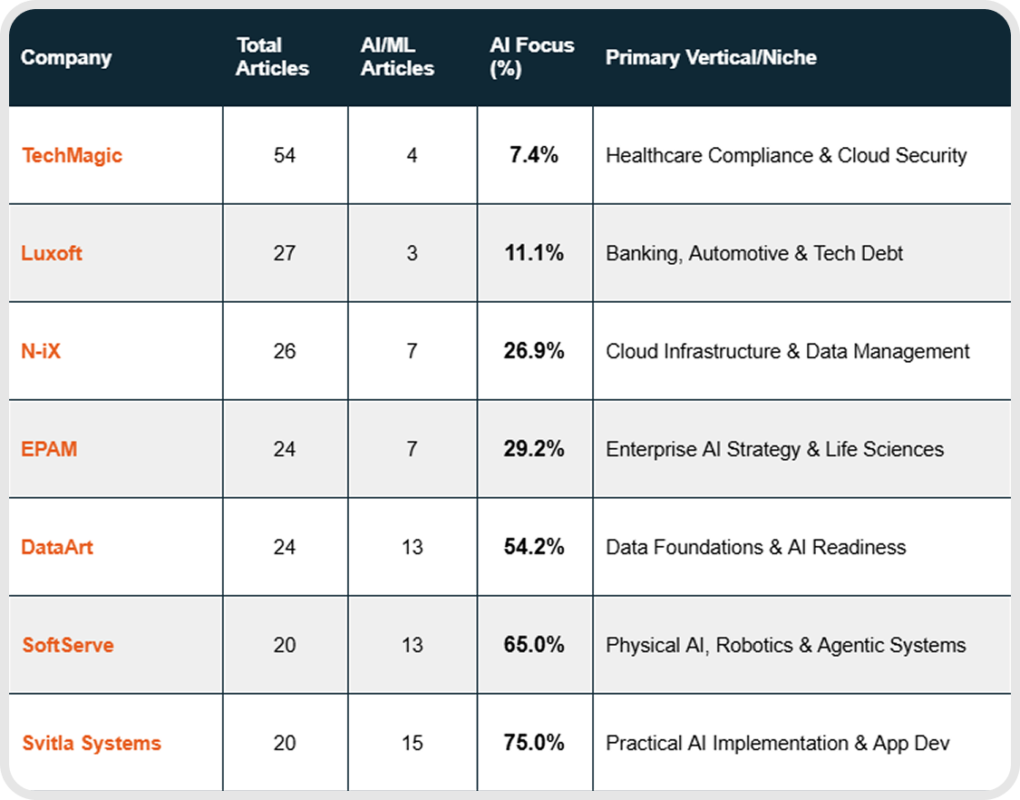
At the same time, 6 out of 7 companies position themselves as AI-driven. If you look at companies’ homepage messaging and positioning, you’ll find titles like:
- EPAM: Accelerating AI-Native Enterprise-Wide Transformation
- SoftServe: We design and build data, cloud, AI/ML, robotics, IoT, and XR solutions.
- DataArt: Partners for Progress in Data and AI.
- Svitla Systems: From Idea to MVP, Svitla AI gets you to ROI faster. Svitla AI is powered by people.
- N-iX: Pragmatic AI Software Engineering
- TechMagic: AI-DrivenSoftware Product Development Company

One thing clearly stands out — AI is used as a signal to attract attention and investment, but does it always reflect real capabilities or solve concrete business problems?
This guide takes a practical look at AI startup investing: what is actually happening in the market, whether platforms give real access to it, what types of startups are gaining traction, and how to separate substance from hype.
As a crowdfunding software company, this article is a bit biased towards crowdfunding and investing, so let’s address the elephant in the room first.

What you will learn in this post:
Can you really invest in AI startups through crowdfunding platforms?
Yes, but with limitations.
Crowdfunding platforms have made early-stage investing more accessible. Platforms like Wefunder or Republic1 allow startups to raise capital from retail investors. These are typically:
- Early-stage rounds
- Community-driven campaigns
- Extensions of larger funding rounds
However, most of the strongest AI companies do not start there.
They usually follow a more traditional path:
- Seed and Series A led by venture capital
- Growth rounds with institutional investors
- Optional later-stage access via platforms
So yes, crowdfunding gives access, but mostly to earlier, higher-risk deals or to overflow allocations from larger rounds.
What AI startups are actually popular?
The market is best understood through real products that people already use. Here are some of them.
Generative AI: replacing production workflows
This is the most visible and fastest-moving segment. Tools that generate content: text, voice, music, images, have moved from novelty to utility.
ElevenLabs
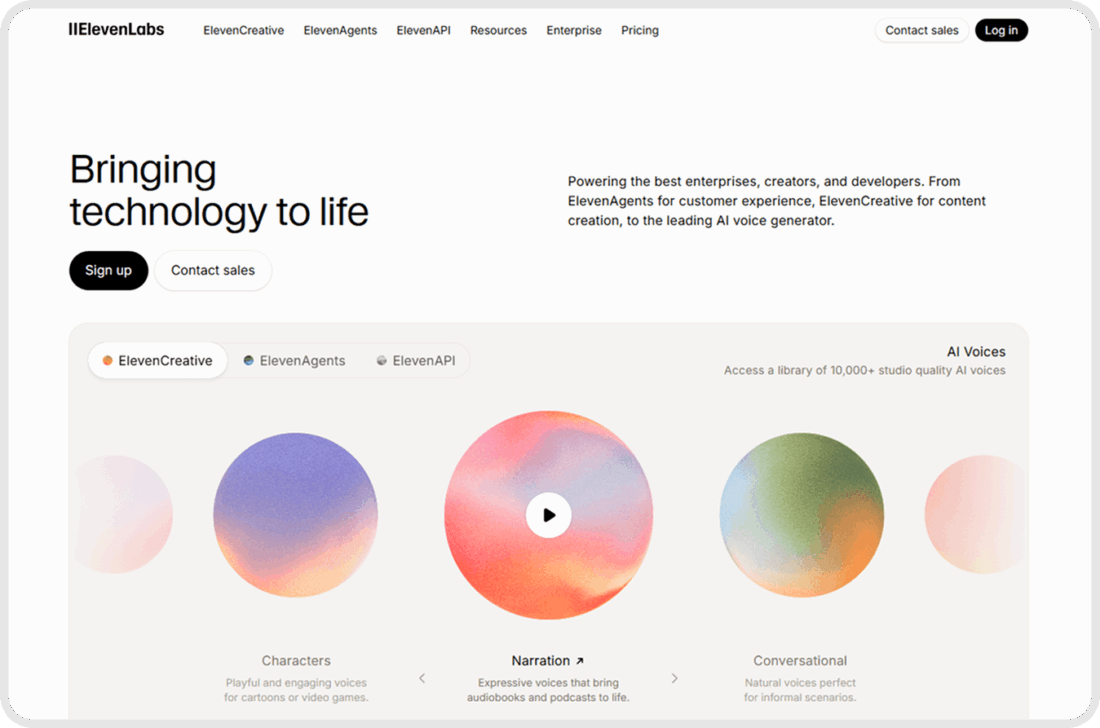
ElevenLabs2 provides realistic voice generation that is now used in media production, content creation, and localization. The company raised venture funding3 from firms such as Andreessen Horowitz and Sequoia Capital, following a traditional VC path. It did not rely on crowdfunding.
It has a strong commercial use case, already embedded in content production
Suno AI

Suno AI4 focuses on generating music from text prompts or augmenting existing tracks. It has been backed by institutional investors, including Lightspeed Venture Partners5. Like most companies in this segment, it raised capital through venture rounds rather than retail platforms. Its long-term value depends on distribution, licensing, and user adoption.
LLM-based tools (like those behind ChatGPT-style systems)
These tools represent another layer of this category. They generate text, code, and structured outputs. These systems are capital-intensive and are almost entirely funded by large institutional investors6. They are increasingly becoming infrastructure rather than standalone products.
Niche AI-image generation tools like PixelLab

Tools like pixel art generators by Pixellab7 also add to the mix of valuable tools. But if text or code come off as easy, AI-image generation is terribly frowned upon by the art community. And yet, many find such tools great for inspiration and fast prototyping.
FinTech AI: decision-making systems
AI fits financial systems where speed, data processing, and consistent execution matter.
Predictiva
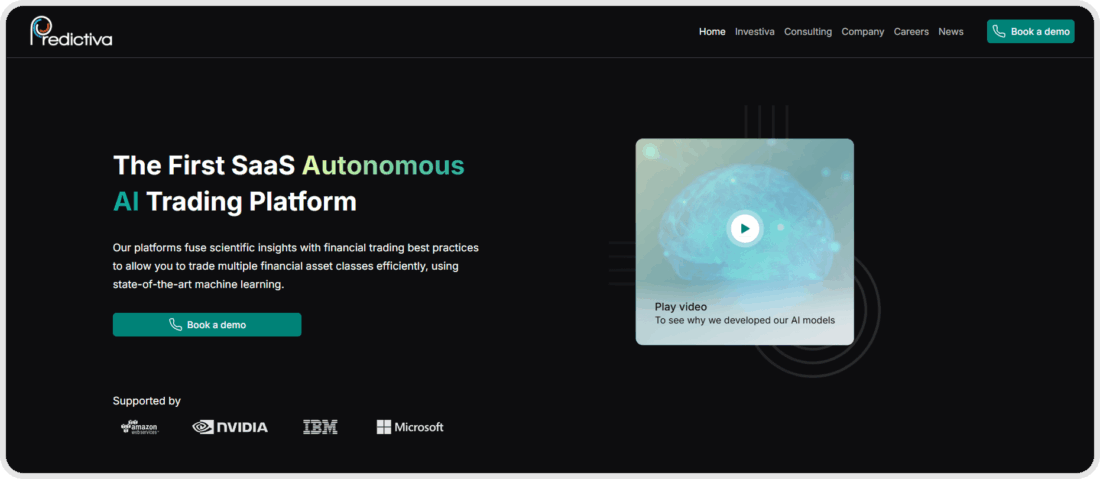
Predictiva8 focuses on autonomous trading, replacing human decisions with algorithms. Despite appearing accessible at the product level, its funding follows a traditional path: early-stage private rounds with investors9 rather than crowdfunding or open retail campaigns. This means it is not a platform-funded company, even if its positioning suggests broader access.
From an investor perspective, it offers exposure to financial infrastructure, but with a clear trade-off: performance risk is high, and outcomes depend entirely on how models perform in real market conditions.
Other autonomous trading platforms
This category splits in practice. More credible platforms, such as Numerai or QuantConnect, are typically backed by venture capital10 or hedge fund capital11 and are not accessible through crowdfunding.
Many retail-facing platforms position themselves as AI trading solutions but are not funded businesses in the traditional sense. Instead of raising venture capital, they are typically monetized through subscriptions or user capital12, offering paid access to trading signals or execution tools.
This model lowers the barrier to entry but often comes with trade-offs. The space includes many easily replicable tools marketed as “AI-powered,” and some platforms operate with limited transparency or regulatory oversight.
AI in credit and risk assessment
Companies like Upstart13 and Zest AI14 show a different model. These tools support underwriting, fraud detection, and risk modeling rather than replacing decision-making entirely. Their funding is almost exclusively institutional15: venture capital, private equity, or public markets, because they integrate directly into regulated financial systems and require scale, data, and compliance.
What this segment shows is simple: AI in finance directly links to financial outcomes, which is why it attracts attention. It is also unforgiving: if models fail in real conditions, there is no buffer, and the business does not hold.
SportsTech AI: industry-specific applications
AI is expanding into less obvious sectors, including sports, where it is applied to analytics, performance tracking, and audience engagement.
SplashSports

SplashSports16 is an example of this approach, although its positioning is slightly different from a pure AI startup. The company operates a social sports gaming platform where users compete in real-money contests, combining elements of analytics, fan engagement, and community-driven participation.
Its funding does not follow a crowdfunding-first model. Instead, Splash has raised capital through traditional venture and private investment rounds. The company has secured over $28M across multiple rounds17, including a $14.5M Series B led by Dream Ventures with participation from Boston Seed, Velvet Sea Ventures, and others.
Consumer and education AI: engagement-driven systems
Another segment focuses on end users and everyday interaction.
Curiouser.ai

Curiouser.ai builds adaptive learning and personalized content systems that improve through user behavior. The company has raised capital through crowdfunding, including a public campaign on Wefunder18 targeting around $50,000, which made it accessible to smaller investors. This reflects an early-stage structure where growth and user retention are still the main drivers of value, and monetization remains uncertain despite strong engagement potential.
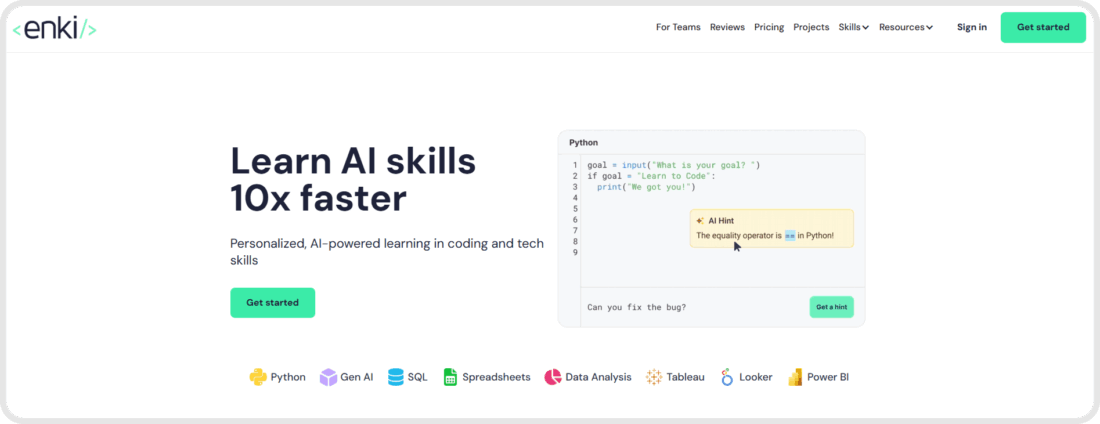
Enki
What this actually means for investors
AI startups are not one uniform category. They operate at different layers: infrastructure (models and core systems), applications (industry-specific solutions), and consumer tools (end-user products). Each of these layers behaves differently in terms of funding, risk, and time horizon.
What is changing now is the direction of the market. We are now entering the AI infrastructure era, where AI is embedded into core business operations19 rather than treated as a standalone innovation. Investors are no longer funding ideas; they are funding systems20 that automate decisions, reduce costs, and produce measurable outcomes.
This shift makes the differences between layers more important. Infrastructure companies are capital-intensive but tend to be more defensible over time. Consumer tools can scale quickly, but they are also easier to replicate. Industry applications sit in between, combining practical use cases with more moderate risk.
Looking at all AI startups through the same lens leads to poor decisions.
How to evaluate AI startups for investing
To assess whether an AI startup is worth investing, check the following:
Technology: Is the system assisting users or replacing decisions? The closer it is to decision-making, the more value it can capture.
Data: Does the company have access to data that others cannot easily replicate? Does that data improve over time?
Product: Is there a working product with real users? Early traction matters more than presentation.
Revenue: Is there a clear and realistic way to generate income? Simplicity is often a strength.
Anything beyond these points is secondary.
Risks of AI startup investing
AI offers strong upside, but investing in it is connected with risks. They come from how the technology is built, funded, and regulated. Ignoring them leads to poor decisions, especially at scale.
Overvaluation and hype: Capital inflow is pushing valuations beyond fundamentals; many startups have high valuations21 with little revenue and uncertain profitability22.
Technical and execution risk: AI systems are complex, costly to scale, and often fail in real conditions, especially when relying on third-party models.
Regulatory uncertainty: Frameworks like the EU AI Act23 and General Data Protection Regulation24 can restrict data use and increase operational costs.
Illiquidity and exit risk: Investments are long-term, exits are uncertain, and many outcomes result in lower-return acquihires.
How investment platforms facilitate AI startup crowdfunding
As AI deal flow grows, platforms play a bigger role. There are more opportunities, but also more variation in quality.
Platforms are no longer just investment or crowdfunding marketplaces. They operate on three levels:
- Filtering deals: They select and maintain quality standards
- Supporting evaluation: They give investors tools to assess technology, data, and business fundamentals
- Enabling transactions: They handle onboarding, payments, and compliance.
Without this structure, growth may come at the expense of quality.
Looking for a ready-made solution or exloring a custom build?
Here's how we can help
How to build AI investment infrastructure with LenderKit
Launching an AI investment platform is not just about sourcing deals. It requires a working system behind it.
At a minimum, that includes:
- Investor onboarding and KYC
- Payment processing
- Deal structuring
- Cap table management
- Regulatory compliance
Building all of this in-house takes time, money, and ongoing maintenance. It slows down launch and adds operational risk.
That’s why you need to consider using white-label crowdfunding software like LenderKit. Instead of building your crowdfunding or investment platform from scratch, you can start with ready-made infrastructure designed for investment platforms. It will allow you to launch faster, stay compliant, and focus on deal flow.
To find out how our product works or discuss details, get in touch with our team.

Article sources:
- AI & Machine Learning
- Free AI Voice Generator & Voice Agents Platform | ElevenLabs
- ElevenLabs raises $500M Series D at $11B valuation
- Suno | AI Music Generator
- Suno Raises $250M at a $2.45B Valuation
- Microsoft invests $10 billion in ChatGPT maker OpenAI - Los Angeles Times
- PixelLab - AI Generator for Pixel Art Game Assets
- Predictiva
- Predictiva Company Information - Funding, Investors, and More
- Numerai is a crowdsourced hedge fund for machine learning experts | TechCrunch
- Crunchbase - quantconnect - financial details
- AI for Trading: The 2026 Complete Guide
- Upstart
- Zest AI
- Upstart, A Site For Crowdfunding People, Raises $5.9M From First Round, Eric Schmidt, And Others | TechCrunch
- Fantasy Sports: Win Cash Prizes | Splash Sports
- Splash Sports Stock Price, Funding, Valuation, Revenue & Financial Statements
- Curiouser.AI | Question everything
- AI is embedded into core business operations
- How To Get A Company AI Pilled And What VCs Want To See Next
- Seed-Stage AI Startups Are Flashing Record Revenue Numbers And Most Of Them Are Not What They Seem
- OpenAI won’t make money by 2030 and still needs to come up with another $207 billion to power its growth plans, HSBC estimates | Fortune
- EU Artificial Intelligence Act | Up-to-date developments and analyses of the EU AI Act
- General Data Protection Regulation (GDPR) – Legal Text