Crowdfunding For Golf Clubs: Business Models, Platforms, Funds Raised


No time to read? Let AI give you a quick summary of this article.


Golf may not be the first industry associated with crowdfunding, but over the past decade, it has quietly experimented with nearly every crowdfunding model available.
Community clubs have financed clubhouse renovations through donation campaigns, startups have raised equity to build golf technology businesses, young golfers have funded their competitive careers, and golf lifestyle brands have attracted thousands of retail investors.
Despite these examples, one question remains largely unexplored: could a dedicated crowdfunding platform for golf club financing become a viable business?
Current evidence suggests that while golf-related crowdfunding is real and growing, the opportunity is narrower than in industries such as renewable energy or real estate. Rather than supporting a standalone platform focused exclusively on golf clubs, the market appears better suited to specialized verticals or broader sports-investment marketplaces.
What you will learn in this post:
Four different golf crowdfunding platform models
Our research shows that golf crowdfunding falls into four distinct categories.
Community Crowdfunding
- Typical projects: Clubhouse improvements, changing rooms, junior programs, renewable energy, irrigation, maintenance equipment
- Main platforms: Crowdfunder UK
Examples of community crowdfunding:
- Newport Golf Club (2024, changing rooms)
- Waterlooville Golf Club (2025, solar panels – £54,340)
- Church Stretton Golf Club (2025, borehole – £15,004)
- Abbey Hill Golf Club (2023, solar panels – £3,510)
- Ashton & Lea Golf Club (2026, robotic mowers – £5,606)
Equity Crowdfunding
- Typical projects: Golf technology companies, booking platforms, software, golf brands
- Main platforms: Republic Europe (formerly Seedrs), Crowdcube, pitchIN
Examples of equity crowdfunding:
- VPAR (2017 – £1.2M+)
- golfscape (2020 – £149,110, 119% funded)
- Deemples (2020 – RM1.3M investor interest)
- Manors Golf (2023–2024, ~£1M combined funding)
Athlete Crowdfunding
- Typical projects: Tournament participation, coaching, travel, equipment
- Main platforms: Sportfunder
- Examples: Amateur and professional golfers raising sponsorship for competitions and career development
Investment Crowdfunding
- Typical projects: Sports businesses, hospitality ventures
- Main platforms: CrowdedHero and general equity platforms
- Examples: Sports and recreation businesses seeking equity investment rather than community donations
Rather than one unified ecosystem, golf crowdfunding is fragmented across platforms specializing in different funding models. Community golf clubs primarily rely on donation campaigns for infrastructure projects, while technology companies and golf brands use equity crowdfunding to finance growth. Individual golfers, meanwhile, typically seek sponsorship for competitions and training through dedicated athlete crowdfunding platforms.
Community golf clubs raise money for facilities
Most golf clubs use crowdfunding for practical improvements rather than business expansion. These campaigns are usually hosted on Crowdfunder UK and rely on donations from club members, local residents, and community supporters.
One example is Newport Golf Club in Wales.
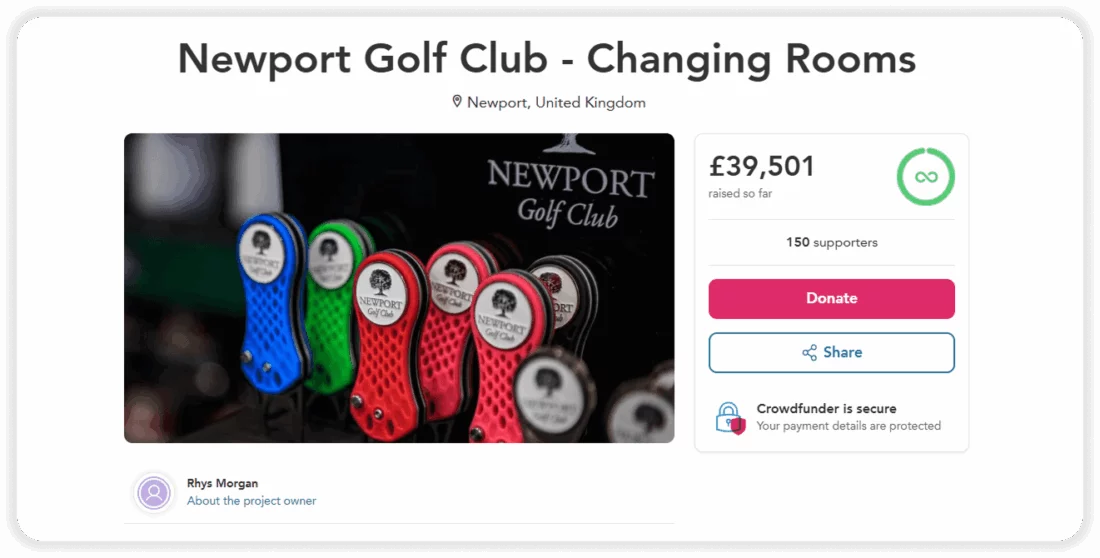
In 2024, the club launched a Crowdfunder campaign1 to modernize its changing rooms and create more accessible facilities for women, juniors, and community users. Instead of offering financial returns, the campaign focused on improving the club for current and future members.
The same pattern appears across many campaigns.
Waterlooville Golf Club raised more than £54,0002 in 2025 to install solar panels. The project reduced electricity costs while improving the club’s environmental performance.
Church Stretton Golf Club raised just over £15,0003 in 2025 to drill a borehole, helping secure a reliable water supply during increasingly dry summers.
Ashton & Lea Golf Club raised approximately £5,6004 in 2026 to replace diesel-powered maintenance equipment with robotic electric mowers.
Earlier, Abbey Hill Golf Club raised around £3,5005 for a solar energy project.
Although these projects differ, they share several characteristics:
- Relatively smaller funding targets
- Strong local supporter communities
- Practical infrastructure improvements
- Donation-based fundraising
- No equity offered to contributors.
This is community financing rather than investment.
Golf technology attracts much larger investments
Larger crowdfunding campaigns are not launched by golf clubs but by technology companies serving the golf industry.
One of the best-known examples is golfscape6.
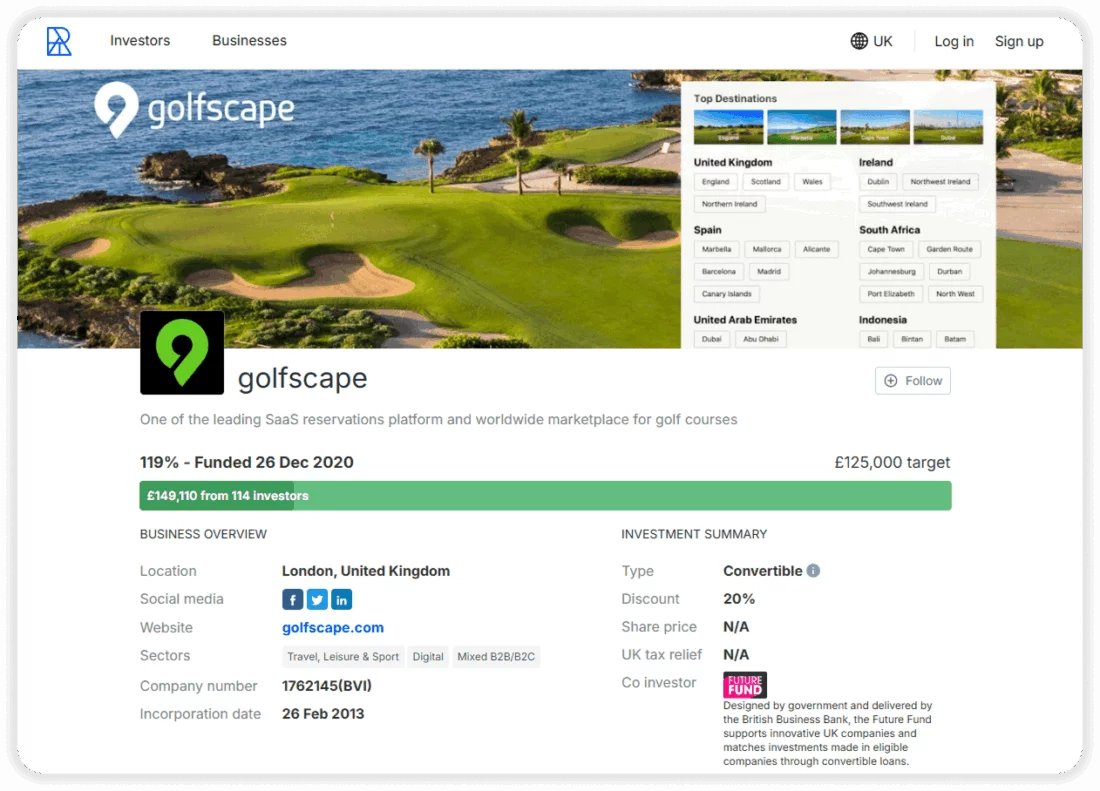
Golfscape is an online booking platform that connects golfers with golf courses worldwide. Its revenue comes from booking commissions, payment processing, and software subscriptions for golf clubs.
In December 2020, golfscape launched an equity crowdfunding campaign on Seedrs, now Republic Europe.
The results were strong:
- Target: £125,000
- Raised: £149,110
- Investors: 114
- Funding achieved: 119%
At the time, the company reported:
- Operations in more than 30 destinations
- Over one million rounds booked
- Around $38 million in annual booking transactions
- Partnerships with approximately 300 golf courses.
Investors were attracted by a scalable software business with recurring revenues rather than ownership of golf facilities.
Another major success is VPAR7, a company developing golf scoring, tournament management, and club software.
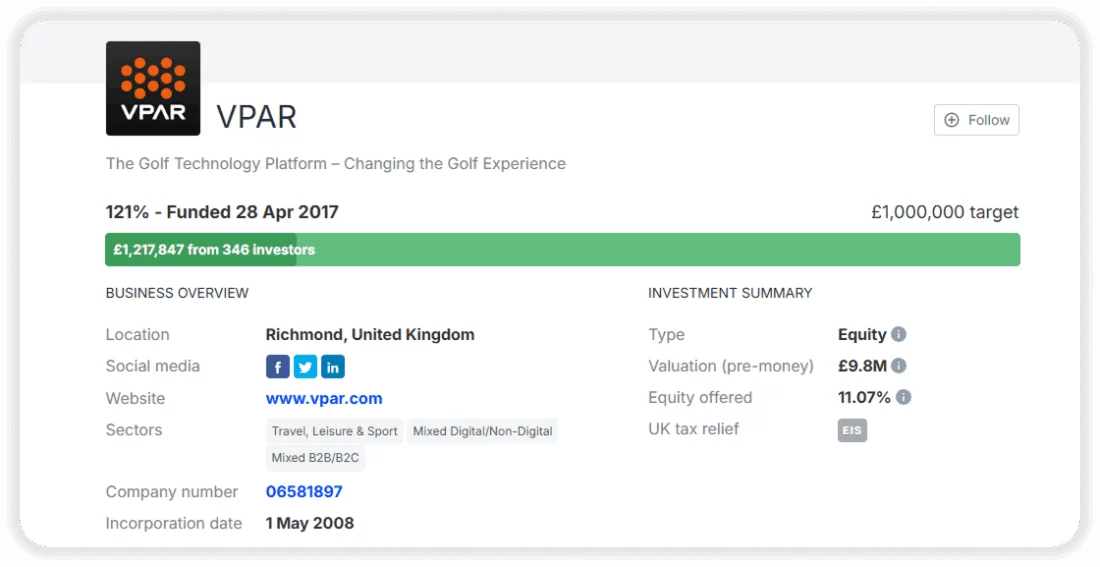
Its Seedrs campaign in 2017 sought £1 million and eventually raised more than £1.2 million. This made it one of Europe’s largest golf-related equity crowdfunding campaigns.
Like golfscape, VPAR offered investors:
- Recurring SaaS revenue
- International expansion opportunities
- Technology products with global demand.
Golf brands have also found investors
Golf crowdfunding is not limited to software.
British apparel company Manors Golf launched a Crowdcube campaign in 20238, initially targeting £400,000.

The company later secured approximately £1 million9 through a combination of crowdfunding and angel investment.
Instead of investing in golf itself, investors backed a consumer brand with:
- Direct-to-consumer sales
- International growth potential
- Premium positioning
- Expanding online retail operations
This reflects another important trend: investors generally prefer businesses that can scale internationally instead of local golf facilities.
Golf social platforms are emerging
Golf-focused digital platforms have also entered the crowdfunding market.
One example is Deemples, often described as a social network for golfers.
The platform helps golfers find playing partners, organize games, book tee times, and connect with golf clubs.
In 2020, Deemples10 launched an equity crowdfunding campaign through Malaysia’s pitchIN platform.
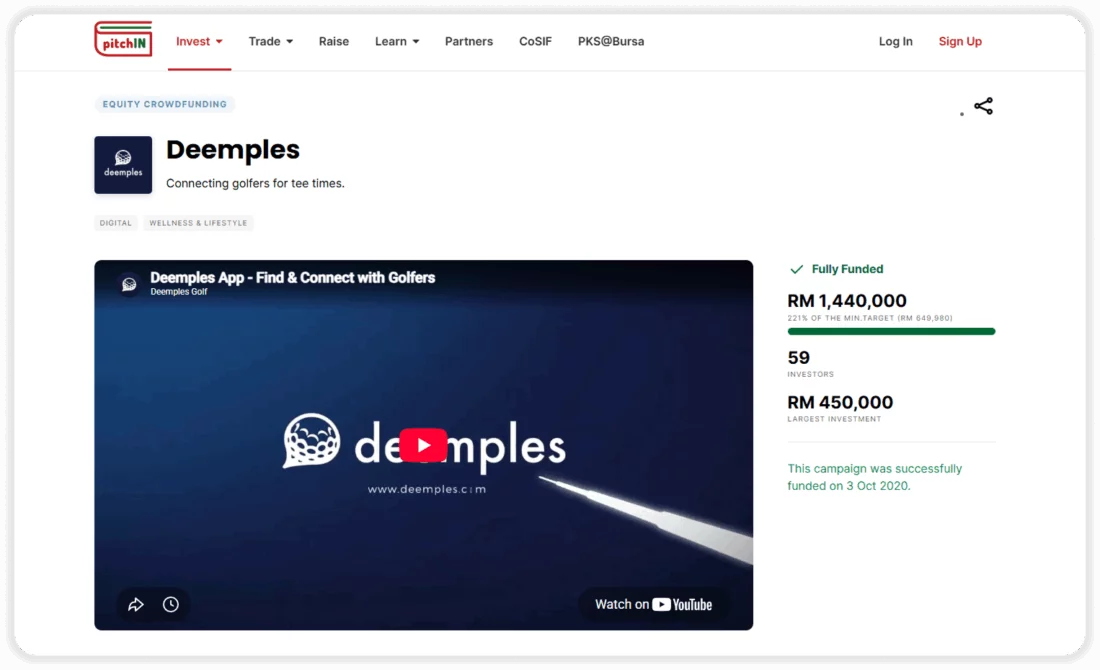
Before the campaign officially opened, the company had already attracted more than RM1.3 million in investor interest.
At the time, Deemples reported:
- More than 25,000 registered golfers
- Operations across five countries
- Recurring software revenues.
Again, investors supported a scalable digital platform rather than physical golf infrastructure.
Individual golfers also use crowdfunding
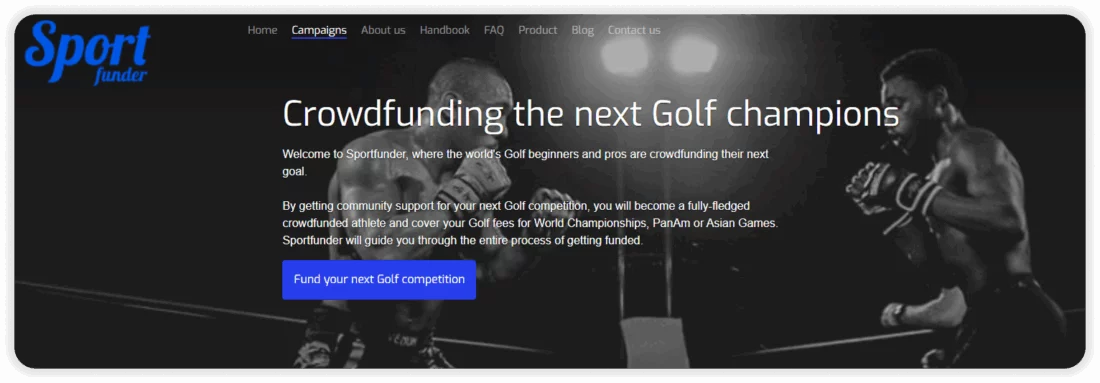
Another segment focuses on athletes rather than clubs.
Platforms such as Sportfunder11 allow amateur and professional golfers to raise money for:
- Tournament entry fees
- Travel expenses
- Coaching
- Equipment
- International competitions
Supporters usually receive updates or rewards rather than financial returns.
These campaigns are generally much smaller than equity crowdfunding campaigns and rely heavily on personal networks, family, friends, and local sponsors.
Could a dedicated golf crowdfunding platform work?
Financing a golf club through equity is difficult. The biggest obstacle is the business structure of golf clubs12 themselves. Many clubs operate as member-owned associations or nonprofit organizations, which is why they usually cannot offer equity.
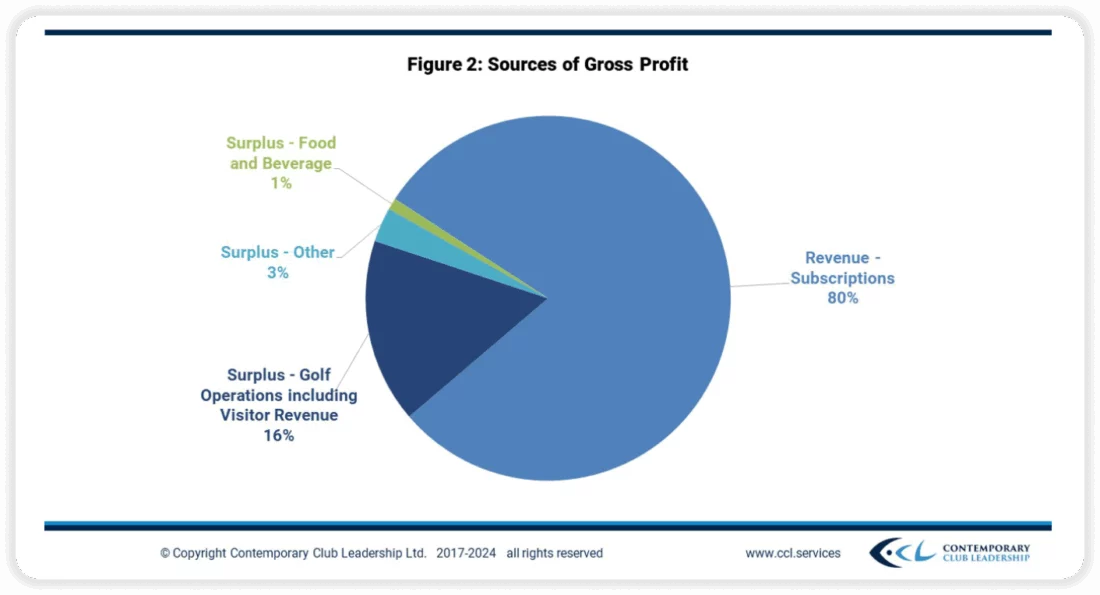
Membership subscriptions are the primary source of profit for golf clubs, generating around 80% of gross profit. Golf operations, including visitor green fees, contribute 16%, while other activities (3%) and food and beverage services (1%) make only a small contribution. This highlights the industry’s reliance on stable membership income rather than diversified, high-growth revenue streams. This also creates a mismatch between investor expectations and golf club economics.
Another challenge is the size of campaigns. Most community projects raise between £3,000 and £60,000, while only a handful exceed that range.
By contrast, technology companies and golf brands can issue shares, attract investors, and pursue rapid growth. This explains why golfscape, VPAR, and Manors Golf raised hundreds of thousands or even millions of pounds, while golf clubs generally raise much smaller amounts.
These are the reasons why a broader sports infrastructure crowdfunding platform would have better commercial potential than the one that focuses only on golf clubs. Such a platform could serve:
- Golf clubs
- Tennis clubs
- Rowing clubs
- Sailing clubs
- Cricket clubs
- Rugby clubs
- Community sports facilities.
Golf would remain an important category, but the wider market would generate a much larger and more consistent pipeline of fundraising projects.
The same platform could also support multiple funding models, including donations, rewards, equity, and sponsorships.
How to launch a crowdfunding platform with LenderKit
For entrepreneurs interested in launching a sports crowdfunding platform, building the software from scratch is not the only option. Many operators choose white-label crowdfunding solutions, which provide the core platform functionality while significantly reducing development time, costs, and technical complexity.
Here is where LenderKit’s white-label crowdfunding software can be handy. They come with all integrations and allow you to choose one flow or combine multiple fundraising flows, including donation crowdfunding, rewards crowdfunding, equity crowdfunding, debt crowdfunding, and investment marketplaces. This allows platform owners to combine different campaign types within one platform.
To find out how the solutions work and discuss options, please get in touch with our team.

Article sources:
- Newport Golf Club - Changing Rooms
- Help Waterlooville Golf Club Go Solar
- Borehole Funding Project
- Robot Mowers & Free Golf Club Membership at A&L GC
- Abbey Hill Solar Panels
- Golfscape
- VPAR
- Manors Golf
- Golf Business News - MANORS launches seed funding campaign
- Invest in Deemples (Successfully funded) | pitchIN
- Crowdfunding the next Golf champions
- Where does your club get their cash – and how do they spend it?