Fund Formation Costs, Structures, Licensing & White-Label Fund Software


No time to read? Let AI give you a quick summary of this article.


Launching an investment fund involves more than drafting legal documents. Managers must choose the right structure, understand licensing requirements, build operational infrastructure, and establish processes for investor reporting and compliance.
Now, the fund formation has become more standardized. Venture capital, private equity, hedge funds, and digital asset funds often share common legal frameworks and operational workflows. However, they differ in investment strategies, jurisdictions, and regulatory requirements.
This guide explains:
- Common fund structures;
- Licensing and regulatory requirements;
- Fund formation costs;
- Which fund types are best suited for different managers;
- Software and operational infrastructure.

What you will learn in this post:
Common legal structures
Most private investment funds are built around three entities1:
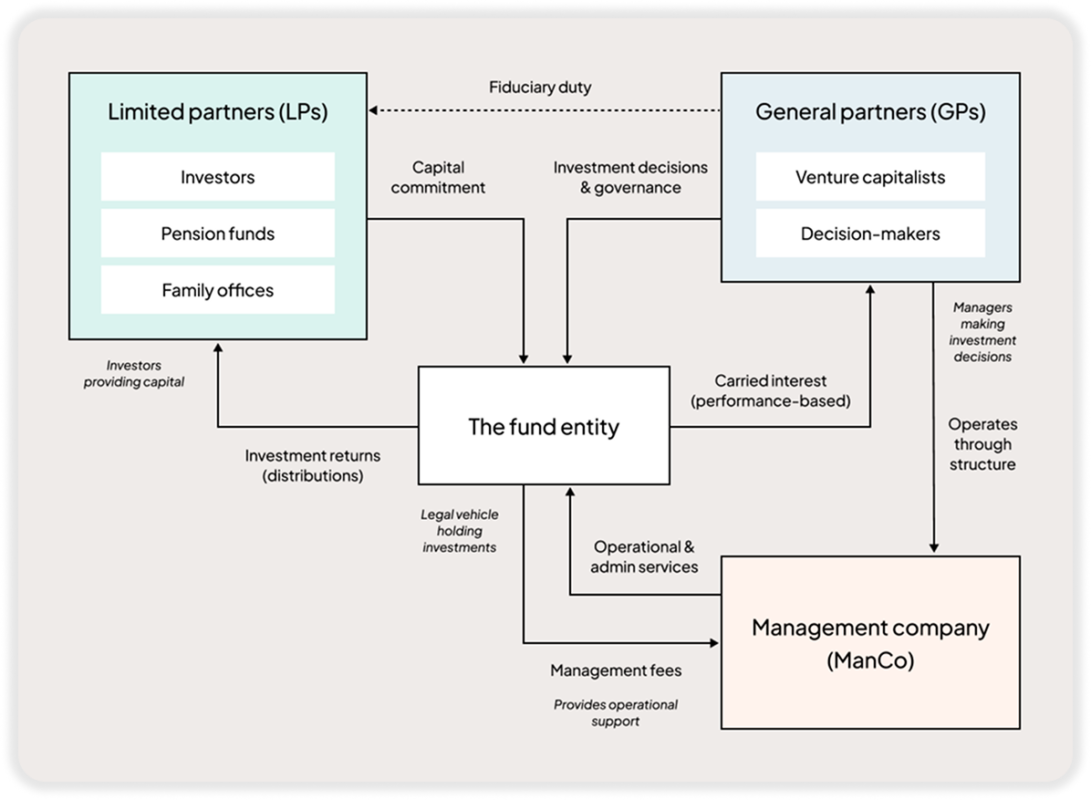
Source: Carta2
Limited Partnership (LP), which is the investment vehicle itself. Investors participate as Limited Partners (LPs) and contribute capital, but they do not manage the fund.
The General Partner (GP) manages the fund and makes investment decisions. It is often formed as an LLC and receives carried interest.
The management company employs staff, receives management fees, oversees fundraising, and manages operations and investor relations.
This LP–GP–management company structure is standard for most venture capital and private equity funds.
Master-feeder structures
Hedge funds and some digital asset funds often use a master-feeder structure3.
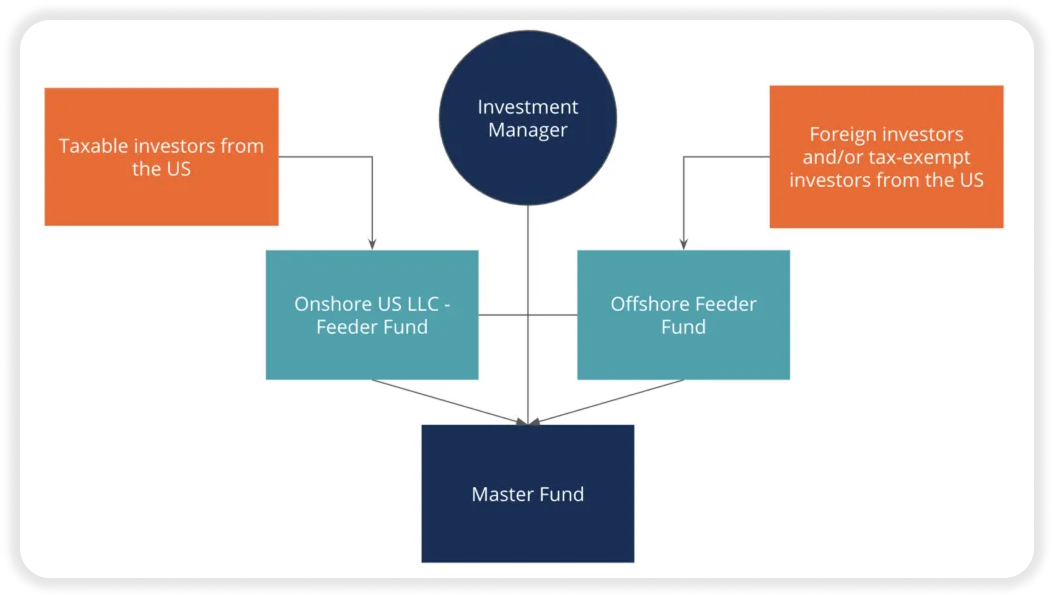
The structure typically consists of:
- A master fund, which executes all investments and trading activities;
- A feeder fund for US taxable investors;
- A feeder fund for non-US and US tax-exempt investors.
The feeder funds invest all of their assets substantially into the master fund. This arrangement allows investors with different tax and regulatory profiles to participate in the same investment strategy while maintaining a single trading portfolio and centralized portfolio management.
Common licensing and regulatory requirements
Most US private funds rely on exemptions under the Investment Company Act. The most common exemptions are:
- Section 3(c)(1)4 – generally limits a fund to 100 investors;
- Section 3(c)(7) – allows an unlimited number of investors if they are qualified purchasers;
- Regulation D – permits private offerings without public registration.
Fund managers may register5 as:
- SEC Registered Investment Advisers (RIAs);
- State Registered Investment Advisers;
- Exempt Reporting Advisers (ERAs).
Managers that register with the SEC or file as Exempt Reporting Advisers (ERAs) must submit their filings electronically through the Investment Adviser Registration Depository (IARD)6. The IARD is the central filing system used by the SEC and state securities regulators to process registration documents, amendments, and public disclosures.
The SEC-approved IARD filing fees are:
| Assets under management | Initial fee | Annual amendment |
| Less than $25 million | $40 | $40 |
| $25 million to $100 million | $150 | $150 |
| More than $100 million | $225 | $225 |
Exempt Reporting Advisers pay:
- $150 for the initial filing;
- $150 for annual amendments.
The SEC generally has 45 days after receiving Form ADV7 to declare an adviser’s registration effective.
Which fund type is more suitable?
The right fund structure depends on your investment strategy, target investors, regulatory preferences, and operational capabilities.
Venture capital fund
Venture capital funds invest primarily in startups and high-growth companies, typically at the seed, early, or growth stages. The industry relies on widely used legal documents8 and established market practices, particularly in the United States.
A venture capital fund is commonly launched by:
- Emerging managers raising their first institutional fund;
- Angel investors and syndicate leads seeking a more formal investment vehicle;
- Seed and early-stage investors focused on financing innovative startups.
VC funds are usually structured with a lifespan of around 10 years9, often with extension options.
Private equity fund
Private equity funds invest in mature private companies through buyouts, growth investments, or other forms of private ownership. Managers often take an active role in improving operations, expanding businesses, or preparing portfolio companies for exits.
Private equity funds are commonly launched by:
- Managers pursuing buyouts or majority acquisitions;
- Growth equity investors;
- Sector-focused investment firms;
- Experienced operators and entrepreneurs entering asset management.
These funds are particularly popular among institutional investors seeking exposure to private markets.
Hedge fund
Hedge funds are investment vehicles that pursue a wide range of strategies, including long-short equity, global macro, event-driven investing, quantitative trading, credit, and multi-strategy approaches.
Hedge funds are commonly launched by:
- Experienced portfolio managers;
- Long-short equity investors;
- Quantitative and algorithmic traders;
- Macro and multi-asset managers;
- Teams spinning out from banks, asset managers, or family offices.
Because hedge funds trade actively and often offer periodic investor redemptions, they typically require sophisticated operational infrastructure, including fund administration, portfolio accounting, risk management, and compliance systems.
Digital asset fund
Digital asset funds invest in cryptocurrencies, blockchain infrastructure, tokenized securities, decentralized finance (DeFi), and other blockchain-based assets.
Over the past several years, jurisdictions such as Abu Dhabi Global Market (ADGM)10, and Dubai International Financial Centre (DIFC) have introduced frameworks governing virtual assets and digital asset service providers.
Digital asset funds are commonly launched by:
- Crypto-native investment firms;
- Traditional asset managers expanding into digital assets;
- Venture investors focused on blockchain startups and Web3;
- Managers specializing in tokenized real-world assets (RWAs);
- Institutional teams seeking regulated exposure to digital assets.
Compared with traditional funds, digital asset funds typically require additional expertise in custody, cybersecurity, token classification, and anti-money laundering procedures.
Looking for a ready-made solution or exloring a custom build?
Here's how we can help
Fund formation software and operational infrastructure
Building a fund is only part of the challenge. Managers also need technology to onboard investors, manage offerings, track transactions, distribute documents, and maintain ongoing communication. Developing this infrastructure in-house can take months or even years, which is why many firms opt for white-label investment platforms instead.
Here is when LenderKit can help.
It offers white-label solutions designed for private equity firms, venture capital funds, real estate investment businesses, crowdfunding platforms, and other alternative investment companies.
Rather than building an investment platform from scratch, firms can launch a branded platform with ready-made components for investor onboarding, deal management, compliance, reporting, and payments.
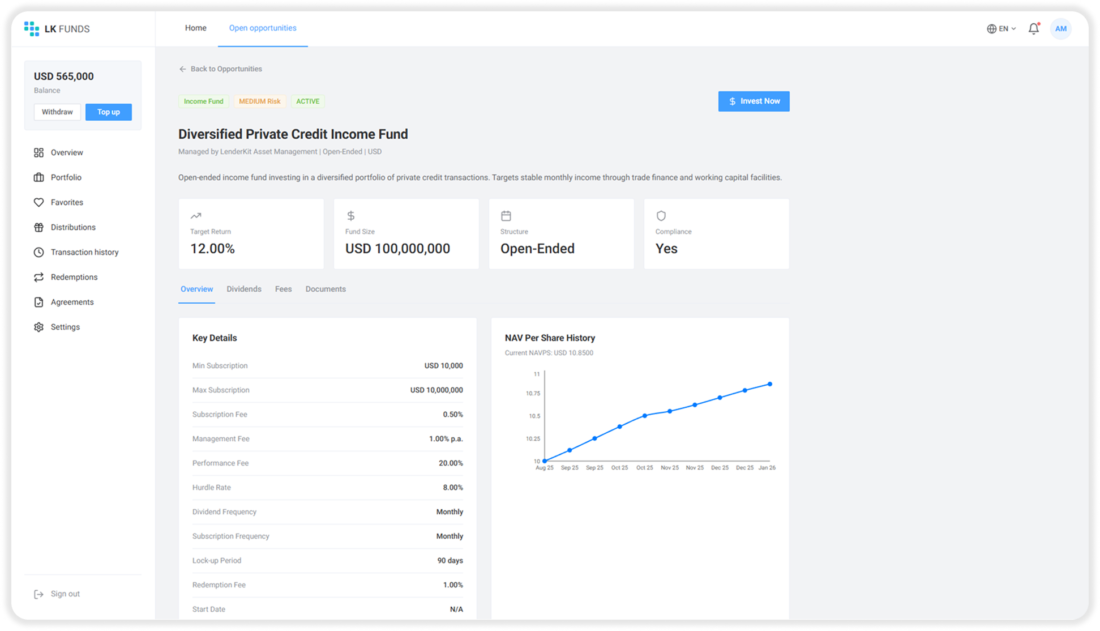
LenderKit also develops software designed specifically for investment funds and fund managers. The platform aims to provide a dedicated environment where investors and managers can access all key fund information in one place.
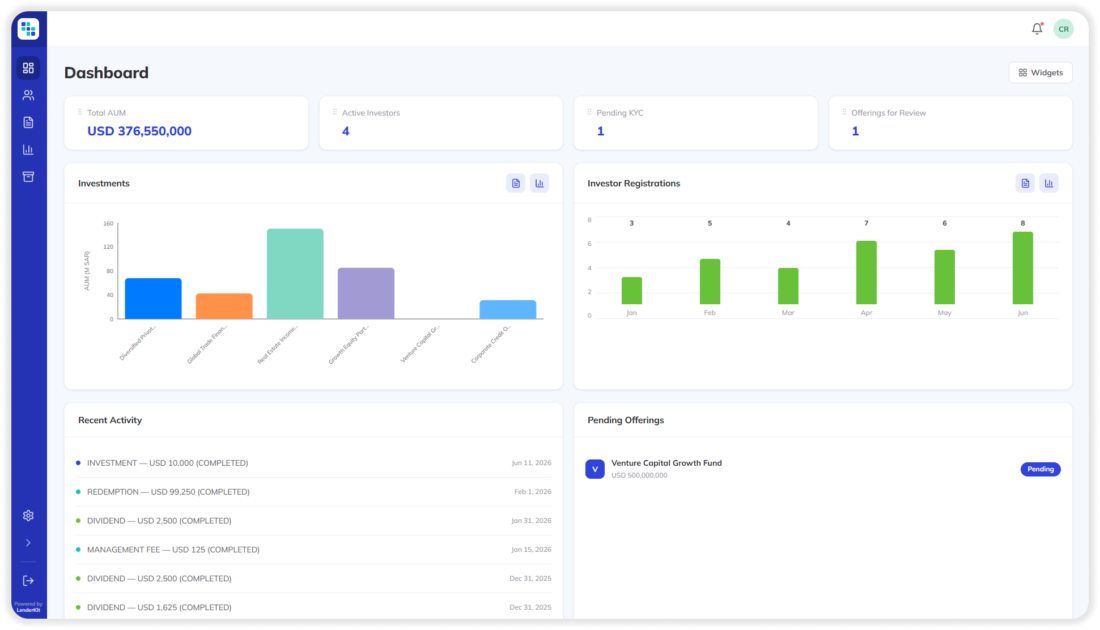
Our future white-label fund software aims to help you:
- Manage your entire investment operation from a single platform designed for fund managers, administrators, and investors.
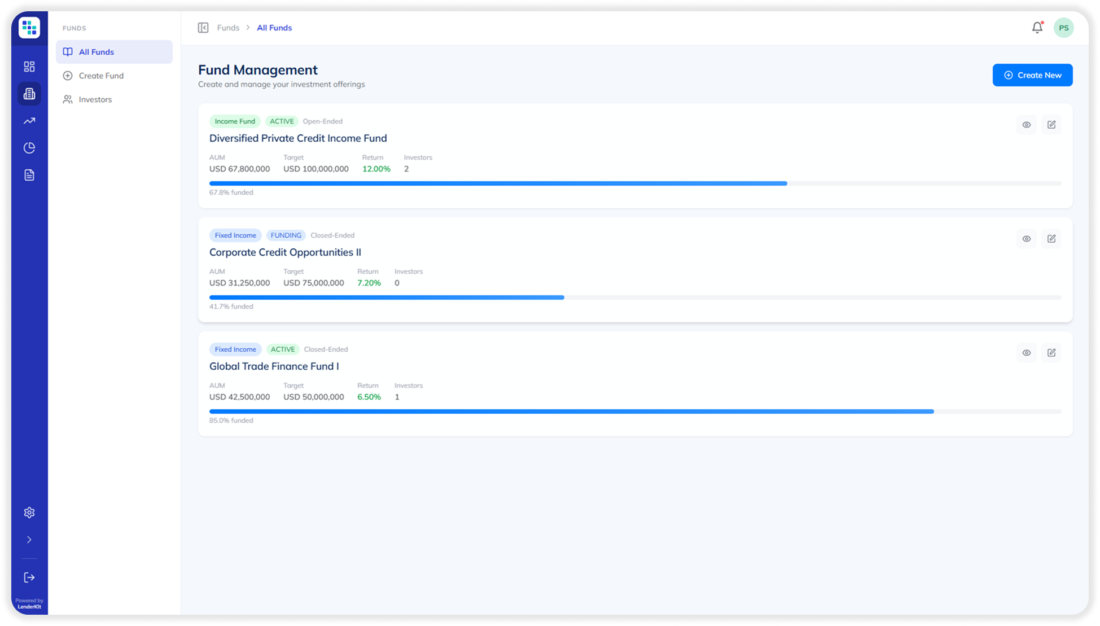
- The solution streamlines fund creation, approvals, investor onboarding, KYC management, portfolio oversight, distributions, agreements, and performance analytics.
- Customizable dashboards provide real-time visibility into assets under management, investor activity, fundraising progress, compliance workflows, and operational performance, helping teams make faster and better-informed decisions.
- Built to improve efficiency and transparency, the platform simplifies investor management, fund administration, reporting, and transaction tracking while delivering a modern self-service experience for investors.
- Automated workflows, configurable permissions, multilingual support, wallet and investment controls, detailed fund reviews, and comprehensive audit trails reduce administrative workload and enable managers to scale fundraising operations with confidence.
If you’re interested in building your custom fund management platform for private capital raising, reach out to us.

Article sources:
- What is a Venture Capital Fund? | AngelList Education Center
- Just a moment...
- Capital Markets Archives | Corporate Finance Institute
- Section 3(c)(1) vs 3(c)(7): Choosing an Investment Company Act Exemption — Capital Company
- Just a moment...
- Just a moment...
- PDF (https://www.sec.gov/about/forms/formadv-part2.pdf)
- Just a moment...
- 1.3 Lifecycle | VC Fund Institute
- Digital Assets