We Analyzed 257 ECSPR Platforms – Plumbing Revealed: How Lemonway, Mangopay, and Identity Verification Providers Power the Ecosystem


No time to read? Let AI give you a quick summary of this article.


The European crowdfunding market is often discussed in terms of investment opportunities, fundraising volumes, and regulatory changes. Much less attention is paid to the infrastructure that makes these platforms work.
Who processes investor payments? Which companies perform identity verification? What authentication systems do platforms use? Are there common technology choices across the market?
To answer these questions, we analyzed 257 crowdfunding platforms authorized under the European Crowdfunding Service Providers Regulation (ECSPR). We used the ESMA register1 as a starting point and supplemented it with manual research of websites, privacy policies, terms of service, and other publicly available information.
The figures presented below are approximate. Many platforms do not publicly disclose their service providers, and some use white-label solutions that are difficult to identify. Nevertheless, the research reveals several clear patterns.
What you will learn in this post:
The payment layer is surprisingly concentrated
Out of the 257 ECSPR platforms we examined, we could confidently identify payment service providers for 96.
Among those, a remarkable 81.2% rely on just two companies:
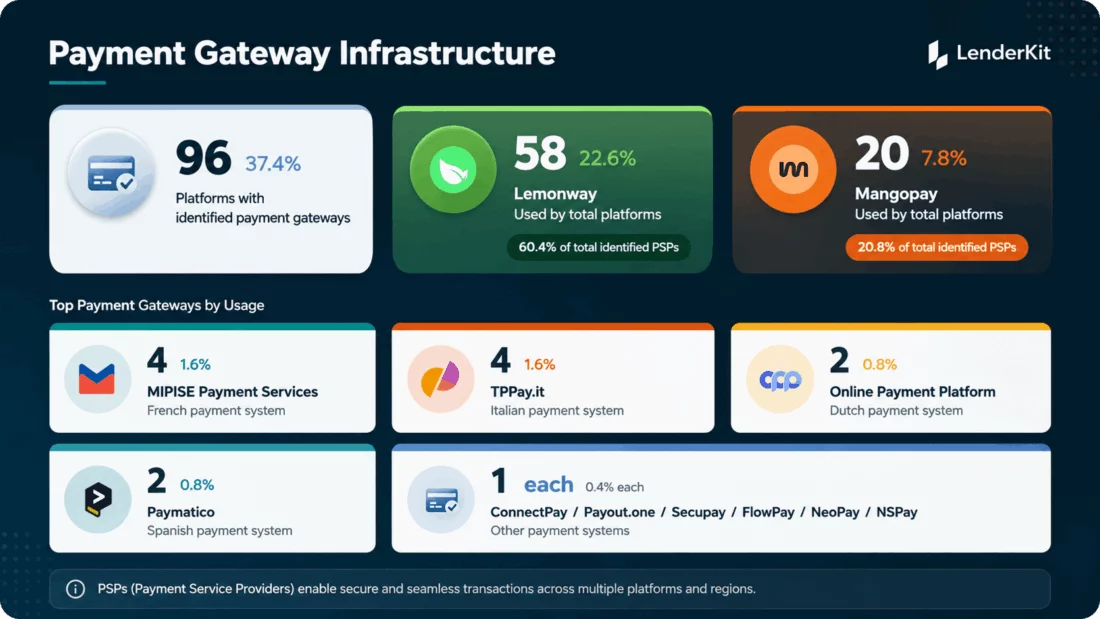
The identified segment of the market resembles a duopoly.
Lemonway is by far the most common provider. It appears on more than 60% of the platforms where payment infrastructure could be identified. Mangopay occupies a strong second position with 20% of the platforms relying on its payment services. Together, these two companies dominate the publicly visible payment layer of the ECSPR ecosystem.
Why?
The answer lies in the crowdfunding regulations and operational requirements.
ECSPR requires4 strict segregation of client funds, robust investor protection mechanisms, and compliance with anti-money laundering regulations.
Crowdfunding platforms also have payment flows that are more complex than traditional online businesses. They must collect investor funds, hold them securely, transfer money to project owners, distribute repayments, and sometimes process refunds.
Providers such as Lemonway and Mangopay were early movers in this space. They developed wallet infrastructure, escrow-like accounts, and compliance tools specifically for marketplaces and crowdfunding businesses.
As a result, many platforms appear to prefer established providers that already understand the regulatory landscape.
Regional providers continue to play an important role
Outside the two market leaders, we identified a number of smaller providers:
- MIPISE Payment Services5 (France)
- TPPay.it6 (Italy)
- Online Payment Platform7 (Netherlands)
- Paymatico8 (Spain)
- ConnectPay9
- Payout.one10
- Secupay11 (Germany)
- NeoPay12
- NSPay13
Most of these appeared only once or a few times in our dataset.
Their continued presence may reflect local market preferences, established banking relationships, and familiarity with domestic regulations.
At the same time, an equally interesting finding is what remains hidden. For 161 platforms, or 62.6% of the sample, we could not confidently identify the payment provider from public information. Some of these platforms likely use proprietary systems or white-label solutions. Others may simply choose not to disclose their infrastructure partners.
For payment institutions and technology vendors, this represents a substantial portion of the market that remains difficult to map.
Identity verification is much less concentrated
Platforms need to manage not only payments. Before investors can participate, platforms must verify their identities, conduct anti-money-laundering checks, and ensure compliance with national and European regulations.
Our research revealed at least 9 identity and compliance providers:
Unlike the payment market, identity verification appears considerably more fragmented.
This is understandable.
European identity systems vary significantly from country to country. Providers must support different identity documents, adapt to local onboarding practices, and comply with national interpretations of anti-money laundering regulations. As a result, platforms have more choices, and no single provider appears to dominate the market in the same way Lemonway or Mangopay do.
For founders launching new crowdfunding platforms, this diversity can be an advantage.
Rather than building KYC and AML systems internally, many platforms integrate specialized vendors with experience in regulated financial services.
The data suggests that proven integrations remain a popular choice.
National digital identity systems remain important
Another interesting finding is the role of national digital identity systems.
We identified integrations with:
- BankID Sweden23
- BankID Norway24
- BankID Czech Republic25
- PSA BankID Austria26
- KBC authentication services in Belgium27
- MitID Denmark20
ECSPR creates a common regulatory framework for crowdfunding across Europe. But investor onboarding remains closely connected to national identity systems.
For platforms targeting Nordic investors, for example, support for BankID or MitID can become an important competitive advantage and, in some cases, a practical necessity.
This highlights an important reality. The European crowdfunding market may be regulated at the European level, but parts of its technology stack remain deeply national.
Tokenization is beginning to appear
A smaller but highly interesting trend involves tokenization.
Among the providers we identified were:
Their market presence is still limited. However, their appearance in the dataset is significant because it points to emerging trends in digital finance.
These companies represent a broader movement toward:
- Asset tokenization
- Digital securities
- On-chain compliance
- Regulated secondary markets
Most crowdfunding platforms still rely on traditional legal and financial structures. But some market participants are already experimenting with technologies that may become more important as the EU digital finance framework evolves.
What the data tells us
Although the figures are approximate, several conclusions stand out.
First, the payment layer is highly concentrated. Among the platforms where payment providers could be identified, more than 80% rely on Lemonway or Mangopay.
Second, identity verification is much more fragmented. Providers such as Veriff, Ondato, Signicat, and others coexist because onboarding requirements vary across European markets.
Third, national infrastructure still matters. BankID and MitID demonstrate that despite the creation of a common European crowdfunding framework, authentication remains closely linked to domestic identity systems.
Finally, many infrastructure relationships remain opaque. We could not identify payment providers for nearly two-thirds of the platforms in our sample. This means the ecosystem is likely more interconnected than public information suggests.
Infrastructure concentration and resilience
The findings also raise questions about concentration risk.
More than 60% of the payment providers we identified belong to a single company, Lemonway. This does not mean Lemonway serves 60% of all ECSPR platforms. Many provider relationships remain unknown.
Nevertheless, the concentration is notable.
When a significant share of an industry depends on a small number of infrastructure providers, technical outages, cyber incidents, or regulatory actions affecting those providers may have consequences across the broader ecosystem.
Similar discussions already exist around cloud providers, payment networks, and financial market infrastructure. Crowdfunding may increasingly face the same questions as the market matures.
The next question is whether these patterns will persist.
Open banking and account-to-account (A2A) payments are gaining traction across Europe. The upcoming EU Digital Identity Wallet30 could simplify onboarding across borders and reduce dependence on country-specific authentication methods.
Will Lemonway and Mangopay maintain their dominant positions?
Will digital identity become truly pan-European?
Will tokenized assets move from pilot projects to mainstream crowdfunding?
These questions remain open.
White-label crowdfunding platform infrastructure by LenderKit
What seems increasingly clear is that crowdfunding platforms are moving toward modular technology stacks built around specialized providers and standardized integrations.
This is one of the reasons white-label crowdfunding software is becoming more popular.
Instead of developing investor onboarding, deal management and compliance workflows from scratch as well as integrating payments, KYC, AML service providers, platforms can rely on proven technologies through a unified framework.
That’s where LenderKit can help.
LenderKit’s white-label crowdfunding platform offers integrations with payment service providers, KYC and AML vendors, electronic signature solutions, and other services commonly used by crowdfunding businesses. This allows founders to assemble a technology stack that reflects established market practices while remaining flexible as the ecosystem evolves.
If you are planning to launch a crowdfunding platform, expand into new markets, or modernize an existing operation, get in touch with us. We will be happy to show you how our platform works, discuss your business requirements, and help you identify the technology stack that best fits your goals.

Article sources:
- ESMA Registers
- Lemonway – Payment made simple for your marketplace
- Multi-party payment flows, built for revenue growth
- Regulation - 2020/1503 - EN - EUR-Lex
- Mipise Payment Services
- TPPay - IMEL as-a-service | TPPay
- Online Payment Platform
- Paymatico
- ConnectPay all-in-one financial platform for online business
- Payment Gateway Slovakia | Online Payments for E-shops
- Secupay AG – pay simple and safe
- Neopay
- NSPAY
- Global AI Identity Verification & KYC Solutions - Veriff
- Ondato | KYC, AML & Identity Verification Software
- Identity solutions for a trusted digital world - Signicat
- Trusted European digital transaction platform | Signaturit
- Entrust | Comprehensive Identity-Centric Security Solutions
- Signteq — eIDAS-first Identity & Onboarding for Regulated Businesses
- MitID is Denmark's digital ID - MitID
- Top Identity Verification and KYC Platform | G2 2026 Leader – Shufti
- Finchecker
- BankID
- BankID
- Bank iD = vaše digitální občanka | BankiD.cz
- Identity – PSA
- KBC Belgium Authorization APIs
- The All-in-One Platform - Tokenized with NYALA
- Blockchain Digital Asset Management - Token City
- European Digital Identity - European Commission