Early-Stage Deep Tech Investing: How to Fund Companies Before Commercialization


No time to read? Let AI give you a quick summary of this article.


Deep tech companies often begin with a scientific discovery, engineering breakthrough, or fundamental technology rather than a ready-to-market product. As a result, their path to commercialization is usually very different from that of a conventional software startup.
While a software company may launch quickly and generate early revenue, businesses developing new battery chemistries, quantum computing systems, advanced semiconductors, medical devices, fusion technology, or novel manufacturing processes can spend years on research, prototyping, testing, certification, and industrial development before reaching the market.
This makes early-stage deep tech investing more complex than evaluating a typical startup. Investors need to assess not only market potential and the founding team, but also whether the technology works, whether it can be scaled and commercialized, and whether its intellectual property can provide a lasting competitive advantage.
In this article, we’ll examine how deep tech companies secure funding before commercialization, what sets deep tech venture investing apart from conventional venture capital, and how specialized funds, syndicates, accelerators, and research ecosystems support these companies. We’ll also look at how investment firms can use LenderKit to manage investor onboarding, fundraising, investments, and ongoing portfolio administration.
What you will learn in this post:
What makes deep tech investing different?
Deep tech1 is generally built around scientific or engineering innovation that is difficult to reproduce.
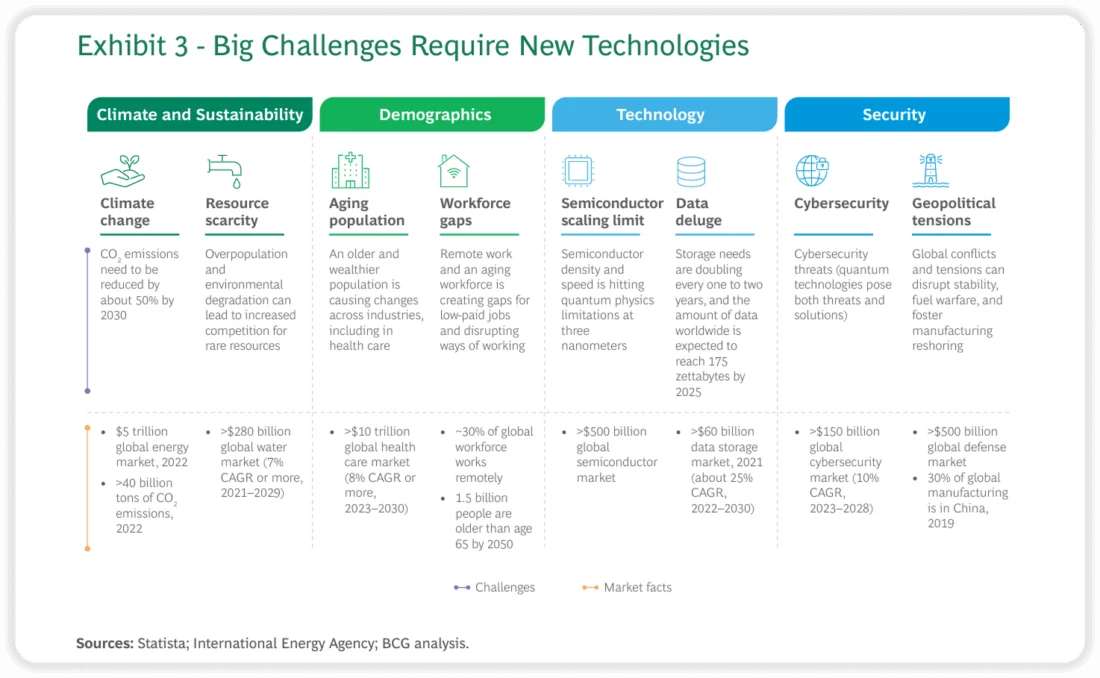
Its competitive advantage may come from proprietary technology, patents, research capabilities, specialized manufacturing processes, or years of accumulated technical knowledge. Among the most common matters that deep tech is working on are climate and sustainability, demographics, technology, and security.
This creates several important differences from conventional venture investing.
Higher upfront capital requirements
Deep tech frequently requires significant spending before a company can generate revenue.
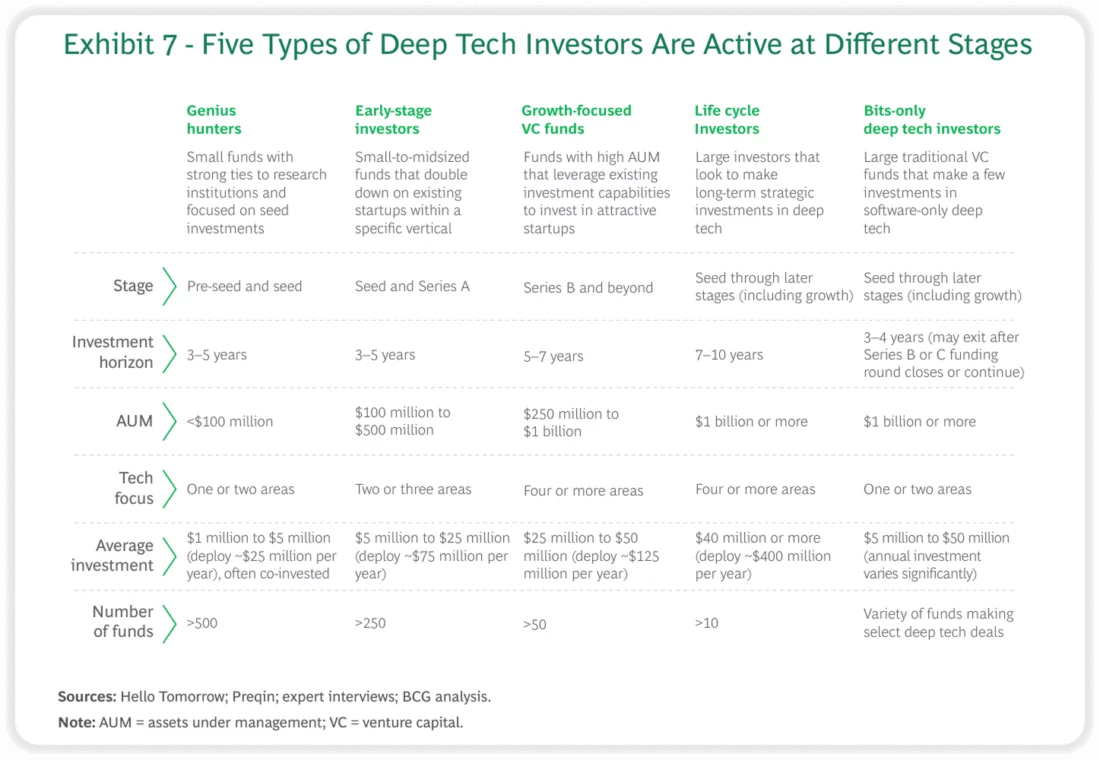
A software startup may primarily need developers, cloud infrastructure, sales staff, and marketing. A hardware or scientific startup may also need laboratories, specialized equipment, materials, testing facilities, prototypes, manufacturing partners, regulatory work, and highly specialized employees.
The capital requirement can therefore increase well before the company reaches commercial scale. As imec notes3, developing new hardware can be orders of magnitude more expensive than developing a software application.
This does not mean deep tech is a worse investment. It means the investment model has to account for a longer period before the business becomes commercially mature.
Longer development and commercialization cycles
A deep tech company may spend several years moving through stages such as:
Research → proof of concept → prototype → validation → pilot production → certification → commercialization → scale
Each stage can require a new injection of capital.
For investors, this means that a promising company may not have conventional signs of traction during its earliest years. Revenue may be minimal or nonexistent while the underlying technology is progressing rapidly.
The appropriate milestones are therefore often technical as well as commercial. Reaching a performance target, completing a prototype, securing a patent, passing a regulatory milestone, or obtaining a pilot agreement can be just as important as revenue growth.
Technical due diligence matters
This is perhaps the clearest difference between deep tech and ordinary startup investing.
An investor cannot always evaluate a company simply by looking at its product, customer growth, and financial projections. The technology itself needs to be examined.
Due diligence may involve:
- Reviewing patents and intellectual property ownership
- Assessing the scientific basis of the technology
- Testing whether technical claims are credible
- Evaluating prototypes and performance data
- Examining manufacturing requirements
- Assessing regulatory barriers
- Reviewing the experience of the scientific and engineering team
- Identifying competing technologies
- Estimating the capital required to reach the next technical milestone
This is why deep tech investors often have scientific, engineering, medical, or industry expertise alongside traditional venture capital experience.
A specialized investor audience
Not every venture investor is comfortable funding a company that may remain pre-revenue for years.
Deep tech companies therefore tend to seek investors who understand technical risk and can tolerate longer development cycles. The investor pool can include specialized venture capital funds, corporate investors, family offices, university investment organizations, government-backed funds, specialist angels, and syndicates.
For example, Alumni Ventures’ Deep Tech Fund4 combines a diversified venture fund with deal-by-deal syndications and focuses on areas including AI, biotech, space, fusion, advanced manufacturing, and industrial technology.
Dedicated funds can also bring more than money. Their networks may provide access to technical experts, later-stage investors, industrial partners, and potential customers.
How companies find early deep tech capital
There are several models to fund scientific discovery.
Specialized venture capital funds
Deep tech VC funds are often the most obvious source of institutional capital. They can invest at pre-seed, seed, or later stages and provide follow-on financing as the company progresses.
A specialized fund can also understand the difference between technical failure and normal development risk. Instead of expecting immediate revenue, its investment thesis may be based on technological milestones, intellectual property, market potential, and the team’s ability to reach commercialization.
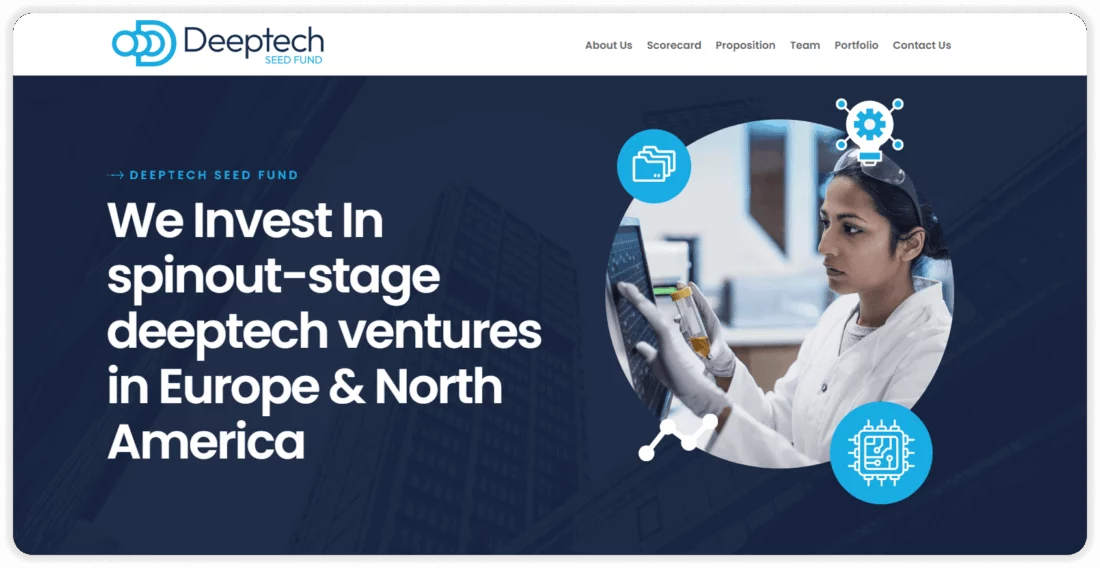
Deeptech Seed Fund5, for example, focuses on companies that commercialize defensible intellectual property that already have connections with potential customers. Its stated goal is to bridge the gap between research and market readiness and connect early companies with later-stage investors.
Investment syndicates
Syndicates allow several investors to participate in a deal rather than relying on one investor to provide all the capital.
Alumni Ventures4 is one such syndicate. It uses both funds and syndicates, giving investors the option of diversified exposure or participation in individual deals.
Accelerators and specialized programs
Deep tech accelerators can help companies become investable before they are ready for a conventional VC round.
They may provide funding, laboratory access, technical guidance, business development support, introductions to investors, and help with commercialization.
Activate6 is a strong example. Its two-year fellowship is designed to help scientists and engineers turn research into hard-tech companies, providing funding, technical resources, and access to investors, commercial partners, and scientific networks.

Creative Destruction Lab7 takes another approach. Its programs support seed-stage science and technology companies through structured objectives, experienced mentors, scientists, investors, and business-development support. Its streams cover areas such as quantum, energy, robotics, manufacturing, health, space, and compute.
University and research spinout ecosystems
Universities are another major source of deep tech companies.
Research institutions can provide the original scientific discovery, intellectual property, laboratories, researchers, and networks needed to create a startup. Technology transfer offices and university investment organizations then help turn that research into commercial ventures.
Oxford provides a useful example. Oxford University Innovation8 works with spinouts and investors, while Oxford Science Enterprises9 provides capital and support to companies based on university research. Oxford spinouts have included companies that work in autonomous vehicles, quantum computing, medical imaging, and other advanced technologies.
In 2024, Oxford University Innovation also organized a dedicated Deep Tech investor day10 that brought more than 50 investors together with university spinouts working in areas including AI, robotics, quantum computing, clean technology, and photonics.
Dedicated investment platforms
Investment platforms can make specialist opportunities easier to present, finance, and manage. Instead of relying entirely on email, spreadsheets, documents, and manual payment processes, an investment organization can create a centralized environment where investors can review opportunities, complete onboarding, commit capital, and monitor their investments.
Odin11, for example, provides infrastructure for venture firms and fund managers, covering areas such as SPVs, investor onboarding, KYC/AML, payments, compliance, reporting, and fund administration. Other platforms, including AngelList Meridian12, provide digital access to venture funds and startup SPVs, allowing accredited investors to discover and manage private-market investments through a single platform.
Building infrastructure for deep tech investment with LenderKit
For firms that organize deep tech investments, the investment process does not end when a deal is sourced. Investors need a reliable way to onboard, complete compliance checks, invest, access documents, and monitor their portfolios.
LenderKit provides the infrastructure for building this type of investor-facing investment platform. Its software supports private capital raising and investment management, including investor onboarding, deal management, investment processing, portfolio tracking, documents, and reporting.
LenderKit also supports different approaches to the investor experience. A firm can launch a branded, white-label investor portal rather than building the entire infrastructure from scratch. Alternatively, businesses that require a more tailored experience can use LenderKit’s API and custom development capabilities to integrate investment functionality into their own interface.
This distinction is important for deep tech investment firms because their value proposition is often highly specialized. The investor experience may need to reflect a particular fund strategy, investment thesis, deal structure, or target investor group.
To find out which option is most suitable for you and see how the product works, please get in touch with our team.

Article sources:
- Deep Tech Investment: High Risk, High Reward in Cutting-Edge Innovation
- PDF (https://web-assets.bcg.com/a8/e4/d3f2698b436aa0f23aed168cd2ef/bcg-an-investor...)
- Investing in deep tech: a path to superior revenue | imec
- Deep Tech Startup Investing | Syndicate & Venture Fund | Alumni Ventures - Alumni Ventures
- Deeptech Seed Fund | Early-Stage Deeptech Investments
- The Activate Fellowship
- Program - Creative Destruction Lab
- Homepage | Oxford University Innovation
- Home - Oxford Science Enterprises
- Oxford University Innovation to host leading global investors and spinouts at Deep Tech Investor Day
- Odin
- Meridian