How to Start a Private Equity Fund

No time to read? Let AI give you a quick summary of this article.


Starting a private equity fund is not just about finding good deals. It requires a clear investment strategy, the right legal structure, trusted investors, and solid operational systems.
Whether you’re starting a fund from scratch or doing it on the regular, it’s easy to underestimate the structure, regulations and technology requirements for seamless operations.
This guide explains how private equity funds work, who is involved, how capital is raised and invested, and what steps are required to launch a fund properly. It also covers the services and private equity fund software that help managers move from concept to a fully operating private equity fund.
What you will learn in this post:
What is a private equity fund
A private equity fund is a type of investment fund that pools money from qualified investors to buy businesses that are not listed on the stock market. Instead of trading shares like mutual funds or ETFs, private equity funds invest directly in companies or buy public companies and take them private.
The goal is to improve the company over several years (usually three to ten years) and then sell it for a profit. Private funds are not required to be registered or regulated as investment companies1 under the federal securities laws. A private fund cannot publicly offer its securities. This is why investors cannot easily sell their shares whenever they want. Their money is tied up until the fund exits its investments.
Private equity funds follow a specific partnership structure2 that clearly separates management responsibilities from capital ownership. In a private fund, experienced professionals make investment decisions, while investors participate in the returns without being involved in daily operations. These roles are general partners (GPs) and limited partners (LPs).
In a private equity fund, general partners (GPs)2 are the managers. They run the fund, raise capital, choose which companies to invest in, negotiate deals, and decide when to sell investments. GPs are fully responsible for the fund’s operations and performance. They earn money through a management fee and a share of the profits (carried interest), which motivates them to grow the value of the fund.
Limited partners (LPs) are the investors. They provide most of the fund’s capital but do not take part in day-to-day decisions. LPs are typically pension funds, institutions, family offices, or high-net-worth individuals.
How private funds work
Before you start a private equity fund or invest in one, you need to understand how it works. The process is well-structured and follows a clear logic.
Capital commitments and contributions
In private equity, investors do not give all their money at once. Instead, they commit to invest a specific amount. The fund then requests this money over time, only when it is needed for deals. These requests are called capital calls. This is different from many hedge funds, where investors transfer the full amount upfront so it can be invested immediately.
Investment strategy
Every private equity fund follows a defined investment strategy set out in its legal documents. Most funds focus on one or more of the following3:
- Growth equity: investing in companies that are ready to scale.
- Buyouts: buying controlling stakes in established but underperforming businesses.
- Venture capital: investing in early-stage startups.
Each strategy comes with different risks and return expectations, and affects how easy it is to raise capital and run the fund.
Fund lifecycle and returns
A private equity fund typically moves through the following main stages4:
- Fundraising and capital commitment: raising commitments from institutions, family offices, and wealthy individuals.
- Investment: using capital to acquire companies.
- Value creation: improving the businesses to increase their value.
- Exit: selling the investments through sales, IPOs, or other exits.
Investors usually receive returns only after several years, once the investments are sold and profits are distributed.
How to start a private equity fund
Starting a private equity fund begins with understanding the business model. Here, we will check the process step-by-step, and the details can be watched in the video.
1. Define the fund concept
The first step is to define what your fund will do. This includes the type of companies you want to invest in, the size of deals, the industries you focus on, and how you plan to create value. Investors need to understand why your fund exists and what makes it different from others.
2. Decide on the fund structure
Private equity funds are typically structured as limited partnerships. In this setup:
- The general partner (GP) manages the fund and makes all investment decisions.
- The limited partners (LPs) invest capital but do not manage the fund.
This structure clearly separates control from capital and limits investor liability.
3. Set fees and incentives
The fund must define how managers are paid. This usually includes:
- A management fee to cover operating costs.
- A share of profits earned after investors receive their initial capital back.
This aligns incentives so managers are rewarded only when the fund performs well.
4. Set up the fund legally
Before raising capital, the fund must be legally established. This includes forming the fund entity, establishing a management company, and preparing legal documents that explain how the fund operates, the risks investors face, and how returns are distributed. The fund typically relies on private offering exemptions and cannot raise money publicly.
6. Raise capital
Once the structure and documents are in place, the fund raises commitments from qualified investors. These investors agree to provide capital over time rather than all at once. The fund draws capital only when investments are ready to be made.
7. Start investing and operating
After the fund closes, operations begin. This includes sourcing deals, buying companies, improving their performance, and preparing for future exits. Throughout the fund’s life, managers report performance and financial results to investors.
Investment fund setup services
Starting a private equity fund often requires external support. There are specialist investment fund setup service providers that help managers handle regulatory compliance, legal entity formation, documentation, and operational readiness.
Here are examples of such services.
SCG Fund Services
SCG Fund Services5 specializes in launching funds in offshore jurisdictions such as the Bahamas, Cayman Islands, or British Virgin Islands, which can be favorable from a tax and regulatory perspective. The company supports fund formation, legal structuring, regulatory compliance, and preparation of required documentation. It also assists with selecting service providers and handling ongoing administrative needs. The service is positioned as guidance through complex regulatory and operational processes.
PPM
PPM6 offers services for creating and managing private placement memorandums and related fund documentation. The company focuses on helping fund sponsors, issuers, and managers prepare legal documents required for private investments and capital raising. Their services include drafting offering materials and ensuring compliance with applicable securities regulations.
Private equity fund administration services
Once your fund is up and running, private equity fund administration becomes important. Fund administrators can provide you with a specialized set of services focused on operational support so that you can concentrate on investment decisions rather than back-office complexity.
What fund administrators do
Independent administrators handle tasks such as:
- Fund accounting and NAV calculation
- Investor reporting and distribution schedules
- Compliance monitoring
- Capital calls and cash management
- Tax coordination and audit support
For example, firms like Ocorian7 offer comprehensive back-office fund services including accounting, investor communications, compliance, and reporting across jurisdictions.
Other providers, such as Sterling Trust & Fiduciary8, deliver tailored administrative platforms that support private equity lifecycle needs: from investor onboarding to financial statements and governance services.
This function is distinct from fund setup and can be outsourced or brought in-house depending on your scale and expertise.
Private equity fund software
Technology is very important in modern fund management.
A strong private equity fund software suite simplifies daily operations, improves reporting accuracy, and automates routine tasks.
Here are some examples of software used by private equity managers.
FIS Private Capital Suite
FIS Private Capital Suite9 is a comprehensive private equity fund management software that automates accounting, reporting, and investor management for complex funds. It replaces manual spreadsheets with real-time dashboards, connected data, and automated workflows, reducing errors and improving operational efficiency.
The platform has been reengineered into a cloud-native SaaS solution that supports the full private equity lifecycle, from investor onboarding and analytics to fund accounting and regulatory compliance.
Allocations

Allocations10 is a modern fund administration and SPV platform designed to make launching and managing investment vehicles much faster and easier.
It provides end-to-end tools for fund formation, investor onboarding, automated capital calls, distributions, compliance workflows, and real-time reporting: all in a unified system that reduces manual admin work.
Clients benefit from integrated dashboards and workflows that support multiple vehicles (funds and SPVs) without struggling with spreadsheets or disconnected tools.
Pricing is transparent with flat, one-time fees. For example, standard SPV setups start around $9,950 and premium or fund options around $19,500. There are no ongoing AUM charges, which makes costs predictable compared to percentage-based models.
Qapita
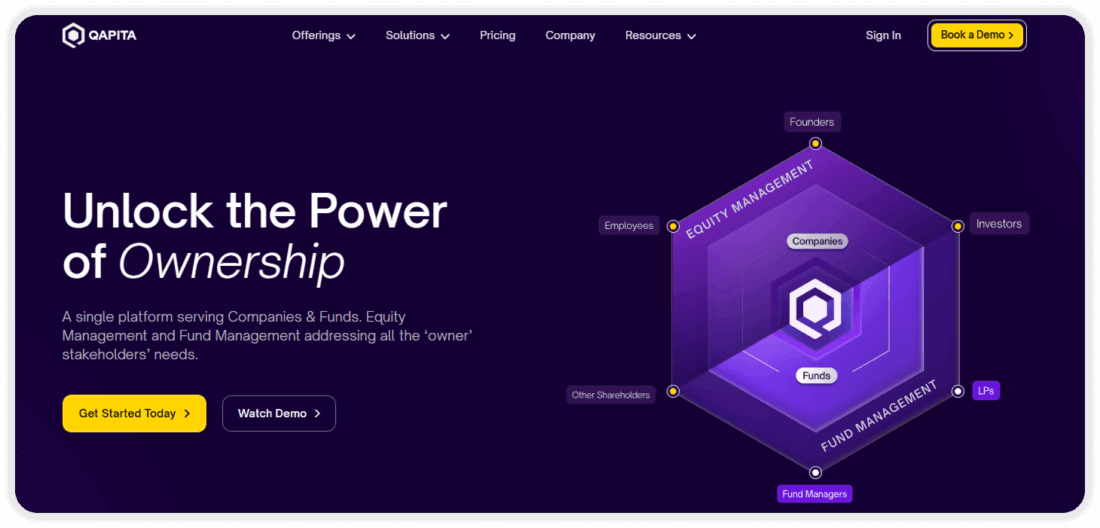
Qapita11 is a modern equity and fund management platform that helps startups and funds manage cap tables, ESOPs, capital calls, LP reporting, and fund operations in one place. The software streamlines investor onboarding, automates valuations and reconciliations, and gives both managers and investors real-time visibility into contributions and statements. This reduces manual work and spreadsheet chaos.
Pricing is flexible and tiered: there’s a free entry plan with basic features, while Surge and Growth plans ($1,600 and $3,000 per year, respectively) add more stakeholders and advanced tools, and Enterprise pricing is customized based on needs.
How LenderKit can help with the launch of a private equity fund
For private equity funds, LenderKit can be used to set up a private investment portal that supports equity offerings, investor onboarding, and capital flows.
The platform facilitates key operational processes, such as investor sign-ups, offering creation, deal management, transaction tracking and reporting. Instead of handling these tasks manually or through disconnected tools, fund managers can centralize operations and reduce administrative risk.
LenderKit also includes a back-office dashboard that allows managers to monitor investor activity, manage deals, track funding progress, and generate reports. Investors, in turn, get access to a dedicated portal where they can see their commitments, investments, payouts, and performance data.
This level of transparency helps strengthen trust and simplifies ongoing investor relations.
LenderKit does not replace legal setup, compliance advisors, or fund administrators. Instead, it complements them by providing the digital layer that makes fundraising, investor management, and daily operations more efficient.
To discuss details, please get in touch with us.

Article sources:
- SEC.gov | Starting a Private Fund
- What’s the Difference Between a General Partner and a Limited Partner?
- Understanding Private Equity Fund Investment Strategies
- Understanding Private Equity: Key Concepts and Strategies – CapitalVenture Magazine | Private Equity, Venture Capital & Markets
- OFFSHORE HEDGE FUND FORMATION & SETTING UP FUNDS | SCG FUND SERVICES
- PPM.net | Private Placement Memorandum PPM
- Administration Solutions that Unlock New Value | Ocorian
- Sterling Trust and Fiduciary Ltd. – Trusted by global clients since 2006
- Private Capital Suite | Private Equity Accounting Software
- Allocations | Launch SPVs & Funds 10x Faster
- Qapita: #1 Rated Equity Management Software | CapTable, Stock Options & Valuations