Crowdfunding in Morocco: What You Need to Know


No time to read? Let AI give you a quick summary of this article.


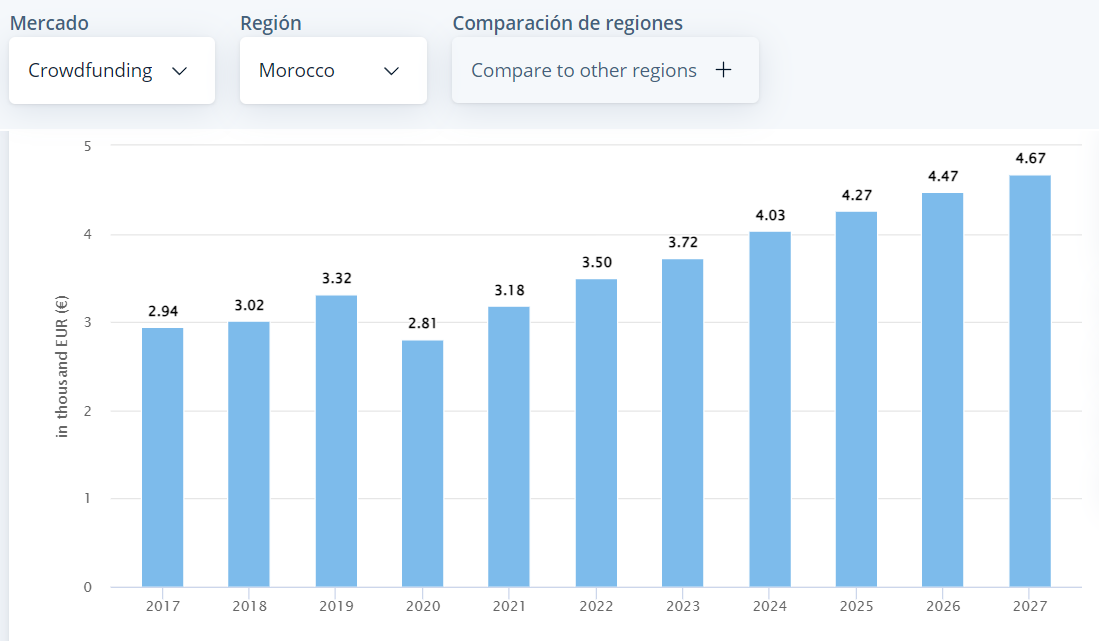
Morocco’s crowdfunding market is small but active. According to Happy Smala’s 2025 crowdfunding barometer1, presented on 10 September 2026 at the Moroccan Impact Finance Forum in Casablanca, 707 campaigns raised about 6.32 million MAD from nearly 11,000 contributors in 2025.
Don’t treat the previous edition as the baseline. It recorded more than 130 million MAD raised between September 2023 and December 20242. Most of that came from solidarity giving after the Al Haouz earthquake, which was a one-off surge. No reliable public forecast for the coming years is available. Still, the campaign count passing the 700 mark in 20251 points to a widening base of projects. For anyone planning a platform, the takeaway is that today’s market is made up of many small, mostly donation-led campaigns. Investment crowdfunding is still at an early stage.
What you will learn in this post:
The history of crowdfunding in Morocco
Morocco’s first crowdfunding platform was smala & co3, a donation-with-reward platform for high-impact projects. The team behind Happy Smala4 launched it in 2014. Happy Smala itself, founded in Rabat the same year, is a consultancy and innovation lab for alternative finance rather than a platform. It went on to launch Wuluj in 2017 and remains active in 2026. It publishes the annual crowdfunding barometer and organised the 2nd Moroccan Impact Finance Forum5 in September 2026.
Platforms like smala & co let companies and project leaders raise funds for citizen engagement, education, financial inclusion and other innovative initiatives. Crowdfunding platforms in Morocco not only provide a space to raise funds but also offer mentoring and coaching to entrepreneurs and project leaders.
Crowdfunding platforms in Morocco
Morocco’s platforms fall into two groups: services launched before regulation, and companies licensed under the current framework.
Licensed platforms. Kiwi Collecte became the first licensed platform in March 2024, when it received a donation (“Don”) licence from Bank Al-Maghrib. In April 2025 it partnered with Attijariwafa bank6. By mid-2024, the BAM governor reported that three licences had been granted7. On the investment side, the AMMC had not yet licensed any investment-category platform as of late 20248. Under Law 15-18, BAM and the AMMC must each publish the list of licensed platforms on their websites. Check both lists for the latest approvals before choosing a partner or benchmarking a competitor.
Pre-regulation platforms. These services opened before the licensing regime existed. We could not confirm their current status or whether they hold a licence, so treat them as part of the market’s history unless they appear on a regulator’s list:
- Cotizi9 (2015) – a platform for collecting donations and launching petitions.
- Wuluj10 (2017) – a donation-based platform launched by Happy Smala.
- Flowingo (2019) – the first investment-based crowdfunding platform, focused on connecting entrepreneurs and investors. The platform is inactive now.
- Dealkhir11 (2020) – a donation-based platform.
For most of its first decade, Moroccan crowdfunding had no dedicated rules. Parliament adopted Law 15-18 on collaborative financing in 2021. Decree 2-21-158 followed on 31 May 2022 and was published in the Bulletin Officiel on 3 November 2022. The framework took effect on 31 August 202312, when the implementing circulars of BAM (Bank Al-Maghrib13) and the AMMC (Autorité Marocaine du Marché des Capitaux14), including AMMC Circular 01/23, appeared in the Bulletin Officiel. The AMMC opened its crowdfunding portal on 21 September 2023.
Crowdfunding regulations in Morocco
The framework is no longer new. It has been in force since 31 August 2023, and licensing has followed. Médias24 sums up the sequence15 as a law in 2021, circulars in 2023 and the first licences in 2024. In 2024 the AMMC also moved licence applications for investment platforms onto a digital system and published a guide on how to apply, according to its 2024 annual report16. For founders, this means the process is documented and has been tested on real applications.
Types of crowdfunding in Morocco
So, based on the crowdfunding regulation17, all platforms that want to offer crowdfunding services in Morocco shall obtain authorization from the authorities. Businesses or individuals who conduct crowdfunding activities without permission are liable to criminal sanctions.
Crowdfunding financing is divided into three types:
- Donation or gift
- Lending-based, with or without interest
- Investment-based
Each form has its own specifics, so each requires its own licence. Which authority issues it depends on the category. BAM licenses and supervises lending and donation platforms, while the AMMC licenses and supervises investment platforms12. Applications go to the relevant authority together with the documents listed in its circular.
Platform authorization requirements
The licensed entity is a Société de Financement Collaboratif (SFC), which operates the crowdfunding platform. It must be a public limited company (SA) or limited liability company (SARL) headquartered in Morocco, with running crowdfunding platforms as its main business. Its minimum capital is 300,000 MAD, fully paid up at incorporation. To obtain a licence, business owners need to provide the following documentation:
- Comprehensive information about the company founder, and the company documentation.
- Documentation with detailed information about the company’s capital and its distribution among shareholders.
- Strategic objectives of the company and market research to demonstrate the viability of the company.
- A business plan for five years with pricing policy, growth strategies, and a clear roadmap.
- Anti-money laundering and counter-terrorism financing measures systems.
- Data protection measures aligned with regulatory requirements.
- Policies for selection and monitoring of projects.
The SFC must also sign a service contract with a credit institution that acts as account keeper (“établissement de crédit teneur de comptes”) and holds the project funds, as required by Article 35 of Law 15-1818. The SFC must also ensure that the institution complies with professional confidentiality requirements.
Finally, the platform must have at hand all documentation with clear rules about when the funds shall be returned to the contributors and the forms of doing so. A Moroccan crowdfunding platform must define the financial rights and obligations of the parties and lay out the principles of resolving disputes.
Projects and investors that can participate in crowdfunding
Projects of all types can raise funds in crowdfunding, including:
- Educational
- Social
- Cultural
- Environmental
- Technological
Decree 2-21-158 excludes only two kinds of activity: real estate development and any activity of a political or religious nature. Certain entities are also barred from raising funds. The law excludes companies making public offerings and companies in receivership or liquidation. The decree adds political parties, credit institutions and similar bodies, insurance companies, and companies whose capital is not fully paid up, according to the AMMC’s guide to the framework19.
Investors and fundraisers can be from Morocco or any other country, and investments can be made in Moroccan dirhams or any other currency that will be converted to the national currency. While investors and fundraisers don’t have to request a visa or other permissions from the local regulators, they have to pass a due diligence process conducted by the platform based on the regulator’s requirements.
Any individual or legal entity can contribute12 to a project through a licensed platform, and Law 15-1820 covers both resident and non-resident contributors. There is no general experience or wealth test. Instead, individuals are subject to the per-project and annual caps below.
Maximum amounts for fundraising and investing in Morocco
The regulation imposes limitations12 on how much a project can raise. A donation-based project can raise a maximum of 450,000 dirhams. Lending-based projects can raise up to 3,000,000 dirhams, and investment-based projects up to 5,000,000 dirhams. On top of these, the law caps any single project at 10 million dirhams per year and 20 million dirhams overall. All limits are set in dirhams, so if you plan in euros, convert at the current exchange rate.
According to the AMMC’s framework guide19, the maximum an individual can contribute per project is:
- Donating – 250,000 dirhams
- Lending – 300,000 dirhams
- Investing – 500,000 dirhams
Across all crowdfunding operations combined, an individual can contribute no more than 1,000,000 dirhams per calendar year.
Angel investors are exempt from these caps21, but the status has strict conditions. The investor must be an individual with relevant financial or investment expertise, experience or professional skill, and enough financial means to contribute. They must also belong to an angel investor network registered with the Ministry of Finance. Platforms should verify this membership rather than accept self-declared angel status.
Start a crowdfunding platform in Morocco
If you want to launch a crowdfunding platform in Morocco, you need to choose between white-label crowdfunding software and custom development. Building a crowdfunding platform from scratch is a time-consuming process, requires strict budgeting and commitment. However, you could start with a ready-made crowdfunding software to save time and money while testing the market and building your online presence.
LenderKit offers 3 packages for businesses, so you can really pick the one that fits you best.
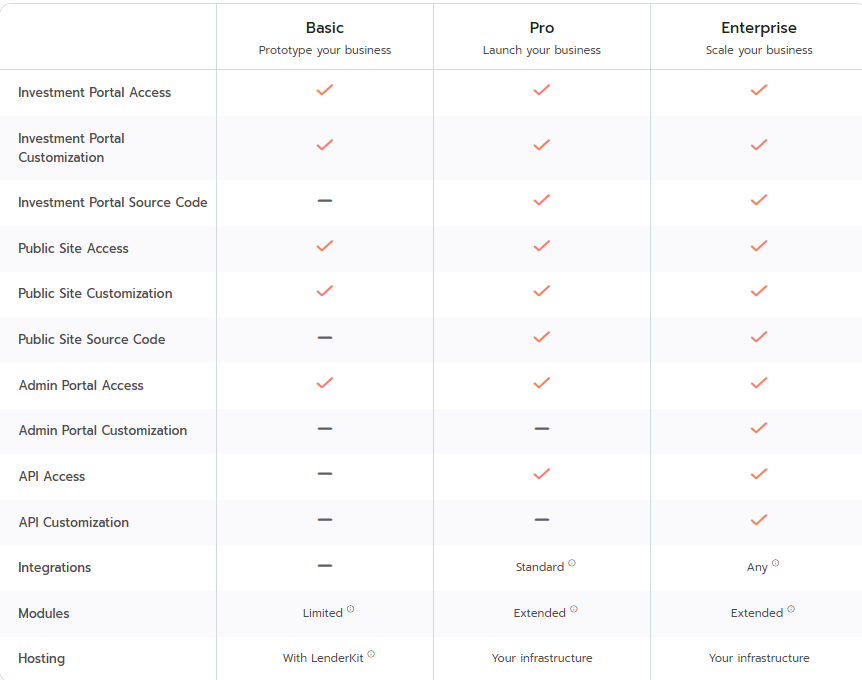
If you want to learn more about LenderKit white-label investment software and launch your online investment business in Morocco, don’t hesitate to reach out to us and book an online demo.
Article sources:
- Crowdfunding : plus de 700 projets en 2025, un cap atteint
- Bond du crowdfunding au Maroc après le séisme d’Al Haouz
- PLATEFORMES - HAPPY SMALA | Concevons ensemble un impact inclusif et durable
- HAPPY SMALA | Concevons ensemble un impact inclusif et durable!
- Crowdfunding: la 2e édition du Moroccan Impact Finance Forum s'ouvre à Casablanca
- Crowdfunding au Maroc: Attijariwafa bank s’allie à Kiwi Collecte
- Crowdfunding: trois pas en avant — Finances News Hebdo
- Crowdfunding : Entre promesses de succès et défis de taille
- Cotizi - Crowdfunding social et pétitions en ligne au Maroc
- Cycle
- Dealkhir
- FAQ | AMMC
- The request could not be satisfied
- Moroccan Capital Market Authority | AMMC
- Just a moment...
- PDF (https://www.ammc.ma/sites/default/files/RAPPORT%20ANNUEL%202024.pdf)
- Financement Collaboratif - Crowdfunding | AMMC
- PDF (https://www.ammc.ma/sites/default/files/Recueil_AMMC_VFR_Financement%20Collab...)
- PDF (https://www.ammc.ma/sites/default/files/Guide%20sur%20le%20cadre%20r%C3%A9gis...)
- PDF (https://www.ammc.ma/sites/default/files/LOI%20N%C2%B015-18.pdf)
- Q 13. Le Crowdfunding est-t-il assorti de limites ? | AMMC