Grimwild RPG Crowdfunding Issues: What Board Game Creators and Platform Owners Can Learn


No time to read? Let AI give you a quick summary of this article.


A crowdfunding campaign can succeed on every visible metric from strong funding, active community to a completed game, and still fail to deliver to backers.
The Grimwild RPG situation illustrates exactly how this happens.
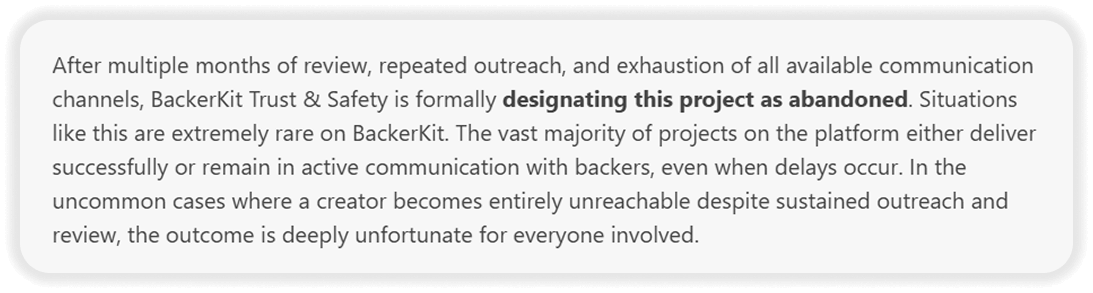
The project raised funding through BackerKit1, digital materials reached players, and community engagement remained active. Yet BackerKit eventually marked it “abandoned” after being unable to reach the creator through multiple channels. And to top it off — no refunds were issued.
This story sparked a discussion across RPG communities not simply because a campaign struggled, but because it exposed several deeper questions that affect the broader ecosystem of crowdfunding for tabletop games.
The Grimwild use case prompts fundraisers, brackets and platforms to keep an eye for potential structural risks that exist across modern crowdfunding — be it tabletop games or pretty much any other niche2.
It raises questions around accountability, communication, creator dependency, and platform trust which become far more relevant beyond a single project.

What you will learn in this post:
How Grimwild RPG went from well regarded to abandoned
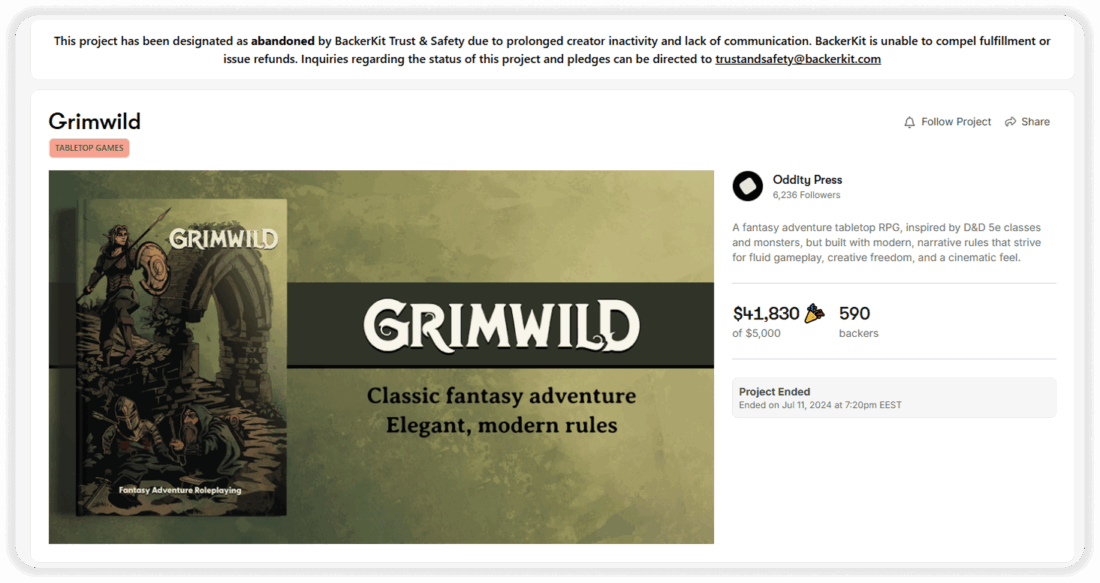
Grimwild4 itself was well received. The fantasy tabletop RPG gained attention for its cinematic approach and narrative-focused design. The project raised funding through BackerKit campaigns and developed an active community around the game. Backers initially got their digital materials, people were talking about the project, and it appeared to be progressing successfully.
Then communication stopped.
Following extended periods without updates, BackerKit later designated the project as abandoned after reporting unsuccessful attempts to reach the creator through multiple channels.
Community reactions varied. Some backers expressed frustration over fulfillment uncertainty and the absence of refunds. Others reacted with concern, suggesting the situation appeared more complicated than a straightforward case of project abandonment.
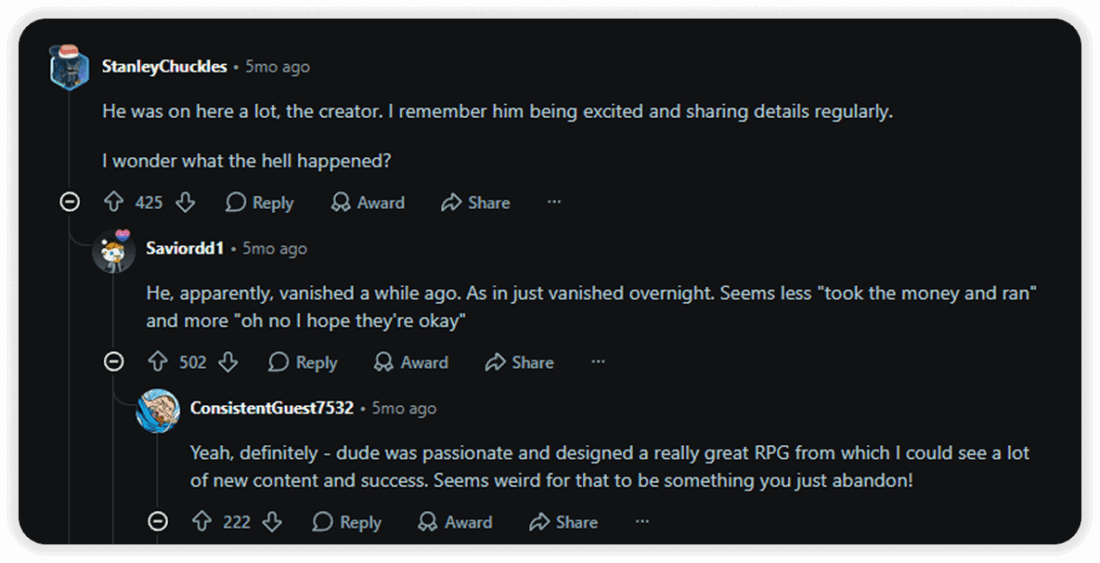
What made the Grimwild case particularly notable was that substantial progress reportedly existed, but reports suggested that certain operational approvals remained tied to a single individual, creating a bottleneck that collaborators could not resolve.
So, the issue was not simply whether a game existed, it was whether the operational systems around the game could survive disruption.
And that lesson extends well beyond RPGs.
Similar cases show recurring crowdfunding patterns.
Grimwild is not the first project to expose structural weaknesses.
Several well-known campaigns across Kickstarter and other platforms revealed recurring patterns affecting tabletop Kickstarter risks.
One early example was The Doom That Came to Atlantic City6.
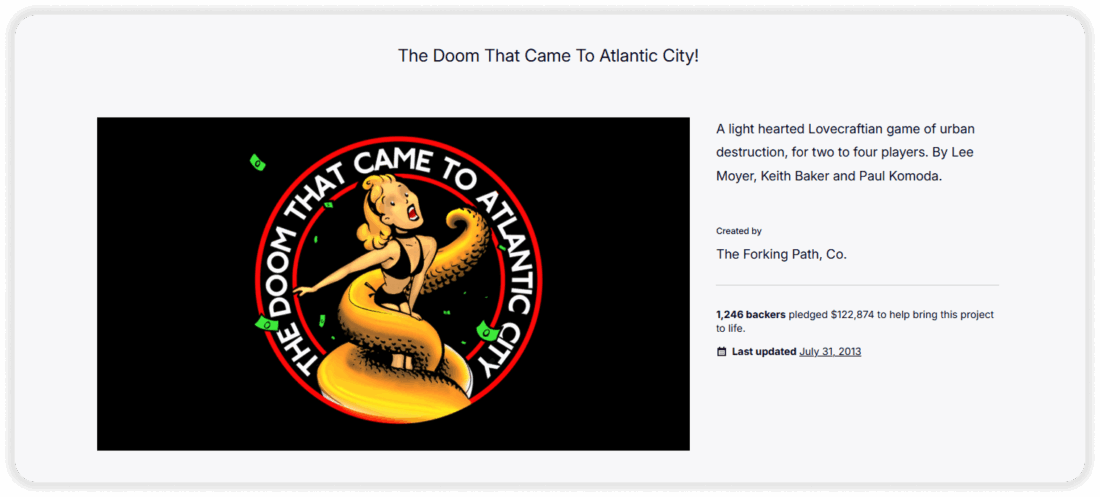
Despite strong support and recognizable industry figures, management problems and operational challenges eventually disrupted the campaign before another publisher stepped in.
Another example came from Kingdom Death: Monster 1.57.
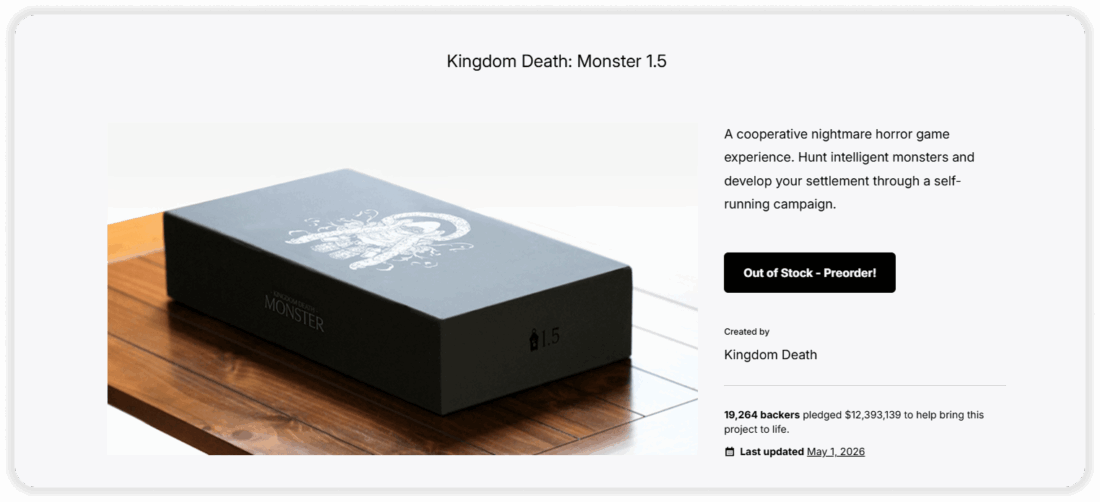
The campaign generated enormous enthusiasm and exceptional funding success. However, expanded scope, stretch goals, and additional content significantly increased production complexity. Fulfillment timelines stretched across years.
Neither example involved malicious intent.
Both demonstrated a recurring reality: campaign success itself can create unexpected operational pressure.
Why crowdfunding for RGP projects and tabletop games is uniquely risky
Many campaigns create the impression that funding represents the hardest stage. In reality, funding frequently marks the beginning of a more complicated process.
Creative products and physical products operate differently. Designers may complete artwork, rules, writing, and playtesting. Yet crowdfunding for tabletop games introduces another challenge entirely: infrastructure.
Campaign fulfillment requires coordination across many moving parts:
- printers
- packaging suppliers
- freight companies
- warehouses
- customs procedures
- regional fulfillment centers
- digital asset management systems
- customer service channels.
Backers often focus on the finished game. Creators increasingly discover that logistics become the real challenge.
A finished game doesn’t guarantee a finished campaign
This may be one of crowdfunding’s least understood realities. A completed game is not necessarily a completed project.
Operational risks
Grimwild illustrates this distinction particularly well because the underlying game itself reportedly existed. Players had digital access. Community engagement continued. Interest remained strong. Yet production and delivery systems remained vulnerable.
In tabletop crowdfunding, several questions often matter as much as game design:
- Who controls printer approvals?
- Who has access to manufacturing accounts?
- Who owns fulfillment data?
- Who can issue updates?
- Who can coordinate with platforms?
- Who can authorize changes if something happens?
These operational questions rarely appear in campaign trailers. But they determine whether projects remain resilient during disruptions.
For creators, reducing operational risk may involve shared account access, documented workflows, backup administrators, and written contingency plans.
For backers, warning signs can include vague fulfillment explanations, unclear responsibilities, or projects heavily dependent on a single individual.
For platforms, prolonged communication gaps and projects lacking visible operational structure may justify stronger monitoring systems or escalation processes.
One-person operation risk
Another challenge is the one-person operation model. Many indie RPG crowdfunding campaigns are essentially run by a single person. One creator may manage writing, project coordination, finances, communication with manufacturers, marketing, social media, and fulfillment.
That setup can work well, but problems arise when unexpected situations happen: illness, personal emergencies, burnout, major life changes, or simple fatigue. When everything depends on one person, the entire project becomes vulnerable.
This issue goes beyond RPGs and appears across Kickstarter board games and the wider tabletop industry.
Larger studios often reduce this exposure through shared access, documentation, and distributed responsibilities. Smaller creators may not have the same resources, but they can still involve collaborators, assign secondary administrators, and document workflows.
Backers may also evaluate team structure before pledging. A visible support team, collaborators, or fulfillment partners can reduce concentration risk.
Platform operators increasingly face broader questions as well: should larger projects identify backup contacts or establish minimum operational requirements?
Financial risks
Funding goals rarely represent the total cost of a campaign. Many creators calculate manufacturing expenses but underestimate everything surrounding production.
Common overlooked costs include:
- freight increases
- customs fees
- warehouse expenses
- taxes
- replacement products
- packaging changes
- platform fees
- currency fluctuations.
Miniatures, collector editions, upgraded components, exclusives, and regional rewards may create additional expenses.
Creators can reduce risk through contingency reserves, conservative budgeting, multiple shipping scenarios, and controlled stretch-goal expansion.
Backers can look for realistic timelines, manufacturing transparency, and evidence of logistics preparation before funding projects.
Platforms may increasingly benefit from stronger milestone tracking or systems that identify unusually high operational risk before fulfillment problems emerge.
Communication risks
Many tabletop communities understand that delays happen. Manufacturing issues, shipping problems, and unexpected expenses are common.
Silence creates bigger problems.
Backers often become more frustrated by a lack of updates than by delays themselves.
Creators can reduce communication risks through simple systems:
- monthly project updates
- centralized communication channels
- clear explanations of delays
- FAQ pages
- backup team contacts
For Kickstarter, BackerKit, and Indiegogo, communication risks increasingly raise broader trust questions. Platforms may eventually benefit from stronger safeguards such as inactivity alerts, backup contacts, milestone reporting systems, or clearer escalation procedures.
Looking for a ready-made solution or exloring a custom build?
Here's how we can help
Why infrastructure matters: The role of white label crowdfunding solutions
Many risks discussed throughout this article ultimately point to one issue: infrastructure. While creators focus on building games and backers focus on outcomes, long-term platform stability increasingly depends on systems supporting communication, accountability, reporting, and operational oversight.
If you’re looking to build a future-proof crowdfunding platform, consider white-label crowdfunding software offered by LenderKit. Having launched multiple crowdfunding platforms across the globe, you’re not just buying software, but also expertise that was accumulated over the years of operations.
The software already comes with the core features required to run a scalable crowdfunding platform, and any extra flavor can be added on demand.
To discuss details or see how the solutions work in practice, get in touch with our team.