What Is an Investment Memorandum and How to Get It Right


No time to read? Let AI give you a quick summary of this article.


When a deal falls apart in due diligence, it’s rarely because the underlying asset was weak. More often, investors walk away because the information presented to them is incomplete, inconsistent, or difficult to verify. For real estate sponsors, fund managers, and alternative investment platform operators, the quality of an investment memorandum (IM) signals operational maturity as much as deal quality.
An investment memorandum is a formal document prepared by an issuer to help prospective investors evaluate an opportunity. Depending on the transaction structure, it may also appear as a confidential investment memorandum (CIM)1, offering memorandum (OM)2, or private placement memorandum (PPM). While related, these documents serve different purposes.
An IM is also different from a pitch deck. A pitch deck creates initial interest. An investment memorandum supports due diligence and decision-making. Investors, legal teams, compliance departments, and regulators often rely on it to evaluate opportunities in detail.
This guide explains what an investment memorandum contains, where operators commonly make mistakes, and how modern investment platforms are streamlining the process.

What you will learn in this post:
What a well-structured investment memorandum includes
There is no universal regulatory template for investment memorandums, but sophisticated investors generally expect a familiar structure.
Readers looking for real-world examples can explore public investment memos of such known companies as Shopify, LinkedIn, etc3. Their examples provide useful insight into how professional investors document opportunities and structure investment thinking.
Many firms also create internal frameworks tailored to their investment process.
Still, regardless of structure, most investment memorandums consistently include the following elements4:
- executive summary
- business or asset overview
- market analysis
- financial information
- management background
- transaction structure
- risk disclosures
- supporting documentation
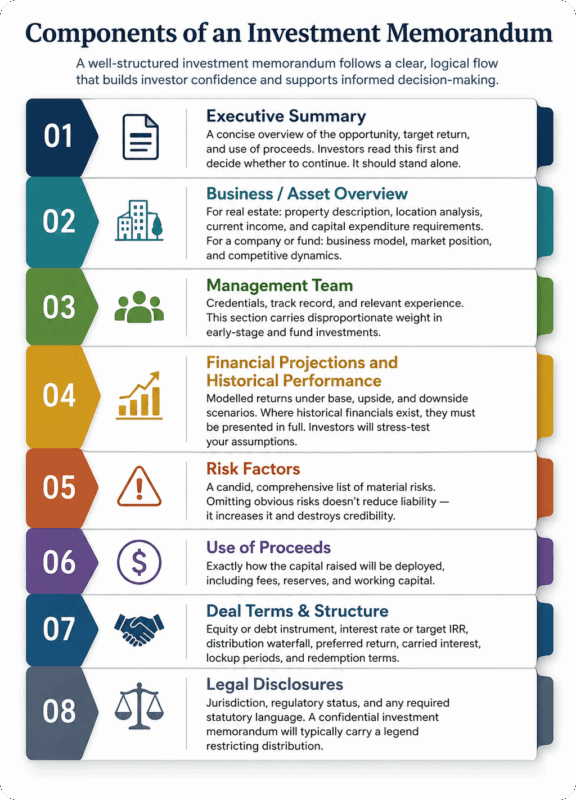
It should not be treated as a universal standard, but rather as an example of how venture investors sometimes organize decision-making. This template is useful because it treats the investment memorandum as a decision framework rather than a static presentation.
The real estate investment memorandum: How it differs
Real estate remains one of the most active categories for private investment platforms, and the real estate investment memorandum has its own conventions.
Beyond the standard sections, a real estate IM includes several property-specific components.
- Property-level financials: Rent roll, occupancy and vacancy rates, Net Operating Income (NOI), cap rate analysis, and tenant lease profiles.
- Comparable transactions (comps): Recent sales and lease transactions in the submarket help validate pricing, rental assumptions, and market positioning.
- Debt structure details: Loan terms, interest rates, amortization schedules, loan-to-value ratios (LTV), and refinancing assumptions.
- Exit strategy assumptions: The target hold period, exit cap rate assumptions, projected sale pricing, and disposition strategy.
- Third-party due diligence materials: Appraisals, environmental assessments, engineering or structural reports, and disclosure of any pending reports.
- Sensitivity and downside analysis: Sophisticated investors expect stress testing around occupancy, rent growth, interest rates, operating expenses, and exit assumptions.
A common failure point is presenting optimistic projections without stress-testing them.
The most common mistakes in an investment memorandum
Even strong opportunities lose credibility when the IM itself is poorly prepared.
Overly optimistic projections
Aggressive projections that exceed historical market performance often raise concerns immediately.
Inconsistent information across sections
Financial models, narratives, and market analysis should align logically.
Weak risk disclosure
Sophisticated investors expect transparency. Avoiding discussion of risks usually reduces trust.
Fragmented data sources
Information spread across spreadsheets, CRM systems, compliance tools, and email threads often creates version-control problems.
Unsupported claims
Market projections and assumptions should always have credible sources.
In private placements and regulated offerings, issuers remain subject to anti-fraud provisions and disclosure obligations even when registration exemptions apply. Material claims that cannot be substantiated may create both investor skepticism and potential compliance exposure.
As investment platforms scale, many of these problems become operational rather than analytical. Financial data, compliance records, market research, and investor communications are often spread across disconnected systems, increasing the risk of inconsistencies, outdated figures, and manual errors.
Agentic AI and investment memorandum creation
This is one of the areas where agentic AI tools are beginning to attract attention across the investment industry. Unlike traditional automation tools, agentic AI systems can coordinate multi-step workflows, gather information across platforms, update calculations dynamically, maintain document consistency, and support compliance and reporting processes with significantly less manual intervention.
Several tools are beginning to automate parts of this process.
Stack AI Investment Memo Generator
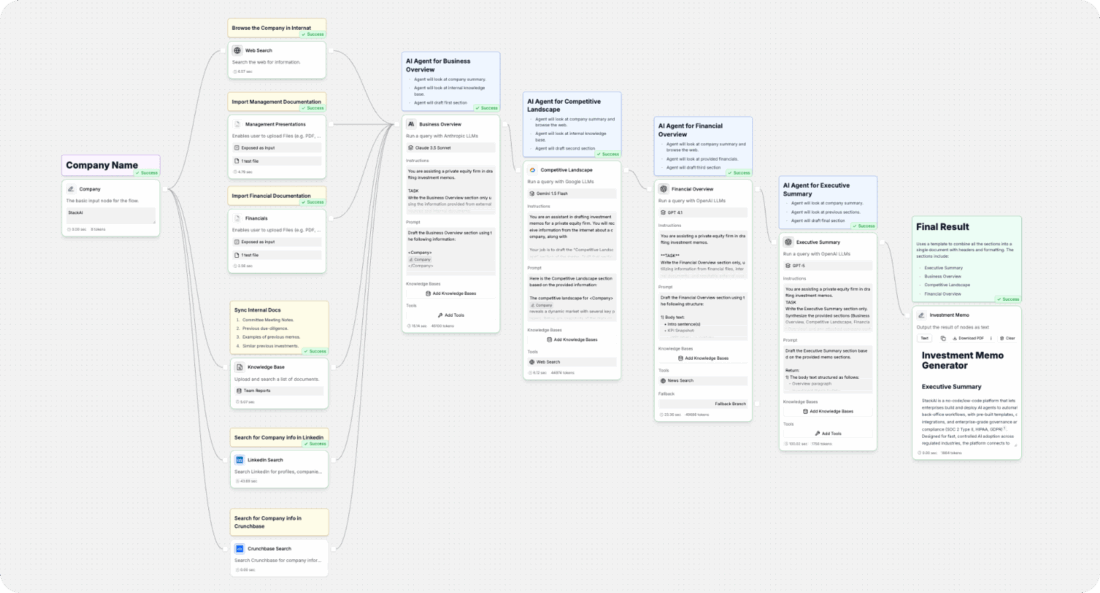
Stack AI5 automates memo drafting by combining spreadsheets, pitch decks, meeting notes, financials, and external research into structured investment memorandums.
Its main strength is workflow orchestration. Instead of functioning as a simple writing assistant, it pulls information from multiple sources and structures outputs automatically.
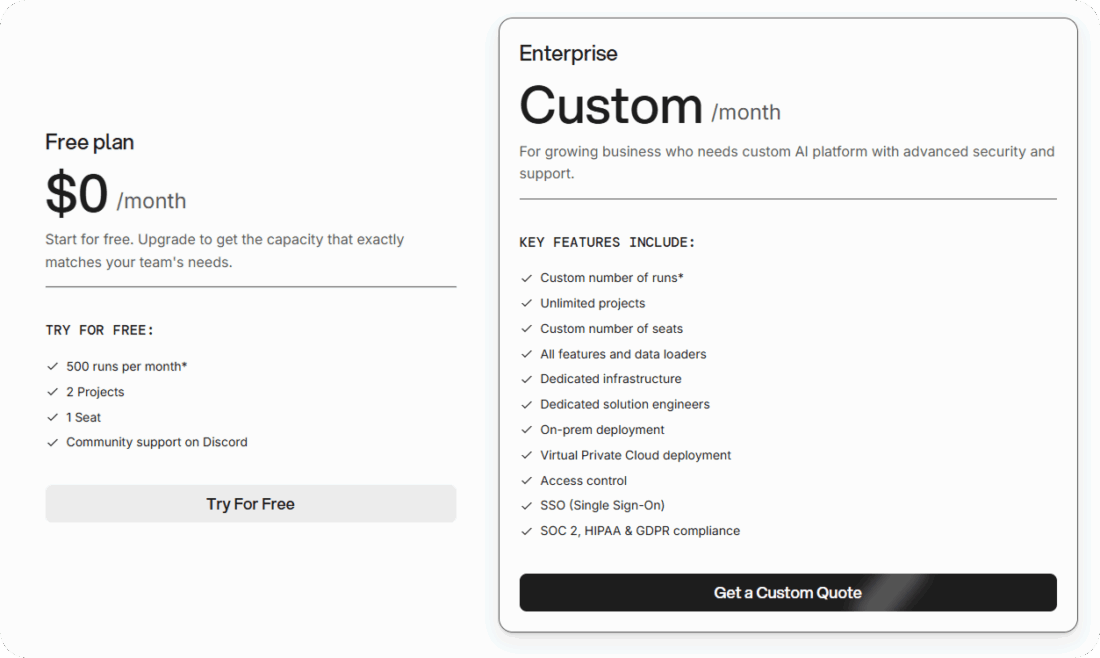
Stack AI allows teams to start with a free plan and upgrade it to get the needed capacity.
The tradeoff is that the setup may feel heavier for smaller teams.
DealMemo.ai
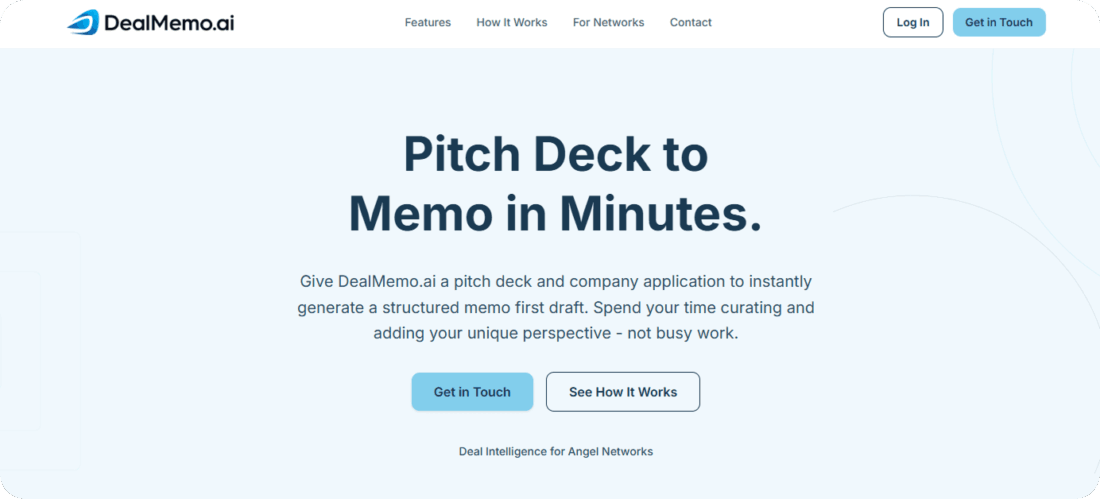
DealMemo.ai6 focuses specifically on generating investment memorandums from raw deal materials such as presentations, financial documents, and transcripts.
A practical advantage is flexibility. Teams can customize templates around their own workflows instead of relying on generic structures.
Pricing is customized based on several factors, including the number of users or network members, memo generation volume, white-label requirements, collaboration and voting features, and the level of customization or integrations needed.
The platform is especially useful for angel groups and smaller investment communities.
Energent.ai
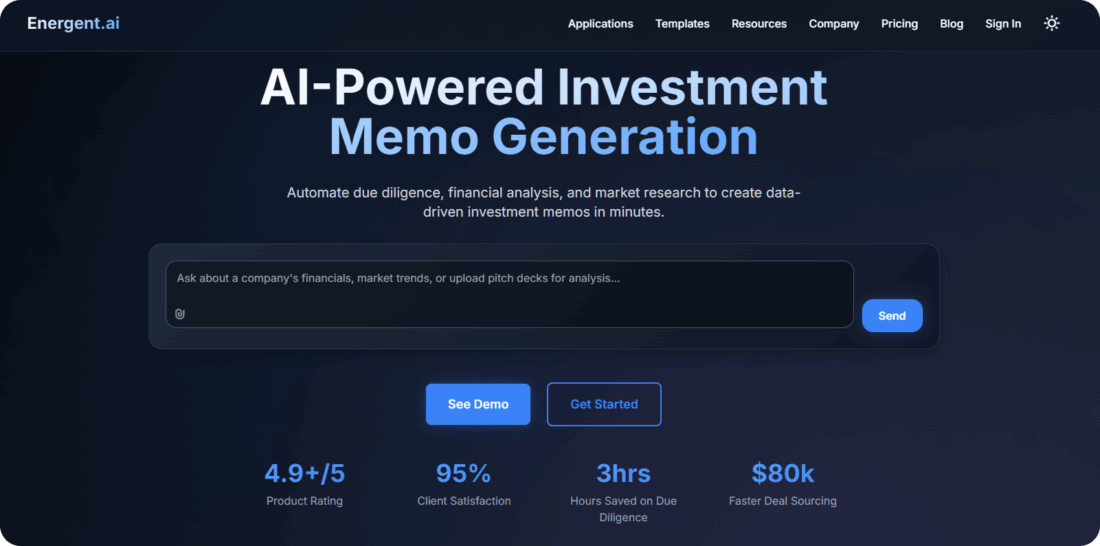
Energent.ai7 positions itself as an AI-powered platform focused on streamlining due diligence and investment memo creation.
Its core value lies in transforming large volumes of information from multiple sources into structured investment memos, helping teams reduce manual research and accelerate decision-making.
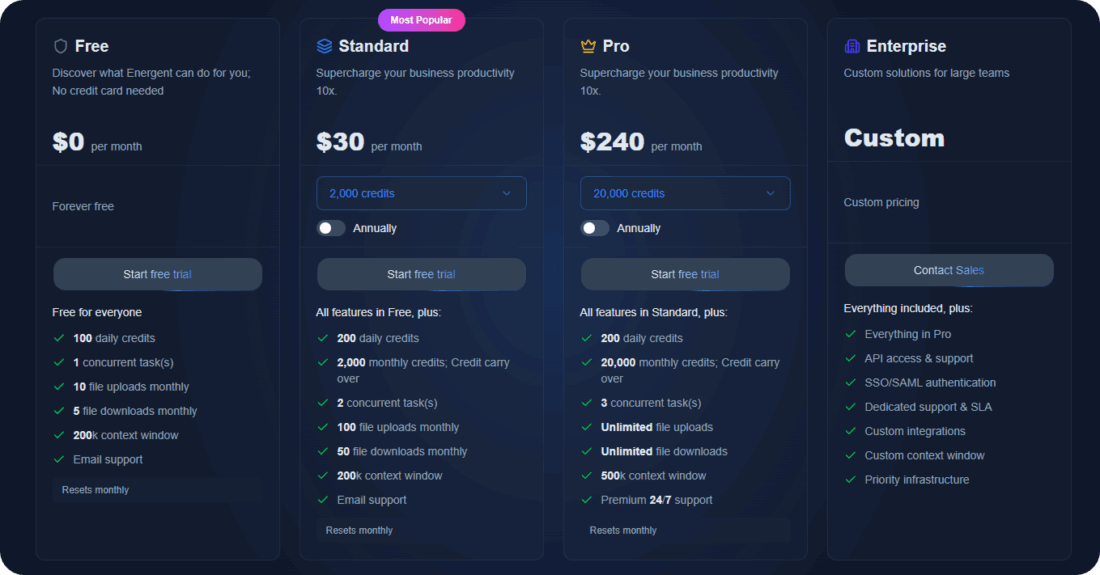
Energent.ai has public pricing with multiple tiers rather than fully custom quote-only plans. Current plans include:
- Starter: $49/month – includes 20k agent credits, 2k document-reading pages, unlimited workflows, and no-code workflow tools.
- Executive: $499/month – includes 100k agent credits, up to 10k document-page extraction, storage, customized workflows, and dedicated support.
- Enterprise: Custom pricing – includes self-hosting options, SSO, scaling features, and enterprise controls.
For investment memo and due diligence use cases, pricing seems to scale primarily with usage and workflow complexity. Key variables include document-processing volume, extraction limits, storage needs, customization requirements, and enterprise infrastructure features. Teams generating large numbers of memos from uploaded documents would likely move beyond the entry tier quickly.
Looking for a ready-made solution or exloring a custom build?
Here's how we can help
Investment memorandums in the context of an investment platform
For those operating a white-label investment platform or running a real estate crowdfunding portal, the investment memorandum is necessary, but it’s not sufficient. The document is only as good as the process that produces it.
For investment platform operators, that means:
- Defining a template that satisfies both deal-type requirements and regulatory minimums for your jurisdiction
- Linking document production to your deal management workflow so figures stay current
- Building access controls into your data room that tie to your KYC and investor classification system
- Establishing a review and sign-off process before any document reaches investors
Platforms built on white-label infrastructure, such as those powered by LenderKit, can embed document management, investor verification, and deal presentation in a single system, removing the manual integration layer that causes most IM production errors.
Looking to launch or scale a real estate or private investment platform? LenderKit provides white-label infrastructure for managing deals, investors, and compliance in one system. Explore LenderKit’s investment platform software or browse the white paper library for deeper research on crowdfunding regulation and market structure.
Article sources:
- What is a confidential information memorandum (CIM)?
- Offering Memorandum: A Guide for CRE Investors | Lev
- Memos - Bessemer Venture Partners
- PDF (https://longterminvesting.stanford.edu/sites/g/files/sbiybj23856/files/media/...)
- How to build an Investment Memo Generator
- DealMemo.ai — AI-Powered Investment Memos for Angel Networks
- AI Data Analysis Tool | Energent.ai