Agentic Crowdfunding Architecture: A Guide to MCP Implementation, Security, and Strategic Readiness


No time to read? Let AI give you a quick summary of this article.


AI is beginning to change how financial software is used. For crowdfunding platforms, this raises a practical infrastructure question: is the existing technology stack ready to support AI-driven workflows?
The answer depends less on adopting AI as a standalone feature and more on the architecture underneath the platform. APIs, permissions, authentication, logging, and clearly defined business functions all become important when AI applications need to interact with platform data and tools.
The Model Context Protocol (MCP) is one emerging approach to this problem. This article looks at what MCP means for crowdfunding infrastructure, how it can be added to existing APIs, what security controls are needed, and how providers can approach implementation without opening their entire platforms to AI.
What you will learn in this post:
What is MCP?
The Model Context Protocol is a standard for connecting AI applications to external data and tools. It works as a bridge between an AI assistant and business software.
For example, a crowdfunding administrator wants to know which campaigns received the most investment this month. Without an AI connection, they need to open the platform, filter campaigns, review statistics, export data, and analyze the results.
With an MCP connection, they could ask an AI assistant about this.
The AI can retrieve the relevant information from the connected platform and present the result in an easy-to-understand format.
MCP does not give the AI direct access to the platform’s database. Instead, it provides controlled access to selected tools and information.
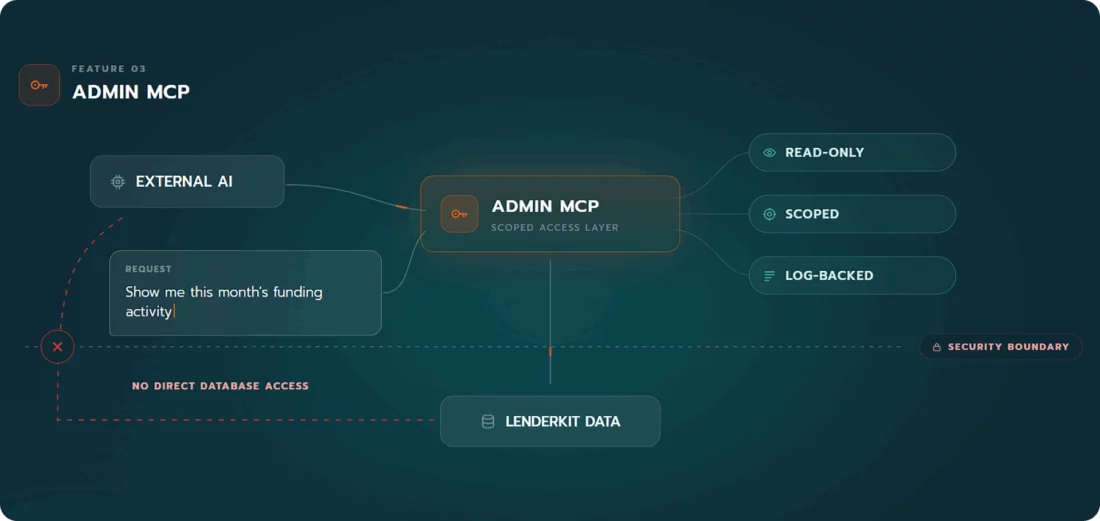
This distinction is important for financial platforms.
MCP builds on existing APIs
MCP does not require a crowdfunding provider to rebuild its platform for AI.
A typical architecture can look like this:
Crowdfunding platform → REST API → MCP server → AI assistant
The existing platform remains. Its API continues to handle requests, while the MCP server provides an additional interface for AI applications.
For example, a crowdfunding platform may already have API endpoints for:
- Campaigns
- Investments
- Users
- Transactions
- Analytics
- Organizations
- Reports
An MCP server can expose selected functions from these existing APIs as tools that an AI assistant can use.
This is an advantage for established providers: MCP can build on infrastructure they already have.
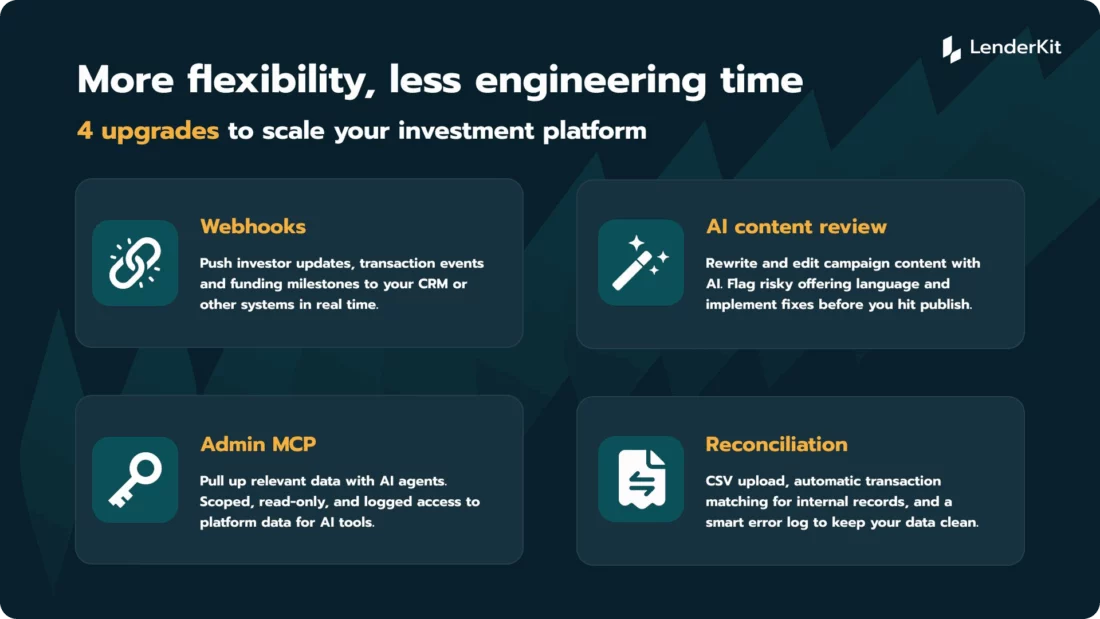
LenderKit‘s Admin MCP, for example, provides authorized AI tools with access to selected platform data, including users, organizations, transactions, investments, offerings, and analytics. Its current implementation uses individual MCP keys and provides read-only access.
Thrinacia1 has taken a similar approach, connecting its MCP implementation to its existing REST API and permission model.
From dashboards to natural language
The most visible change is how users interact with the platform.
Crowdfunding software traditionally relies on dashboards, filters, reports, and exports. MCP adds another option: natural-language interaction.
For example:
- An administrator could ask to show the campaigns with the highest investment volume in the last seven days.
- An analyst could ask to compare investment activity across current campaigns.
- A manager could ask еo summarize the main changes in campaign activity for the month.
Instead of learning where information is stored in a complex interface, the user simply describes what they need.
Potential applications include:
- Campaign performance analysis
- Investment reporting
- Investor activity summaries
- Transaction reviews
- Campaign monitoring
- Internal reports
- Data reconciliation
- Administrative tasks
This can be useful for both technical and non-technical users.
Security: control what AI can access
Connecting an AI assistant to a crowdfunding platform raises a question: what can the AI actually see and do?
MCP itself does not make an integration secure. Security depends on how the MCP server, platform API, authentication, and permissions are configured.
The safest approach is to build on the platform’s existing access controls.
For example, different users might have access to:
- Campaign information
- Analytics
- Investor information
- Financial data
- Administrative functions
The MCP connection should respect those same permissions. An AI assistant should not gain access to information simply because it is connected through MCP.
The MCP specification supports authorization mechanisms for controlling access to MCP servers and tools.
For example, LenderKit has made its MCP access read-only. For crowdfunding platforms, this is a useful starting point. Reading and analyzing data is generally easier to control than allowing an AI system to change campaign settings, modify user records, or initiate financial operations.
Not every AI action should be automatic
There is an important difference between asking an AI to find information and asking it to change something.
For example, asking about which campaigns are underperforming is a reporting request. But asking to change the campaign terms and publish the update is already an operational action with significant consequences. This is why these two requests should not have the same permissions.
For sensitive operations, platforms can introduce additional controls such as:
- User confirmation
- Higher permission levels
- Read-only access by default
- Approval workflows
- Request logging
- Limits on available tools.
This allows platforms to explore AI automation without giving an AI assistant unrestricted control.
Anthropic also recommends2 using trusted MCP servers, reviewing permissions, and considering risks such as prompt injection when connecting AI applications to external systems.
How to prepare a crowdfunding platform for MCP
A provider does not need to make its entire platform agentic at once. A practical implementation can start with a small number of clearly defined use cases.
1. Review the existing API
Start with the endpoints the platform already exposes.
Identify which functions could be useful through an AI interface. Campaign data, investments, analytics, transactions, and reporting are natural candidates.
2. Choose low-risk use cases
Begin with read-only functions.
For example, allow AI to retrieve campaign statistics or prepare reports before giving it permission to perform administrative actions.
3. Map existing permissions
Make sure MCP follows the platform’s existing authorization model.
If a user cannot access certain investor information through the platform, connecting an AI assistant should not give them access to it.
4. Build the MCP server
The MCP server becomes the controlled layer between the AI application and the existing API.
It exposes only the functions the provider has chosen to make available.
There is no need to expose the entire API simply because MCP has been implemented.
5. Add monitoring
MCP requests should be traceable.
Platform operators should know which account or integration made a request, when it happened, and which tool was used.
This is particularly important when AI can access financial or personal data.
6. Test real workflows
The objective is not simply to have an MCP endpoint. It has to solve problems.
- Can an administrator retrieve campaign data without opening several dashboards?
- Can an analyst prepare a report through natural language?
- Can the platform enforce existing permissions?
- Can sensitive actions require human approval?
These are more meaningful measures of MCP readiness than simply declaring support for the protocol.
What MCP means for crowdfunding infrastructure
Our analysis of 257 European crowdfunding platforms found only one publicly identified MCP implementation at the time of the research: Stock.estate3. Since then, LenderKit and Thrinacia have introduced MCP capabilities at the infrastructure level.

This early adoption does not mean every crowdfunding platform needs to implement MCP immediately. But it shows where the industry may be heading.
Crowdfunding platforms already depend on APIs to connect their systems with payment providers, identity verification services, reporting tools, and other software. MCP adds another potential interface – this time designed for AI applications.
For technology providers, the strategic question is whether the existing architecture is structured, permissioned, and documented well enough for AI to use it safely.
Platforms with clear APIs, granular permissions, authentication, and reliable logging are already closer to this model.
How to add MCP to your platform with LenderKit
If you want to introduce AI capabilities without rebuilding your existing investment infrastructure, LenderKit provides a good starting point. Its Admin MCP gives MCP-compatible AI tools controlled, read-only access to selected platform data, including users, organizations, transactions, investments, offerings, and platform analytics. Access is managed through individual MCP keys that can be scoped to specific entities, given an expiration date and usage limit, while requests are recorded in LenderKit’s existing inbound request logs.
This approach allows investment platforms to experiment with AI-assisted reporting, data analysis, and administrative workflows without giving AI unrestricted access to the platform database. It also fits the architecture discussed in this guide: the existing platform remains in place, while MCP provides a controlled interface for AI applications.
To discuss the best options or see how the product works, get in touch with our team.