Building an Investor Portal for Distressed Debt Funds


No time to read? Let AI give you a quick summary of this article.


Distressed debt investing is an investment strategy that focuses on buying the debt of companies facing financial difficulties1. Because these companies may be close to restructuring or bankruptcy, their debt often sells for less than its original value. Investors buy this debt at a discount and aim to make a profit if the company recovers, completes a successful restructuring, or achieves a better-than-expected legal outcome.
Today’s investors want secure access to documents, clear reporting, and transparent communication. This is where an investor portal becomes valuable.
In this guide, we’ll look at the key features a distressed debt investor portal should include and walk through the steps involved in building one.
What you will learn in this post:
Why distressed debt funds need an investor portal
Managing a distressed debt fund is more demanding2 than managing many other investment funds. Investments often stay active for years, valuations can change over time3, and fund managers regularly work with confidential documents and complex legal processes4.
Most investors in these funds are institutional investors, family offices, wealth managers, and experienced high-net-worth individuals5. They expect the same professional digital experience they receive from private equity, venture capital, and real estate funds.
A dedicated investor portal helps solve several common challenges.
Investor onboarding
Once an investor decides to participate, the portal guides them through identity verification, eligibility checks, subscription documents, electronic signatures, and compliance reviews.
Instead of managing numerous emails and paper forms, managers can complete onboarding through a structured digital workflow.
Due diligence and fundraising
Before investing, most limited partners carry out detailed due diligence. They need access to fund presentations, offering documents, legal agreements, performance data, and answers to their questions. Here is just an example of a due diligence form’s small part that fund managers fill in.
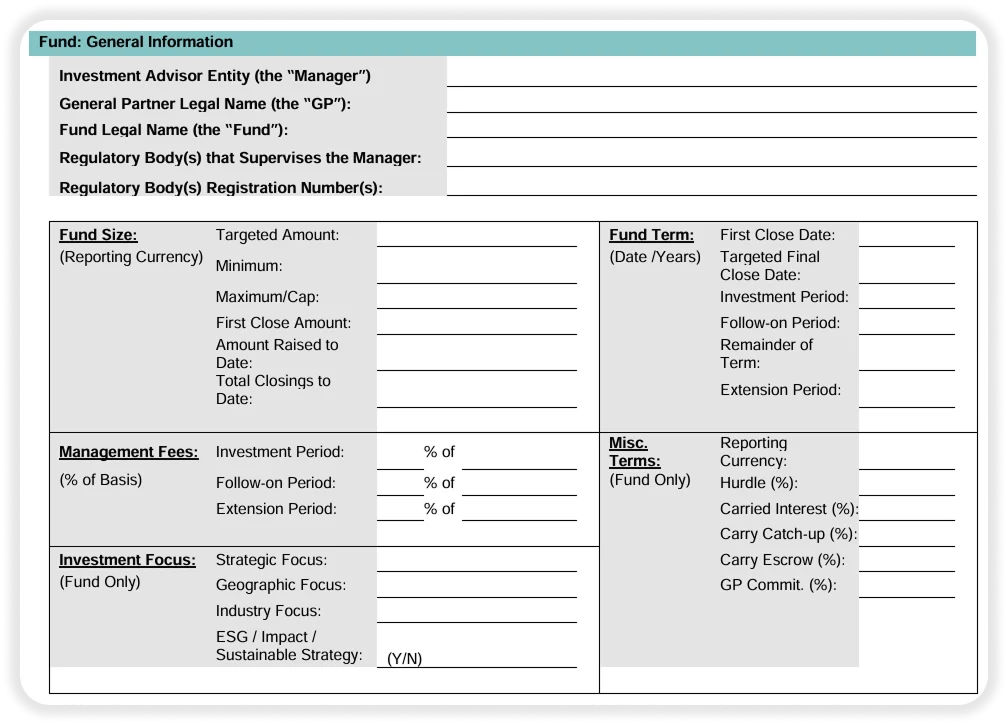
Instead of sending files through long email chains, fund managers can keep everything in a secure online data room7 where access is easy to manage.
Capital deployment and management
Distressed debt funds usually collect investor commitments first and request capital later as investment opportunities appear. After commitments are secured, investors receive capital call notifications through the portal. Payment instructions, deadlines, contribution history, and outstanding commitments remain easily accessible.
Portfolio reporting
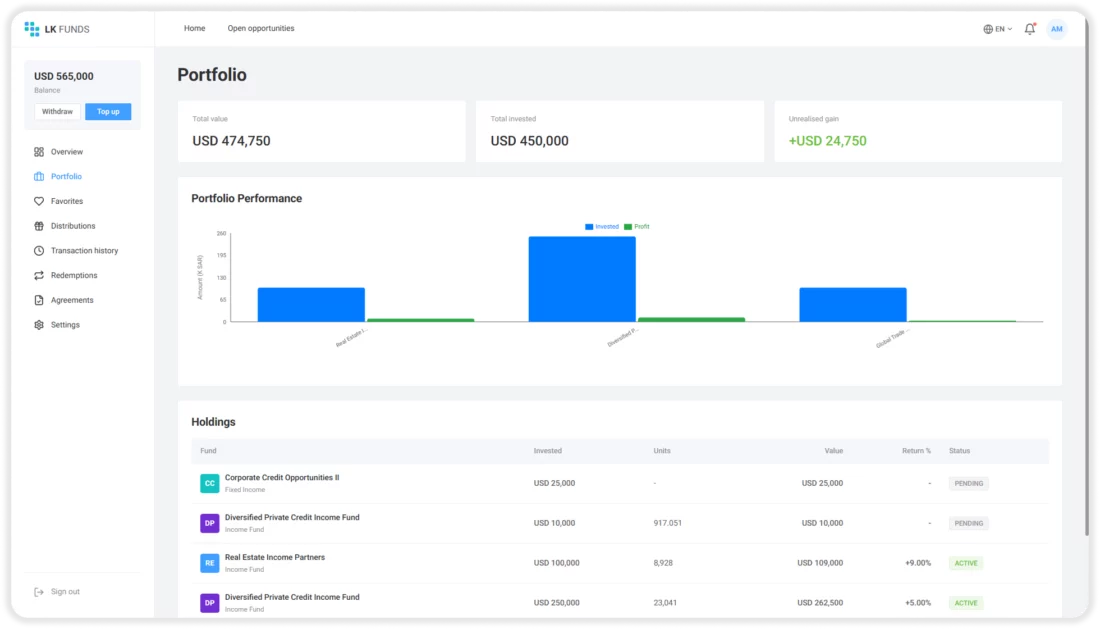
Investors want regular updates on portfolio performance, restructurings, recoveries, valuations, and realized returns. Instead of preparing individual updates for each investor, fund managers can publish reports in the portal, making information available as soon as it is ready.
Ongoing reporting
As investments develop, the portal becomes the central location for quarterly reports, NAV updates, portfolio commentary, performance metrics, and regulatory disclosures.
Distributions and fund closure
As investments generate returns, investors receive distribution notices, payment summaries, tax documents, and final reports through the investor portal. All documents remain available in one secure place, giving investors easy access to their complete investment history throughout the life of the fund.
Security, compliance, and data protection considerations
Investor portals store sensitive financial and personal information, making security and compliance essential. A secure platform should include features that protect investor data while helping fund managers meet regulatory requirements.
Key security and compliance capabilities include:
- Role-based permissions – Different users require different levels of access. Fund managers, compliance officers, administrators, and investors should only be able to view information relevant to their roles.
- Audit logs – Every important action, including document access, electronic signatures, communications, and user activity, should be recorded to support compliance and internal oversight.
- Multi-factor authentication (MFA) – Adding a second layer of authentication beyond passwords helps prevent unauthorized access to investor accounts.
- GDPR and regional privacy compliance – Funds operating across multiple jurisdictions should comply with applicable privacy regulations, including GDPR8 where required. The platform should support secure data processing, consent management, and appropriate data retention policies.
- Integrated KYC/AML – Integration with identity verification providers simplifies investor onboarding while helping fund managers meet Know Your Customer (KYC) and Anti-Money Laundering (AML) requirements.
- Electronic signatures – Secure electronic signatures allow investors to complete subscription agreements and other legal documents online while maintaining legally enforceable records.
- Secure document storage – Sensitive documents should be encrypted during storage and transmission. Regular backups and disaster recovery measures provide additional protection against data loss.
Choosing technology for your distressed debt fund
Selecting the right technology depends on the fund’s size, budget, and long-term growth plans.
Building an in-house solution
Building a proprietary investor portal provides complete flexibility but requires a substantial investment in software development, cybersecurity, integrations, and ongoing maintenance. According to LenderKit, developing a custom investment platform typically costs $100,000 – 400,000, while a custom crowdfunding platform can cost well over $200,000, depending on the project’s complexity and development approach.
Customizing general fund management software
Some firms adapt generic fund administration platforms by adding investor portal functionality.
While this may satisfy basic requirements, customization often becomes difficult as operational complexity increases.
Adopting a white-label investor portal
A white-label platform provides dedicated investor portal functionality while allowing firms to apply their own branding, workflows, and investment processes.
Implementation is typically much faster than custom software development while avoiding the ongoing costs of maintaining proprietary infrastructure.
When evaluating solutions, fund managers should consider:
- Security certifications
- Compliance capabilities
- Investor onboarding workflows
- Document management
- Capital call automation
- Reporting flexibility
- API integrations
- Branding options
- Scalability
- User experience
- Customer support
Investment software by LenderKit
For fund managers who want to launch an investor portal without developing software from scratch, LenderKit offers a flexible white-label investment software designed for distressed debt funds.
The platform supports the entire investor journey from onboarding to investing. Fund managers can automate subscription processes, streamline KYC and AML checks, share documents securely, and give investors access to a central dashboard for commitments, reports, and communications.
LenderKit combines essential tools for capital raising, investor management, reporting, document storage, and secure communication in one branded environment. This allows fund managers to provide a seamless digital experience without relying on multiple third-party platforms.
The platform can be customized to fit different fund structures, compliance requirements, and internal workflows. As the fund grows and the number of investors increases, the portal can scale with the business.
If you are exploring options for creating an investor portal for your distressed debt fund, contact our team to discuss your requirements and learn how the platform can be adapted to your investment processes.
Article sources:
- Distressed Debt Hedge Funds: Detailed Guide
- Just a moment...
- IFRS - IFRS 13 Fair Value Measurement
- PDF (https://uncitral.un.org/sites/default/files/media-documents/uncitral/en/msms_...)
- PDF (https://www.imf.org/-/media/files/publications/gfsr/2024/april/english/ch2.pdf)
- Due Diligence Questionnaire | Institutional Limited Partners Association
- What Is A Virtual Data Room? | AI-Powered Platform | Drooms
- What is GDPR, the EU’s new data protection law? - GDPR.eu