Small Units, Big Yields: Launching a Micro-Apartment Investment Platform


No time to read? Let AI give you a quick summary of this article.


Micro-apartments offer real estate investors a way to target urban housing demand with compact, efficiently designed rental units. As housing costs rise in many cities, students, young professionals, and people living alone are increasingly looking for smaller homes in convenient locations1. This creates additional investment opportunities for property operators, fund managers, and syndicators.
In this article, we will explain what opportunities are there for micro-apartment real estate investors, how to choose the right investment model, and how to launch a platform with LenderKit’s white label solutions.
What you will learn in this post:
Why micro-apartments attract investors
Micro-apartments are compact, self-contained homes that typically include a private bathroom, a small kitchen, and a living or sleeping area. Some developments also provide shared facilities such as laundry rooms, gyms, coworking spaces, and communal lounges.
Cushman & Wakefield’s 2024 Micro-Apartments Report2 examines the German market and the growing role of compact housing across student accommodation, business apartments, and serviced housing.
The investment case rests on several factors:
- Efficient use of space. Developers may be able to create more rental units within a building than with conventional apartments, subject to local regulations.
- Urban rental demand. Properties near universities, employment centers, and public transport can appeal to tenants who prioritize location over space.
- Flexible rental models. Units can serve long-term tenants, students, corporate clients, or short-stay guests, depending on local demand and regulations.
- Potential management efficiencies. Multiple units in one building can share maintenance, leasing, and procurement services.
Micro-apartments may generate higher rent per square meter than larger units. However, investors must also account for furnishing, maintenance, utilities, tenant turnover, and management fees. The relevant measure is the property’s net operating performance, not rental income alone.
How to choose the right investment strategy
Before launching a platform, sponsors need to decide what they will invest in and how the properties will generate returns.
1. Acquire existing properties
Buying completed micro-apartment buildings provides access to rental income without the full risks of development. Existing occupancy records and operating statements can also help sponsors evaluate performance before acquisition.
2. Develop or convert properties
New construction or the conversion of existing buildings can create value, but introduces planning, construction, and financing risks. Office-to-residential conversions, for example, require checks on zoning, ventilation, fire safety, accessibility, and minimum dwelling sizes.
3. Build a diversified portfolio
Investing across locations or tenant segments can reduce dependence on a single property or local rental market. However, diversification does not eliminate broader real estate risks, such as falling property values or higher financing costs.
For a new platform, focusing on one strategy is generally more manageable than combining development, long-term rentals, and serviced accommodation from the outset.
Examples of micro-apartment investment platforms
Here are some examples of how platforms package micro-apartments as investments, from individual unit ownership to institutional portfolio management.
MY APART: Individual ownership with professional management
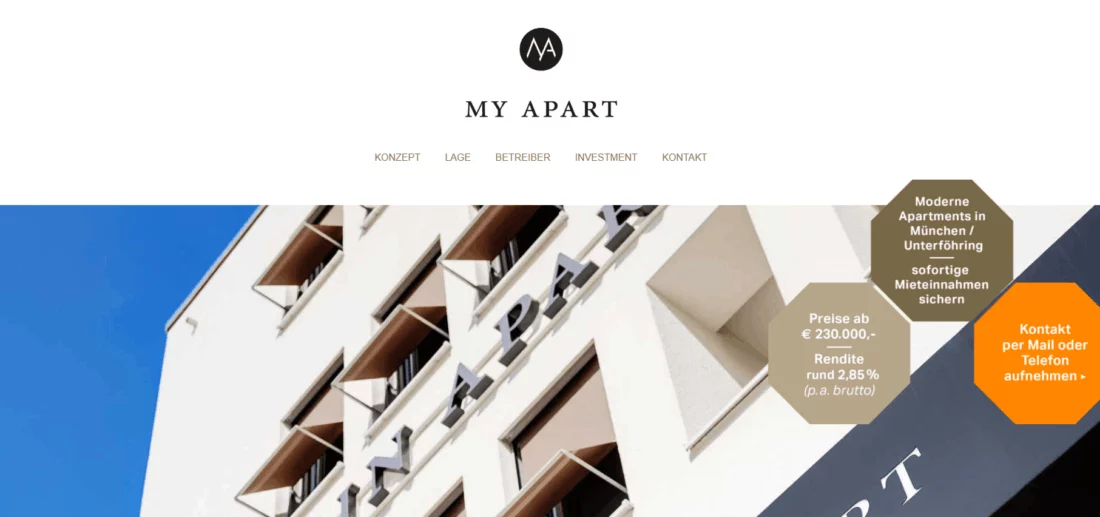
MY APART3, located in Unterföhring near Munich, offers individual ownership of serviced apartments measuring approximately 17–40 square meters. The development includes 561 apartments across two buildings.
Investors purchase individual units and lease them to a professional operator under long-term, indexed rental agreements. The operator manages the properties, allowing owners to earn rental income without handling daily operations themselves.
Published listings show prices starting at approximately €229,962. The final purchase cost depends on the unit, and buyers should confirm whether parking and other additional costs are included. This is a direct property purchase, not a crowdfunding contribution.
i Live Invest: A specialist micro-living investment business
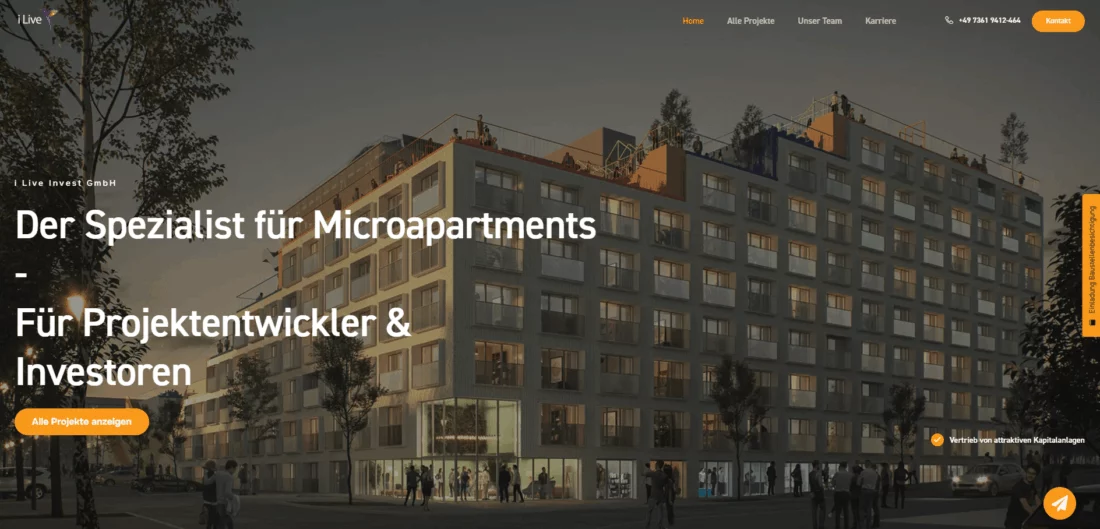
Germany’s i Live Invest4 focuses on structuring and marketing micro-living investments. Its projects include Urban Living Lübeck, with 334 furnished apartments, and Urban Living Südtor Rostock5, with 180 apartments.
The company specializes in compact residential units for students, commuters, and young professionals. It also supports investment structuring, property marketing, and transaction documentation.
Published prices start at €153,500, including a share of communal areas and parking, but excluding furniture and inventory. The project is scheduled for completion in the first quarter of 2028, according to the developer.
Urban Living Südtor Rostock illustrates how a specific micro-apartment development can be presented to potential buyers.
The project comprises 180 apartments intended for students, young professionals, commuters, and other urban residents. Its project website reported that rental operations began in May 2026 and that more than 90% of units were rented by October 2026.
The i Live Invest listing gives a starting price of €138,500, excluding inventory.
These details connect the investment proposition to a real asset, its intended tenants, and its reported leasing performance. However, the occupancy figure is a point-in-time result, not a guarantee of future performance.
Prop.com: Managing a larger micro-living portfolio

In January 2026, Prop.com announced a partnership with Reos6 to manage and digitize its growing European micro-living portfolio, reported at €400 million. The partnership focuses on integrating property-management data, building operations, tenant services, and portfolio reporting.
This model is relevant to sponsors planning to manage multiple properties across different locations. Centralized technology can help track performance and standardize operations as a portfolio grows.
Calculating the potential returns
A sound financial model is essential before raising capital. Sponsors need to understand how much income a property can generate and how much remains after expenses. The financial model should include:
- Purchase or construction costs.
- Renovation and furnishing expenses.
- Expected rents and occupancy rates.
- Maintenance, insurance, utilities, and property management.
- Financing costs and loan repayments.
- Taxes, administration, and platform fees.
- Reserves for unexpected expenses.
- Potential sale proceeds and transaction costs.
Consider a hypothetical building with 100 apartments. Each unit rents for €800 per month, and the expected annual occupancy rate is 92%. The building would generate approximately €883,200 in annual rental income before operating expenses.
This is not the property’s profit. The sponsor must still deduct relevant operating costs, financing expenses, taxes, and other applicable charges to determine the amount available to investors.
It is also important to test different scenarios. What happens if rents fall, more apartments remain vacant, interest rates rise, or renovation costs exceed the budget?
These calculations help sponsors understand whether a project remains viable under less favorable conditions. They also help investors assess the risks instead of relying on optimistic forecasts.
Choosing the right investment structure
Once the property strategy and financial model are ready, the next step is deciding how investors will participate. Several structures are available, depending on the sponsor’s objectives and the applicable laws.
Property-specific special-purpose vehicles (SPVs)
An SPV is a separate legal entity created to hold a particular property or investment. Investors can participate in that entity, allowing the sponsor to track the property’s financial performance separately from other projects.
A pooled investment fund
A fund collects capital from multiple investors and uses it to acquire and manage a portfolio of properties. This approach can support diversification and centralized management, but it also requires appropriate fund administration and governance.
Debt-based investments
In a debt-based investment, investors lend money to a property company or development business in exchange for interest and repayment under agreed terms. Their returns and rights depend on the loan agreement and any security provided.
These structures are not interchangeable. Investors who hold shares in an SPV have different rights from those who invest in a fund or lend money to a property company.
How to launch a micro-apartment investment platform with LenderKit
Whether you plan to raise capital through property-backed loans, offer equity in property-owning companies, or manage a portfolio of investment opportunities, LenderKit is here to help.
LenderKit provides white-label investment software and custom development services for real estate investment companies.
LenderKit has an Interactive Product Tour7 that lets you see the software capabilities before you buy. Plus, everything is fully customizable on demand, so we can build a truly unique platform tailored for your needs, business model and requirements.
Ready to build your micro-apartment investment platform? Get in touch with our team to pick the best solution for your business.
Article sources:
- Just a moment...
- PDF (https://assets.cushmanwakefield.com/-/media/cw/emea/germany/insights/2024-mic...)
- Myapart – Serviced Apartments als Kapitalanlage in Unterföhring bei München
- I Live Invest – Attraktive Kapitalanlage beim Marktführer
- Urban Living Südtor Rostock
- Prop.com enters strategic partnership with Reos to manage expanding €400m micro-living platform
- LenderKit — Interactive Product Tour