Swiss Crowdfunding Market Overview – Operator’s Guide to Starting a Crowdfunding Platform in Switzerland


No time to read? Let AI give you a quick summary of this article.


The Swiss crowdfunding market returned to growth in 20251 after three consecutive years of decline. According to the 2026 Crowdfunding Monitor from Lucerne University of Applied Sciences and Arts (HSLU), the total volume reached CHF 628.9 million, up 14.3% from CHF 550.2 million in 2024.
For companies considering entering this market, the numbers are only part of the picture.
The choice of crowdfunding model, regulatory structure, payment and compliance infrastructure, and technology stack will all shape how a platform can operate in Switzerland.
This guide covers the key areas operators need to consider – from the market and existing platforms to regulations, fintech infrastructure, and the role LenderKit can play in building and launching a Swiss crowdfunding platform.
What you will learn in this post:
The Swiss crowdfunding market: key numbers
The Swiss crowdfunding market covers a broad range of financing needs, from loans for businesses and real estate projects to equity investments, renewable-energy initiatives, creative projects and community campaigns. For a company planning to launch a crowdfunding platform in Switzerland, this diversity is important: the market is not a single segment, and the financing model you choose will largely determine your target users, regulatory requirements and platform setup.
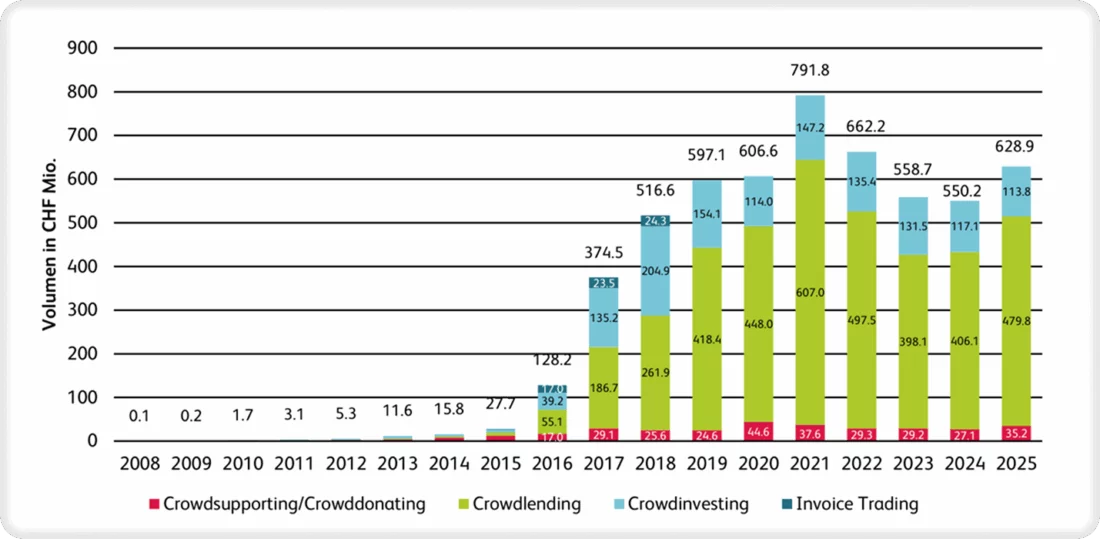
The size of each segment also varies significantly. In 2025, Swiss crowdlending generated CHF 479.8 million, accounting for around three-quarters of the total crowdfunding market. Real estate crowdlending alone generated CHF 275.1 million, making it the largest identifiable subsegment within Swiss crowdlending in 2025.
Crowdinvesting generated another CHF 113.8 million. Real estate represented approximately CHF 99 million of this amount, while business crowdinvesting accounted for CHF 14.9 million.
The smaller crowdsupporting and crowddonating segment also recovered in 2025, reaching CHF 35.2 million, an increase of 29.9% compared with the previous year.
Together, these figures show where crowdfunding activity is concentrated in Switzerland and where different types of platforms can find their target market. A new platform could, for example, focus on real estate lending, SME financing, startup equity, renewable-energy projects, community funding, donations or rewards.
Swiss crowdfunding regulations
Switzerland does not have a single licence2 that automatically applies to every crowdfunding platform. FINMA3 states that the authorisation requirements depend on the specific business model and must be assessed case by case.
One important factor is how the platform handles the money raised. If money raised is merely brokered through a crowdfunding platform and is not pooled in the operator’s accounts, the platform operator is generally not subject to a financial-market authorisation requirement.
The regulatory position can change when the platform itself accepts or holds client funds. FINMA’s FinTech guidance3 identifies the payment of client assets into a company’s own accounts as a factor that can trigger anti-money-laundering and authorisation requirements.
Banking Act and client funds
The Swiss Banking Act4 becomes particularly relevant when a platform accepts public deposits. As a general rule, accepting deposits from more than 20 clients or publicly advertising the acceptance of deposits requires a banking licence, although Swiss law provides specific exceptions.
One exception is the regulatory sandbox4, which allows companies to accept public deposits of up to CHF 1 million without a banking licence, subject to the applicable conditions. Sandbox activities are not supervised by FINMA, and the deposits are not covered by Swiss deposit protection.
For larger volumes, Switzerland also has a FinTech licence5. It allows qualifying institutions to accept public deposits of up to CHF 100 million, provided the funds are not invested and no interest is paid on them.
For a crowdfunding operator, however, these licensing routes are not necessarily the starting point. The platform may instead structure its payment flows so that regulated third-party providers handle client funds.
Prospectus requirements
A public offer of securities can also trigger requirements under the Swiss Financial Services Act (FinSA).
Public offers of securities generally require a prospectus unless an exemption applies. The law provides exemptions for certain offerings6, including offers to fewer than 500 investors and offerings below specific value thresholds.
The exact requirements depend on the securities and offering structure, so an operator planning an equity crowdfunding platform should obtain legal advice before launching individual investment products.
AML and KYC
Depending on the platform’s activities, Swiss AML legislation7 can apply to financial intermediaries8 involved in activities such as payment transactions, asset management and other financial services.
A platform may therefore need processes for:
- Identity verification
- Customer due diligence
- Beneficial-owner identification
- PEP and sanctions screening
- Source-of-funds checks where required
- Transaction monitoring
- Suspicious-activity reporting
- Record-keeping and audit trails.
The precise requirements depend on the business model and regulatory status of the operator.
For investors, this can involve identity verification, KYC screening, investor classification and electronic agreement signing.
The platform can connect these services to its crowdfunding software through APIs. This approach gives an operator more flexibility to adapt the technology stack as regulatory or business requirements change.
Payment infrastructure for a Swiss crowdfunding platform
Payment infrastructure is another area where localization matters.
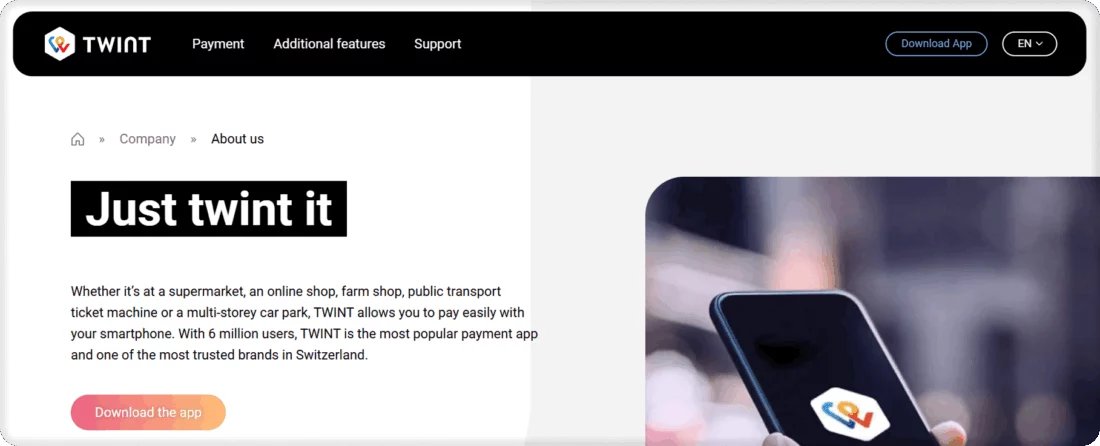
One of the most important Swiss payment methods is TWINT9. The service reports more than 6 million regular users in Switzerland and says that 84% of Swiss online shops use TWINT to accept payments.
TWINT can be integrated through a range of payment service providers, including Stripe, Adyen, Worldline, Datatrans/Planet, Payrexx, Wallee and PostFinance Checkout.
For crowdfunding, however, accepting a simple online payment is only one part of the problem.
An investment platform may need to support a much more complex flow:
Investor → platform/payment provider → investment → funding target → project owner → repayments → investor
Depending on the business model, the platform may also need to handle refunds, failed funding campaigns, scheduled repayments, investor withdrawals and fee payments.
As a result, operators should evaluate payment infrastructure based on the complete investment flow rather than simply choosing a provider that supports cards or TWINT.
Banking infrastructure
The banking setup will depend on the platform’s business model and how funds are structured and held. Depending on the model, an operator may need a Swiss corporate bank account.
Swiss banks such as UBS10, Zürcher Kantonalbank11 and PostFinance12 offer corporate accounts and payment services that can form part of this wider infrastructure. UBS supports business accounts in CHF, EUR and other currencies, while ZKB and PostFinance provide corporate payment and account services in CHF and foreign currencies.
For crowdfunding specifically, FINMA’s crowdfunding guidance13 notes that funds can, under certain structures, be channelled through an independent escrow agent. If project financiers’ funds are instead channelled through the platform operator’s own accounts, the operator must assess whether banking-law requirements apply.
Existing crowdfunding platforms in Switzerland
Switzerland already has a number of established crowdfunding platforms, so a new operator needs a clearly defined financing model, target audience, and value proposition.
CONDA Switzerland – Equity crowdfunding for startups and SMEs
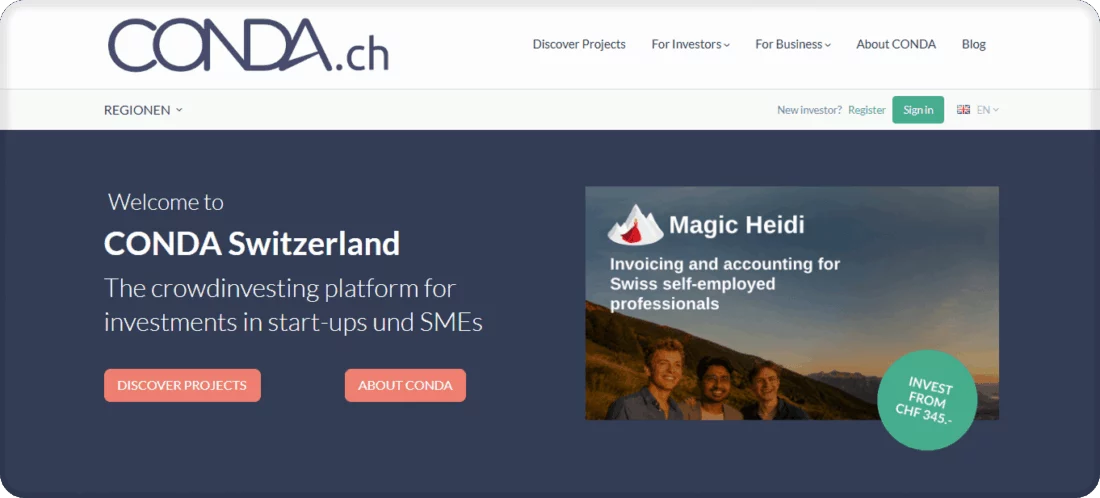
CONDA Switzerland14 focuses on crowdinvesting, connecting investors with startups, scale-ups, and SMEs seeking growth capital. It has more than 21,000 registered users, over CHF 40 million in crowd capital, and more than 50 successfully financed projects. The platform illustrates the infrastructure required for equity crowdfunding, including investor onboarding, investment processing, project information, and investor communication.
Maclear – P2P and crowdlending
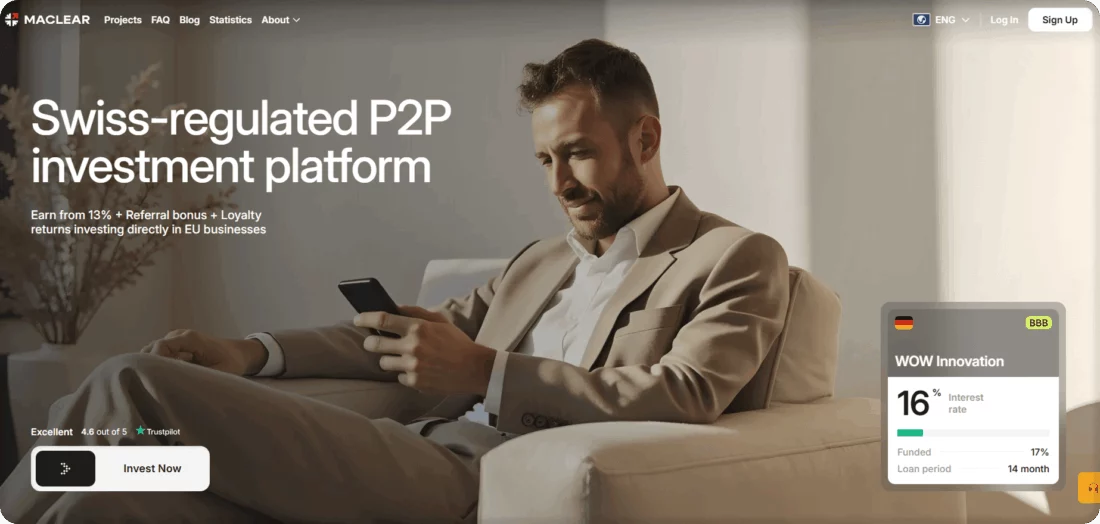
Maclear15 operates a P2P/crowdlending model, connecting investors with European companies and loan originators. Its platform includes investor onboarding and KYC processes and focuses on financing through loans rather than equity ownership. A crowdlending platform therefore needs workflows for loan listings, investor allocation, repayment schedules, interest and principal payments, and related compliance processes.
wemakeit – Reward-based crowdfunding
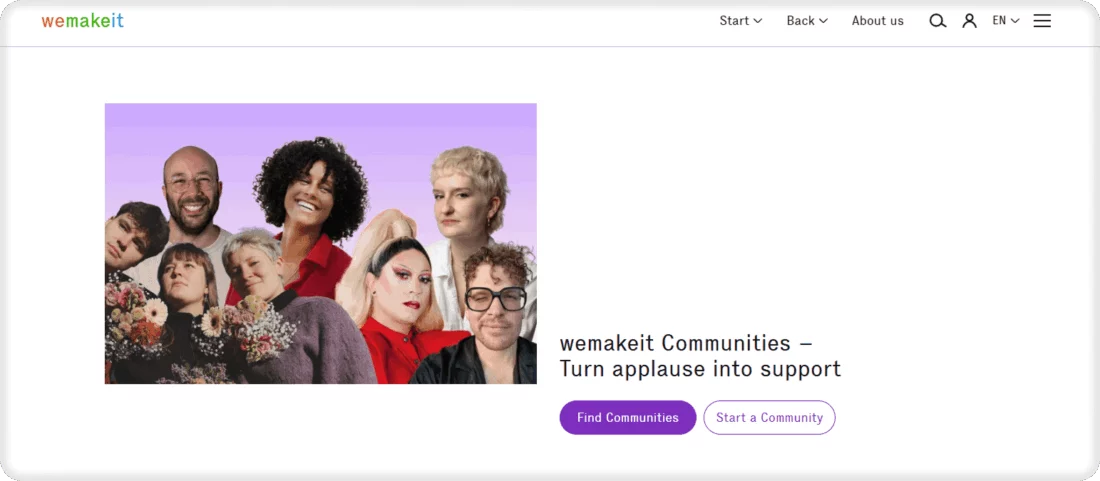
wemakeit16 represents reward-based and community crowdfunding, supporting creative, cultural, social, agricultural, and other projects. Instead of receiving equity or interest, backers typically receive rewards such as products, experiences, or other benefits. This model places greater emphasis on campaign creation, contribution processing, reward management, communication, and community engagement.
Foxstone – Real estate crowdfunding
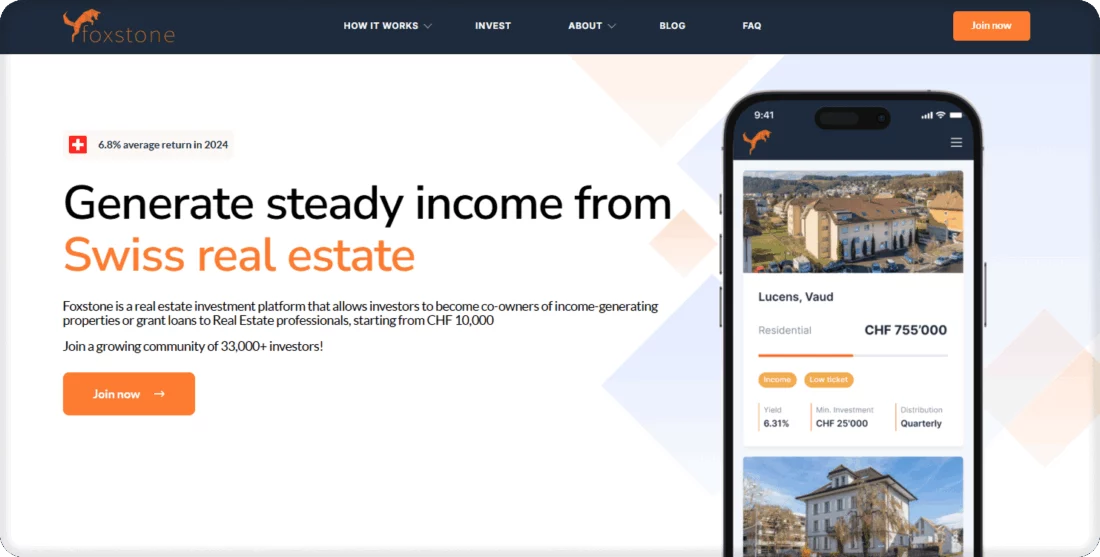
Foxstone17 focuses on real estate crowdfunding, offering both co-ownership and crowdlending opportunities connected to real estate projects. The platform reports more than 32,000 investors, CHF 454 million invested, and 101 projects. Its model requires specialized workflows for property information, investment processing, ownership or lending structures, distributions, and ongoing investor reporting.
Solarify – Renewable energy crowdfunding
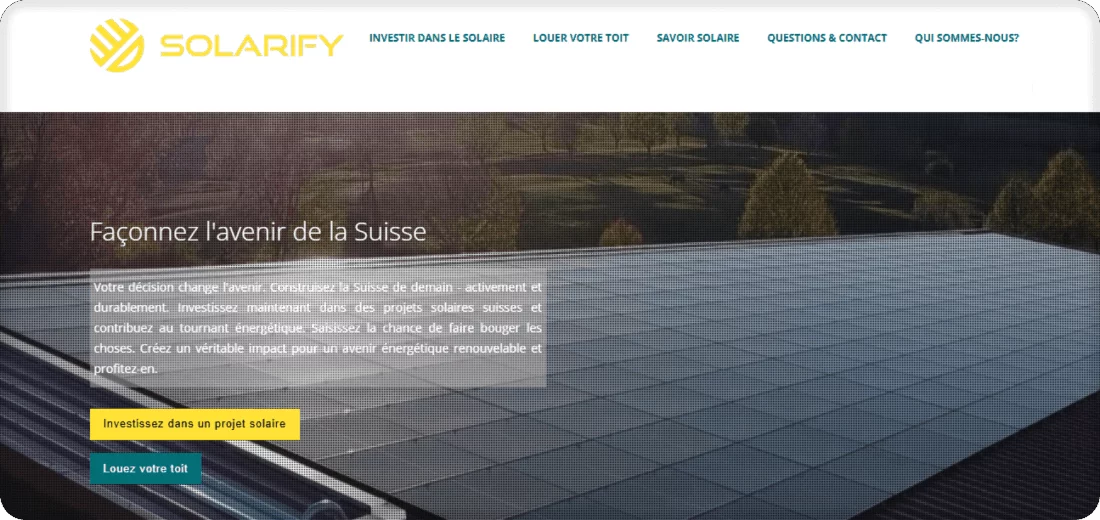
Solarify18 focuses on renewable-energy crowdfunding, enabling individuals and companies to invest in Swiss solar projects. Investors receive returns generated by the projects, while Solarify manages areas such as project development and operation.
How LenderKit can support a Swiss crowdfunding launch
Building a crowdfunding platform from scratch requires more than creating a marketplace website. An operator needs investor accounts, project management, investment workflows, payment integrations, KYC processes, administration tools, reporting, notifications and transaction records.
LenderKit provides the core software infrastructure for building and operating a crowdfunding platform while allowing the operator to configure the business model and integrate external services.
The platform includes a public-facing website, investor portal, and administration back office.
The investor side can support functions such as:
- Account registration and onboarding
- KYC workflows
- Investment management
- Portfolio tracking
- Transaction history
- Documents and agreements
- Investment opportunities
- Notifications
The administration interface gives platform operators tools for managing investors, fundraisers, offerings, transactions, fees, permissions and other operational processes.
This is particularly useful for a regulated or compliance-heavy business because the platform needs to maintain a clear record of activities rather than simply process payments.
If you consider launching a crowdinvesting platform in Switzerland or upgrading your existing platform, get in touch with us to discuss options.
Article sources:
- Schweizer Crowdfunding-Markt wächst wieder: Immobilien-Crowdlending als Haupttreiber | Hochschule Luzern
- PDF (https://www.finma.ch/en/~/media/finma/dokumente/dokumentencenter/myfinma/fakt...)
- FinTech financial services providers | FINMA
- Banks and securities firms | FINMA
- FinTech licence | FINMA
- PDF (https://www.fedlex.admin.ch/filestore/fedlex.data.admin.ch/eli/cc/2019/758/20...)
- Anti-Money Laundering
- Combating money laundering in the context of financial market supervision | FINMA
- About us - TWINT
- Just a moment...
- Legal
- Open a business account online | PostFinance
- PDF (https://www.finma.ch/en/~/media/finma/dokumente/dokumentencenter/myfinma/fakt...)
- CONDA.ch - Crowdinvesting in Switzerland - Homepage - Conda Schweiz
- Just a moment...
- Wemakeit – Crowdfunding Creative Projects
- Swiss Real Estate Crowdfunding Platform – Foxstone
- Investiere in Solarpanels in der Schweiz ☀️ Solarify